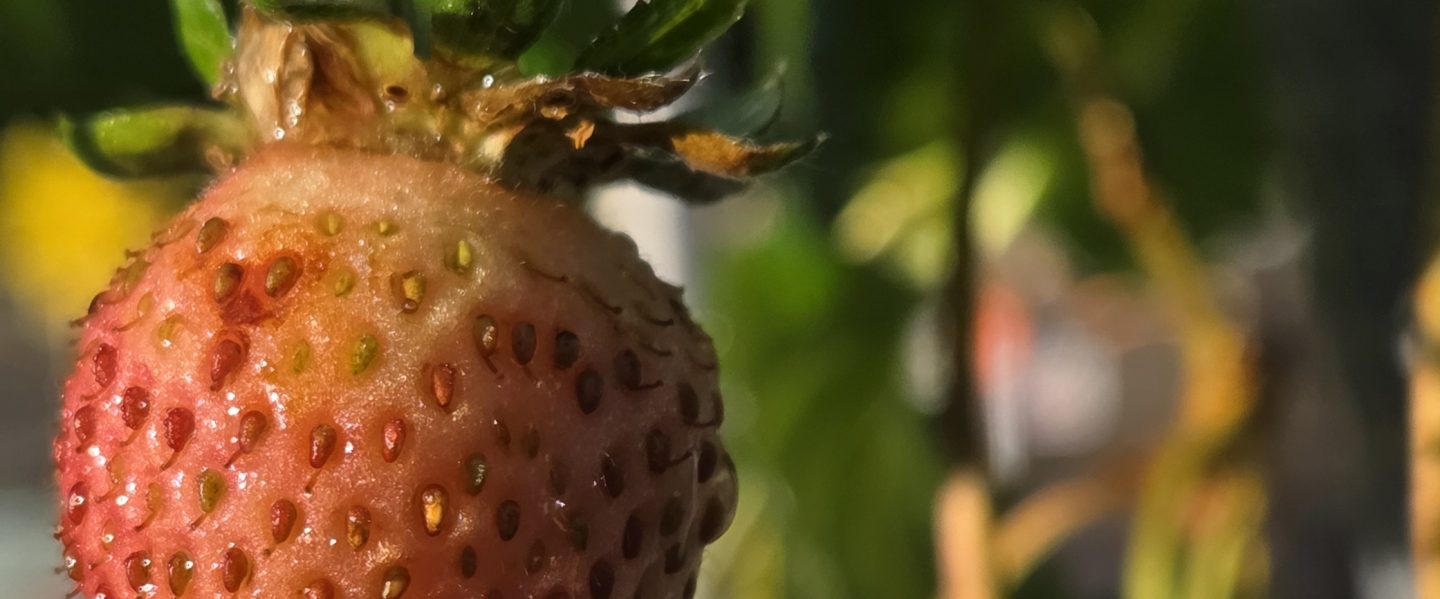
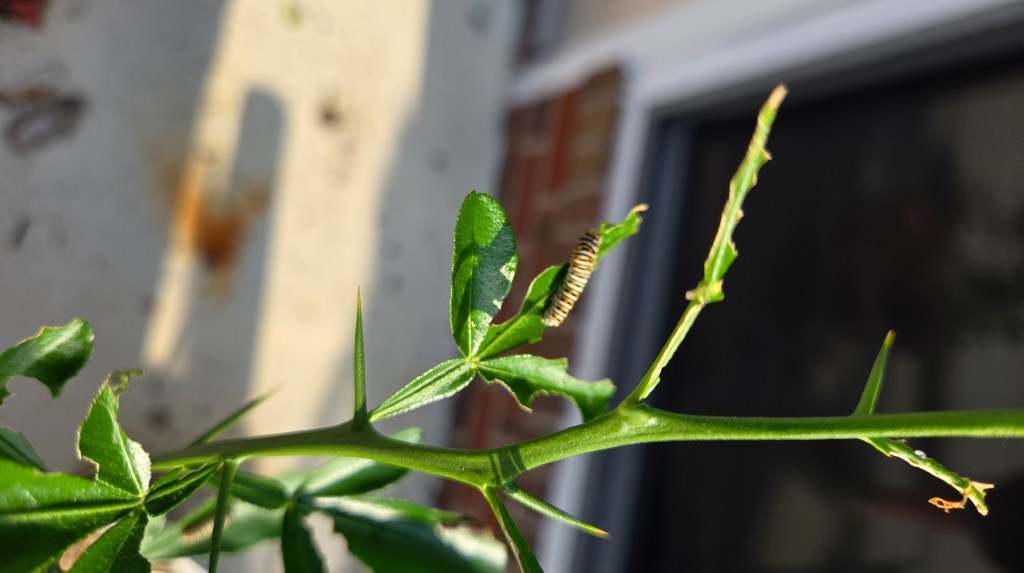
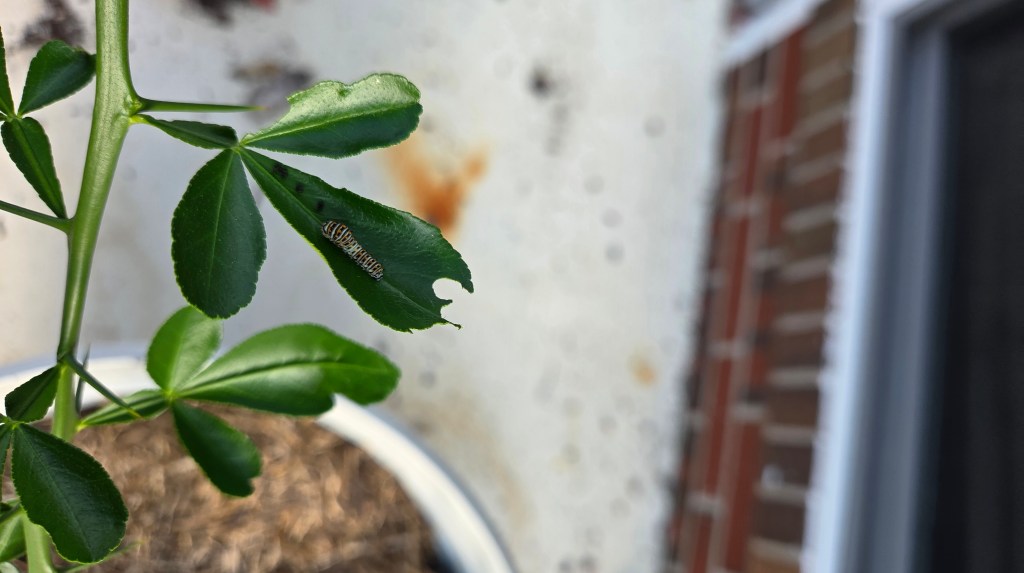
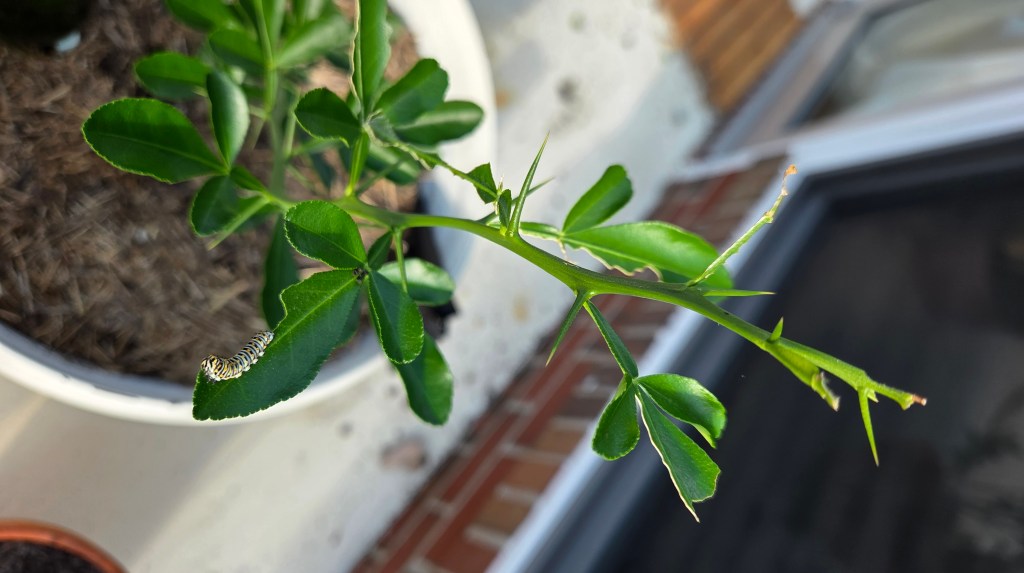
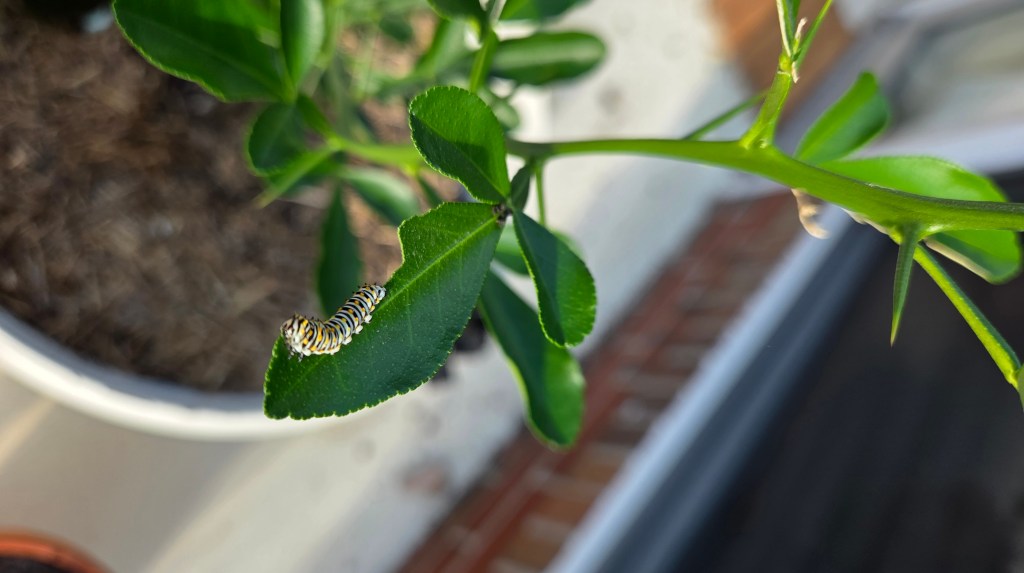
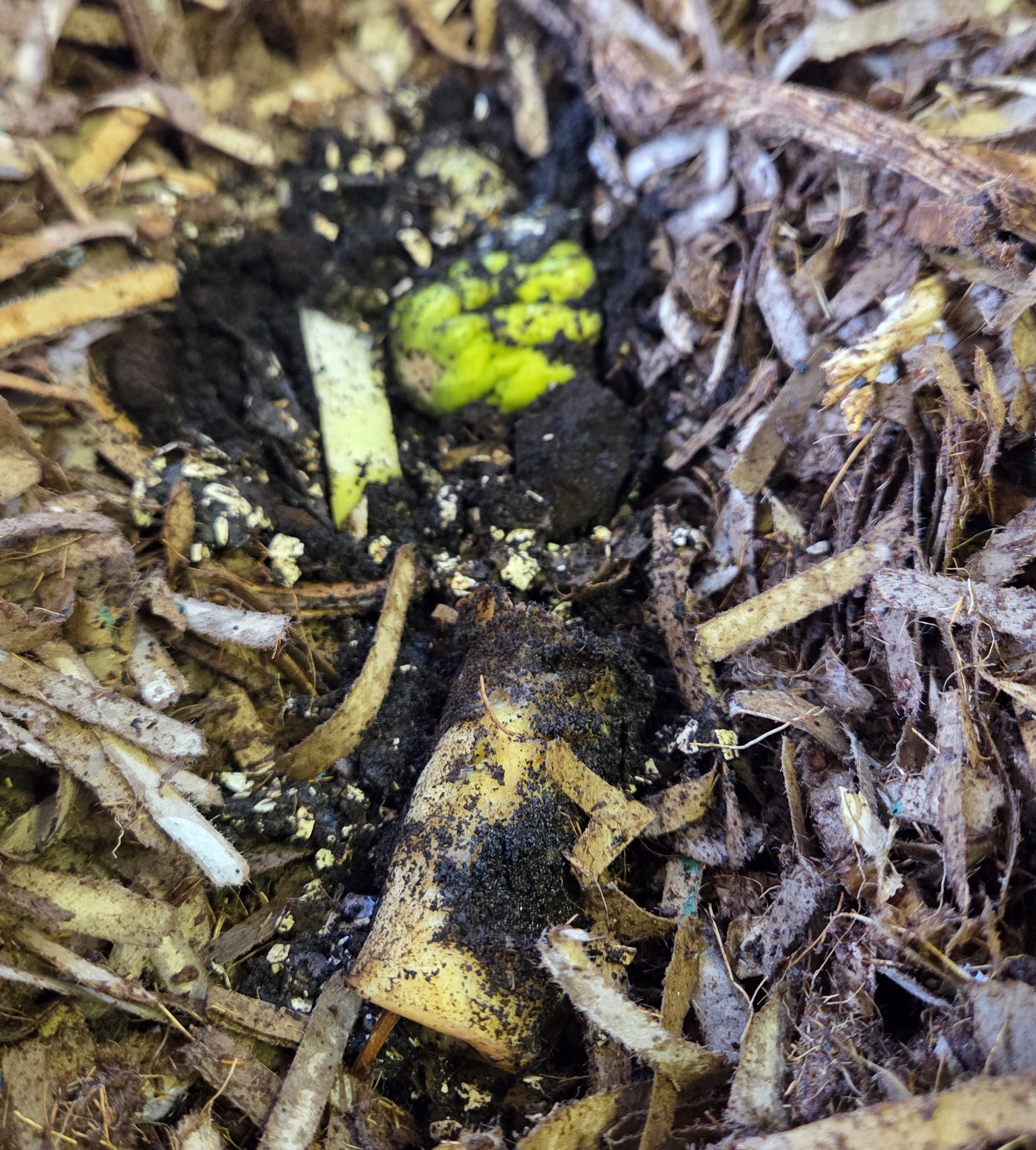
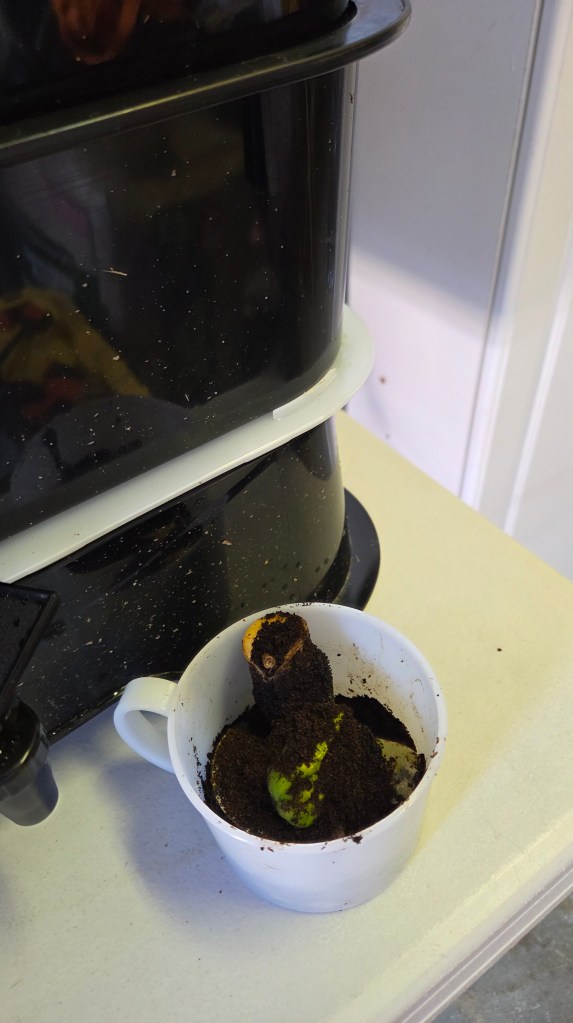
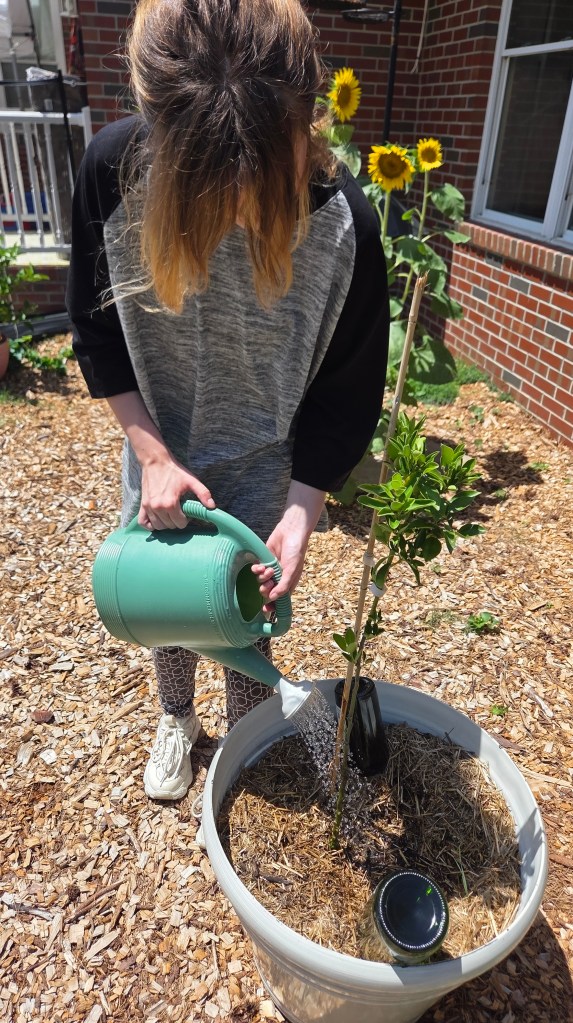
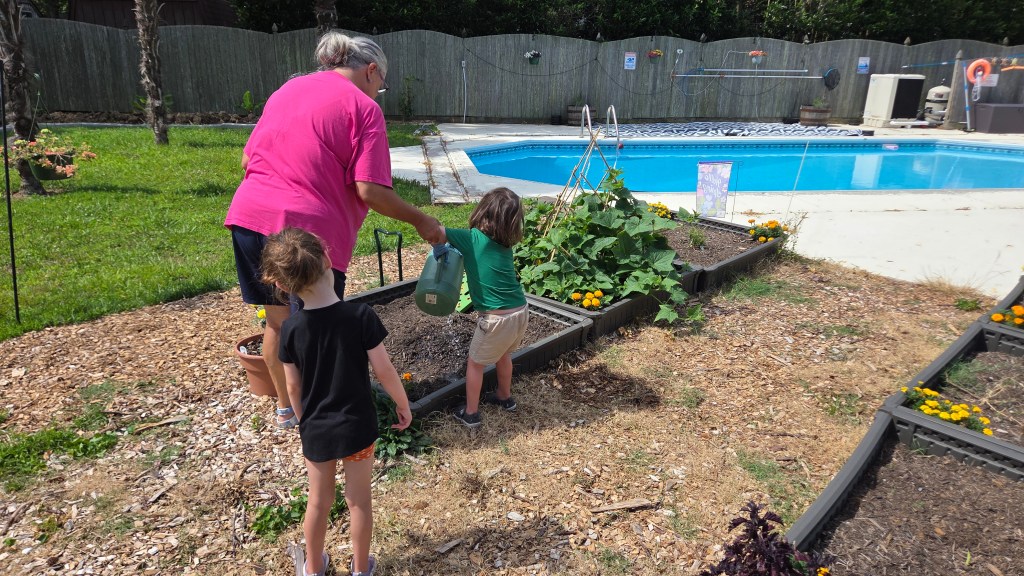
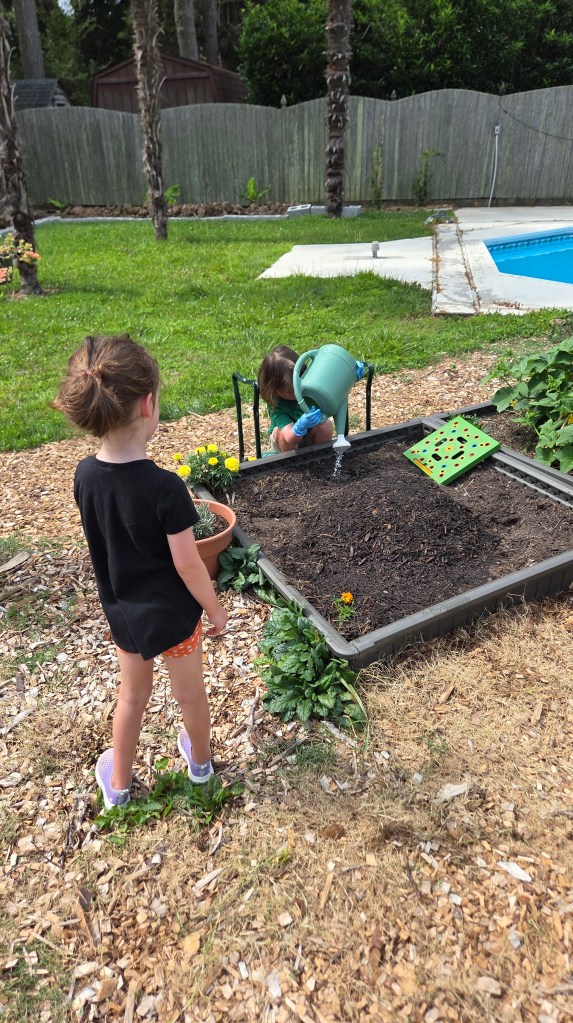
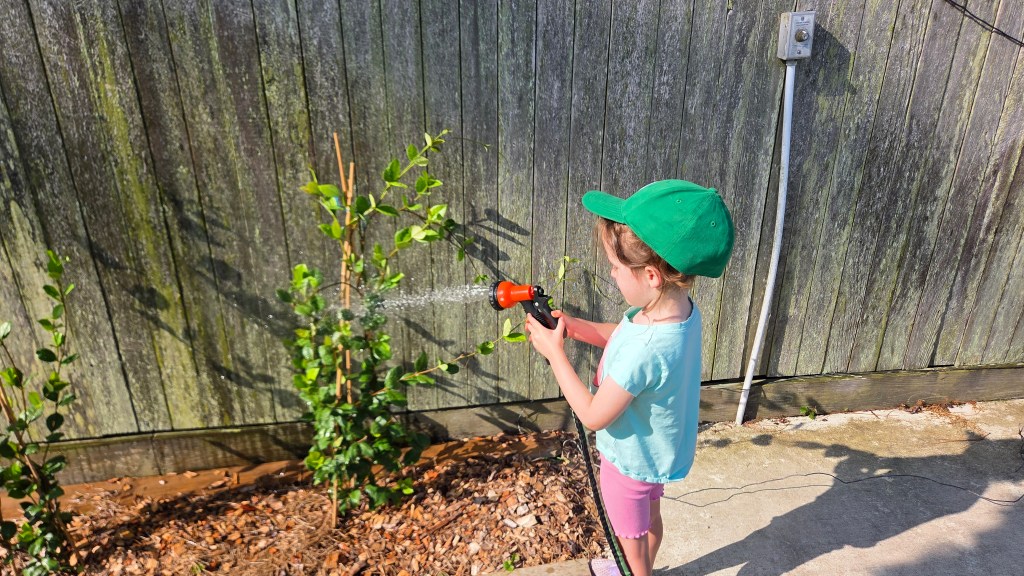
This morning, I found these guys absolutely devouring one of the Mandarin trees.
At first: Yikes. Caterpillars.
Then I figured out what they were. I mean, I asked Google Lens what they were.
Giant Swallowtail Caterpillars.
These strange little creatures, sometimes called “orange dogs,” spend their caterpillar days munching on citrus leaves before eventually becoming one of the largest and most beautiful butterflies in North America.
So now I have a dilemma.
I want my citrus trees.
But I think I want the butterflies more.
So rather than getting rid of them, we’re going to give them a place of their own. I’m looking for some rue and perhaps a sacrificial citrus tree where we can move the caterpillars, let them eat their fill, make their chrysalises, and hopefully watch them emerge as Giant Swallowtails.
I needed another project. Worm rancher moving into Butterfiles.
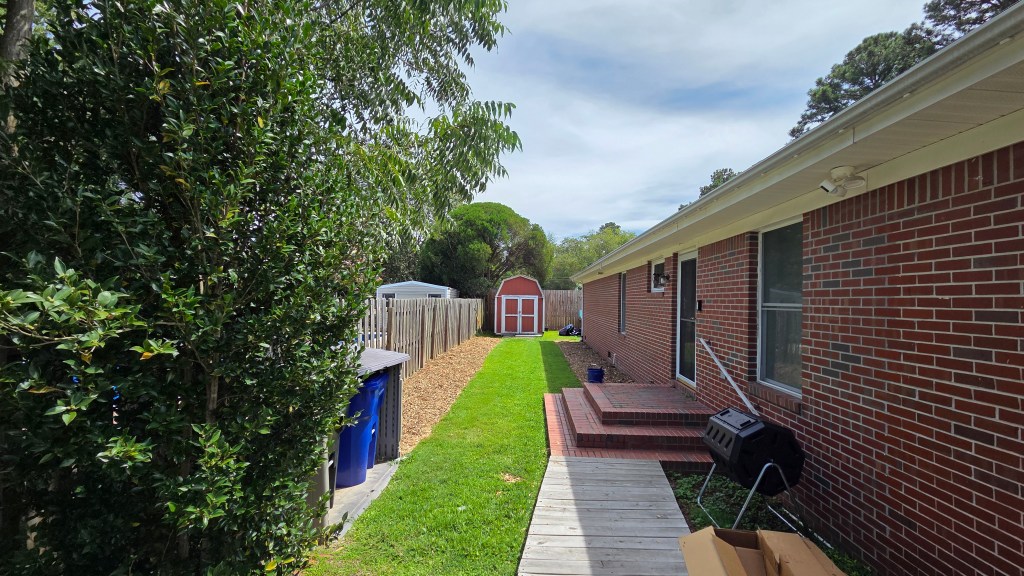
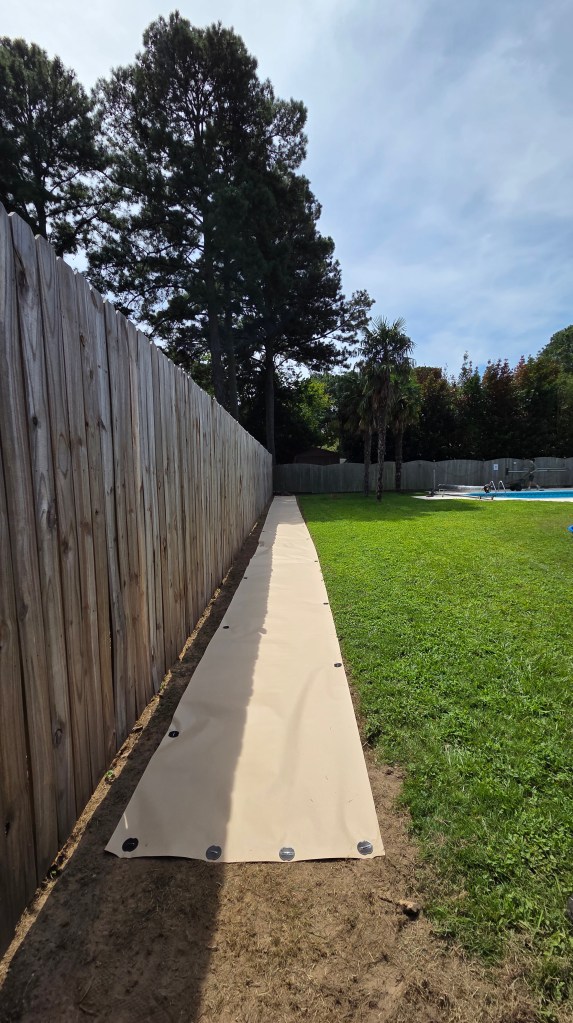
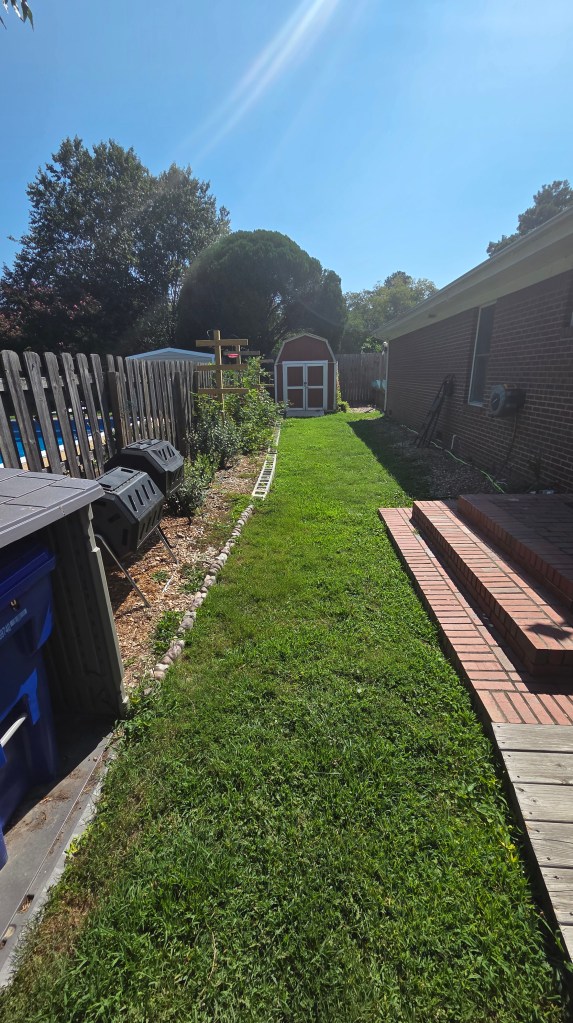
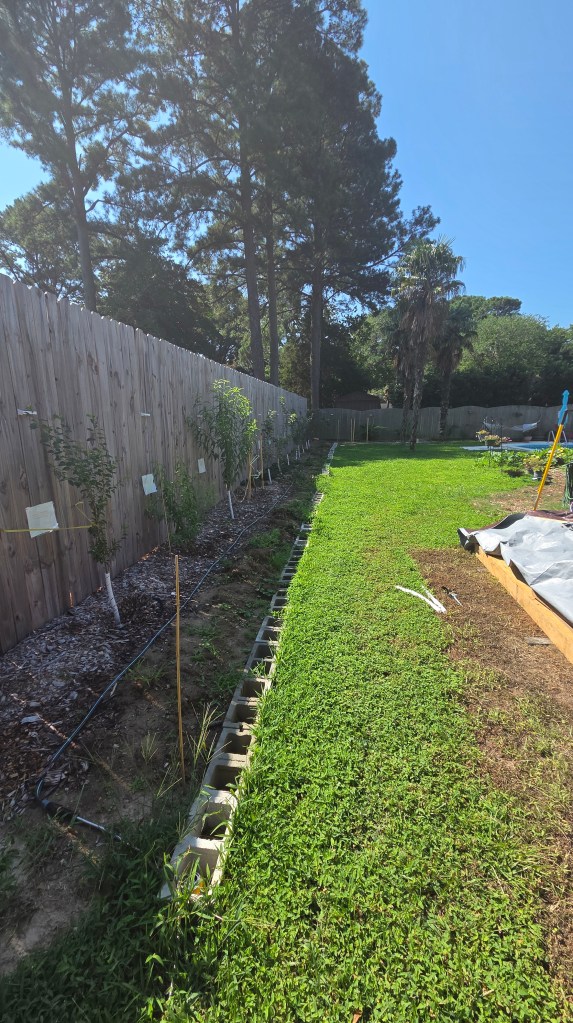
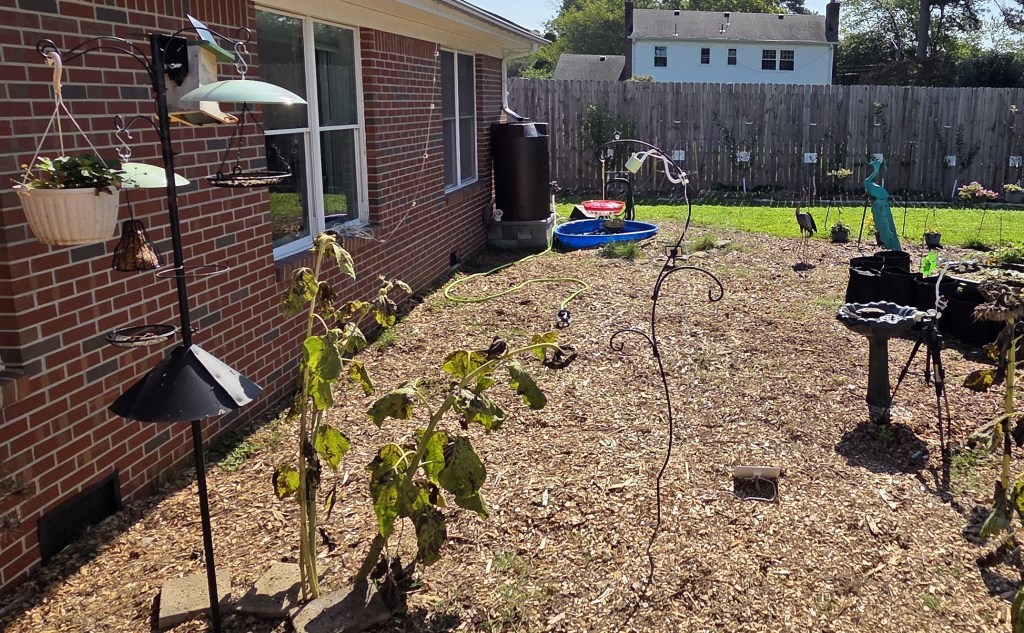
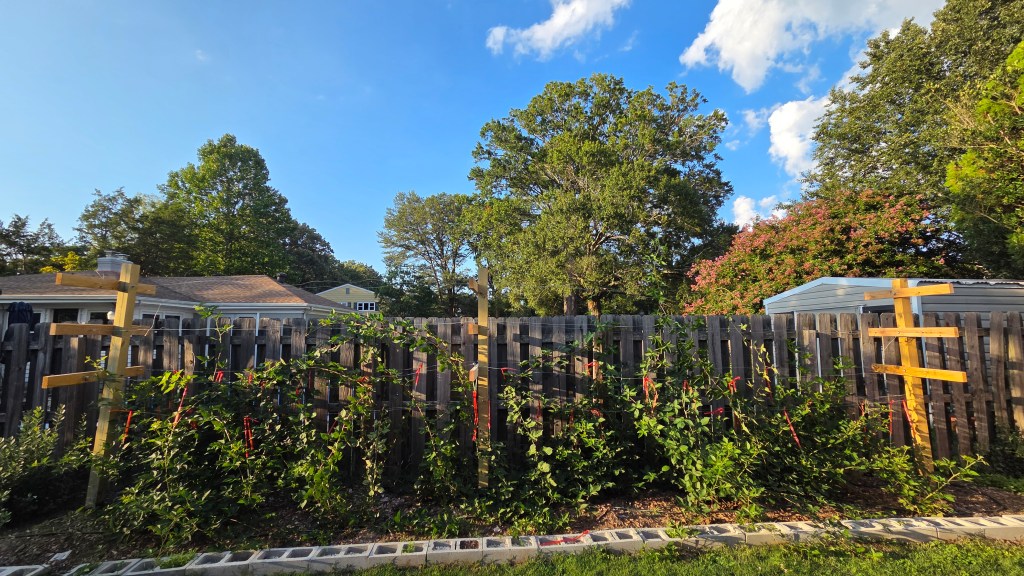
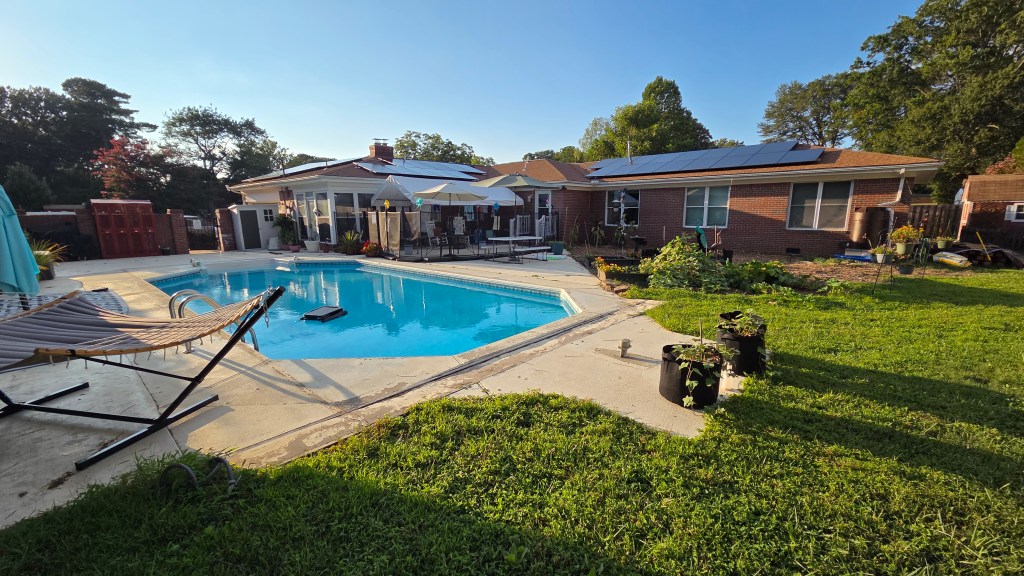
These photos were taken one year and one day apart.
August 30, 2025 and August 31, 2026.
I don’t think I realized how much had changed until the before photo popped up in my memory wall.
A year ago, Buttervale was maintained.
The grass was cut, the bushes were trimmed, the pool was clean. It was a perfectly nice backyard.
Until, we started doing something different.
We started cultivating.
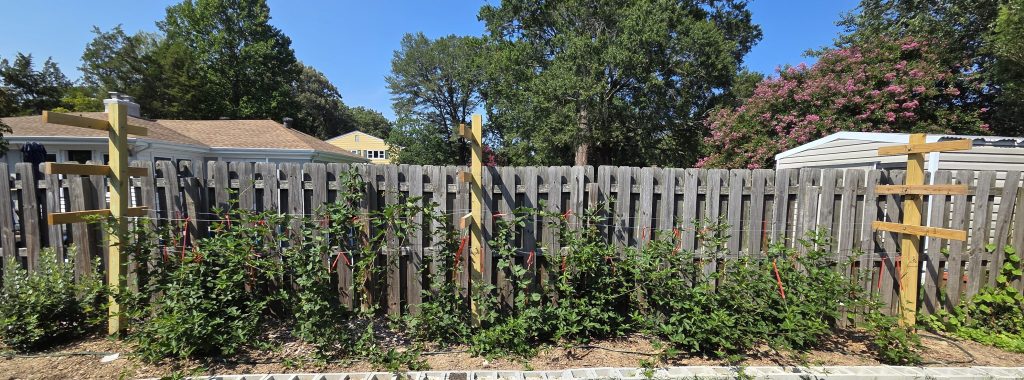
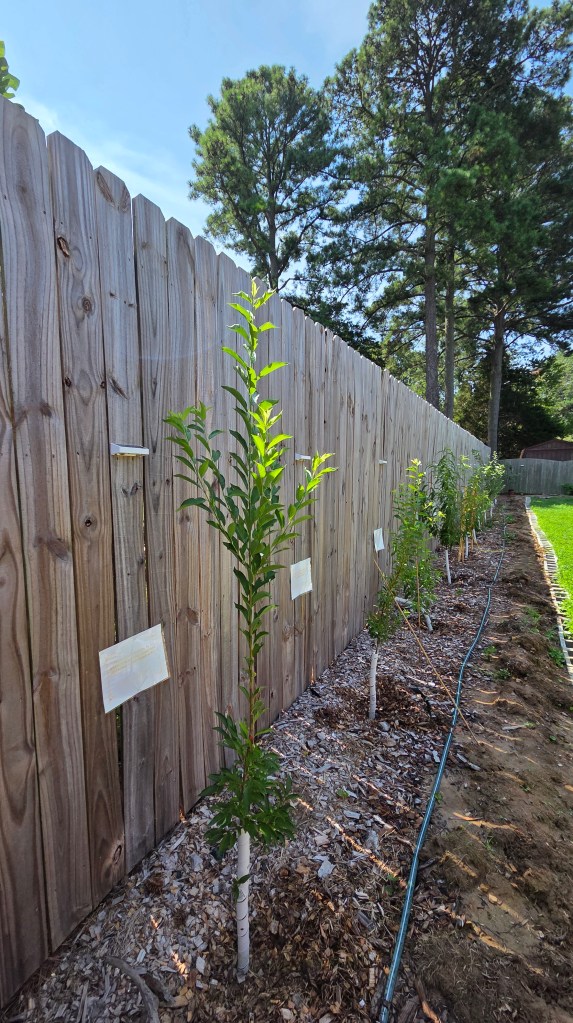
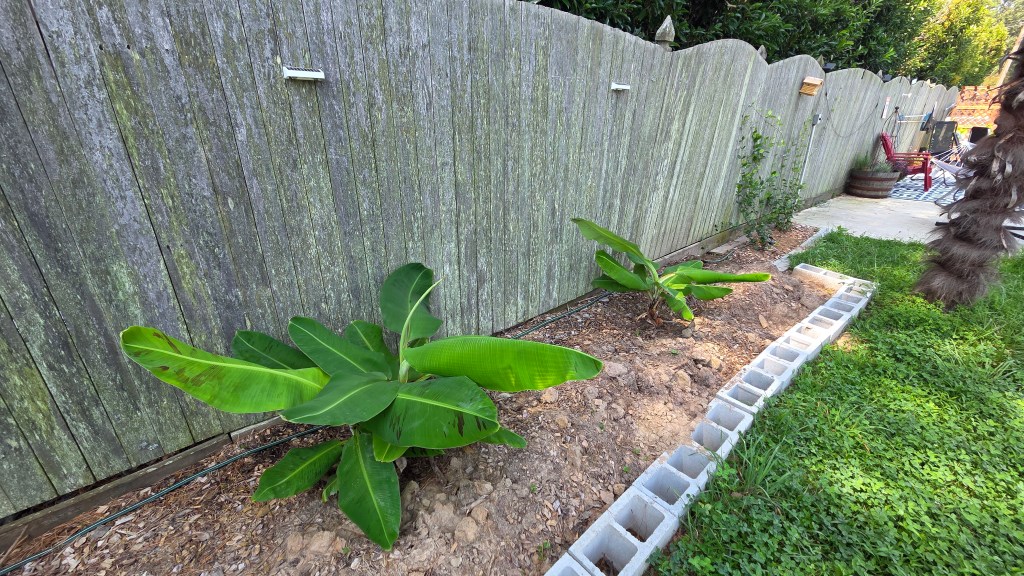
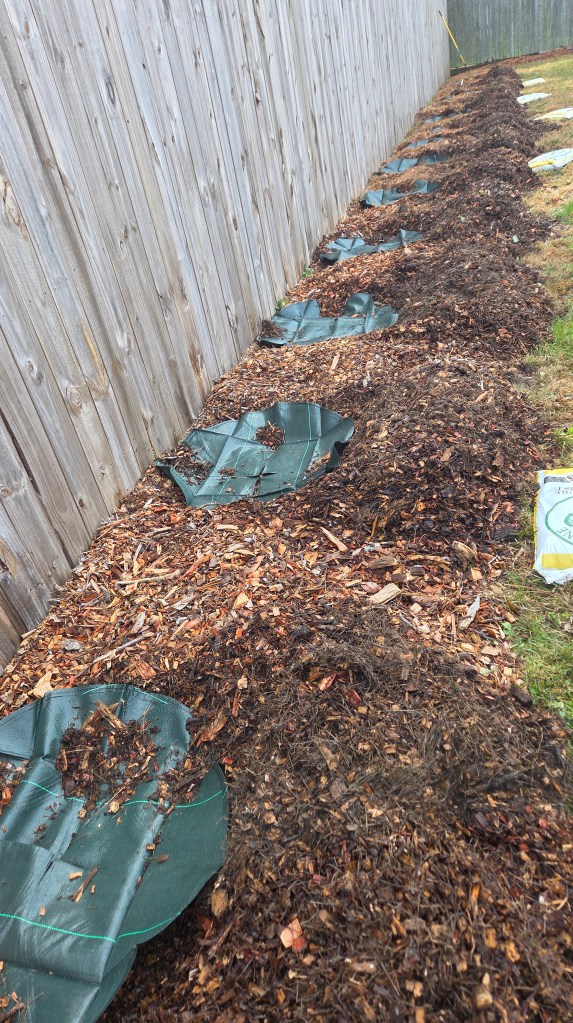
That strip of grass along the fence became an orchard. Apples, peaches, plums and nectarines went in. Then blueberries, blackberries, pineapple guava, cherry trees, artichokes, asparagus, gooseberries, strawberries, figs, citrus trees and bananas found homes around the property.
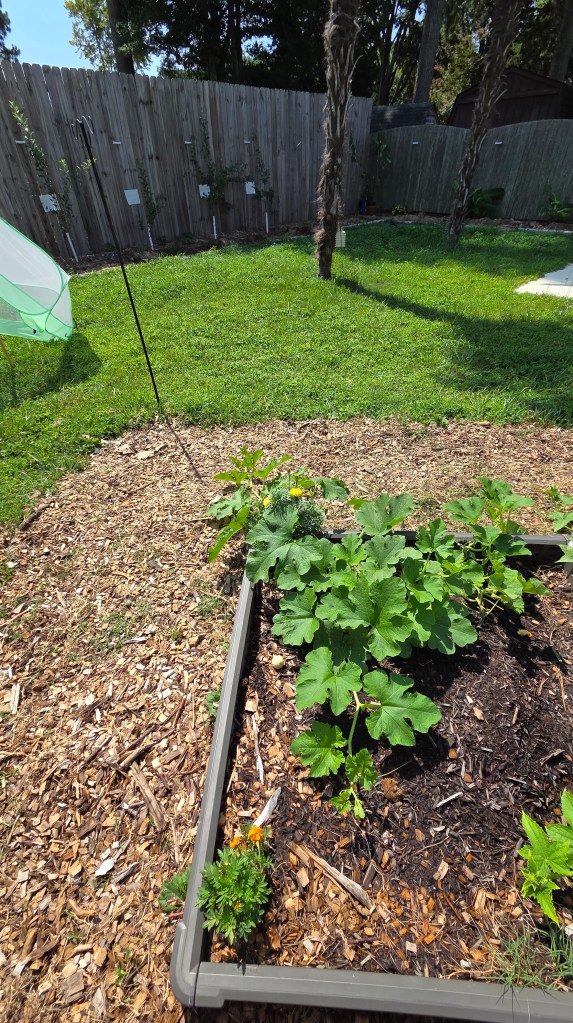
We added a few raised beds and started growing more of our own food. Potatoes went into bags. Herbs and flowers went into cinderblock holes. Fall vegetables went into the ground and became a Thanksgiving Garden.
We have added native plants and more places for birds, bees, butterflies and hummingbirds.
We started composting more of what we used to throw away.
And, somehow, I became a worm rancher.
There have been plenty of failures mixed in. Plants have died. Things got planted in the wrong place and moved. Rabbits ate things. Bugs ate things. I probably bought too many plants.
But looking at these pictures, I don’t really see the individual projects.
I see a yard beginning to pull its own weight. It’s not just sucking down water and fertilizer to support a monoculture lawn designed to resemble a manicured fairway.
It is alive and thriving.
And we’re nowhere close to finished. There are more trees to train, more beds to plant, a greenhouse to put back together and my little taste of New Hampshire is just beginning to take shape.
That’s probably the biggest change in the past year.
We’re no longer just taking care of what was already here.
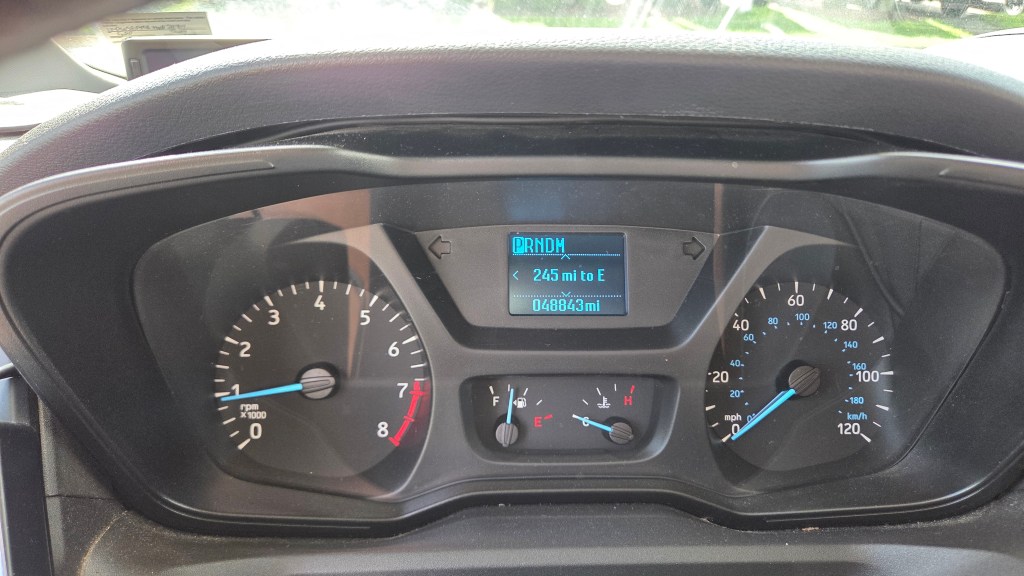
Since this began with a puff of smoke and a slow roll to the side of a Texas highway in the middle of June, we have been waiting to see our RV sitting back in the driveway and fully functional again.
It has been an expensive, lesson-filled, at times frustrating journey, but here we are, at last.
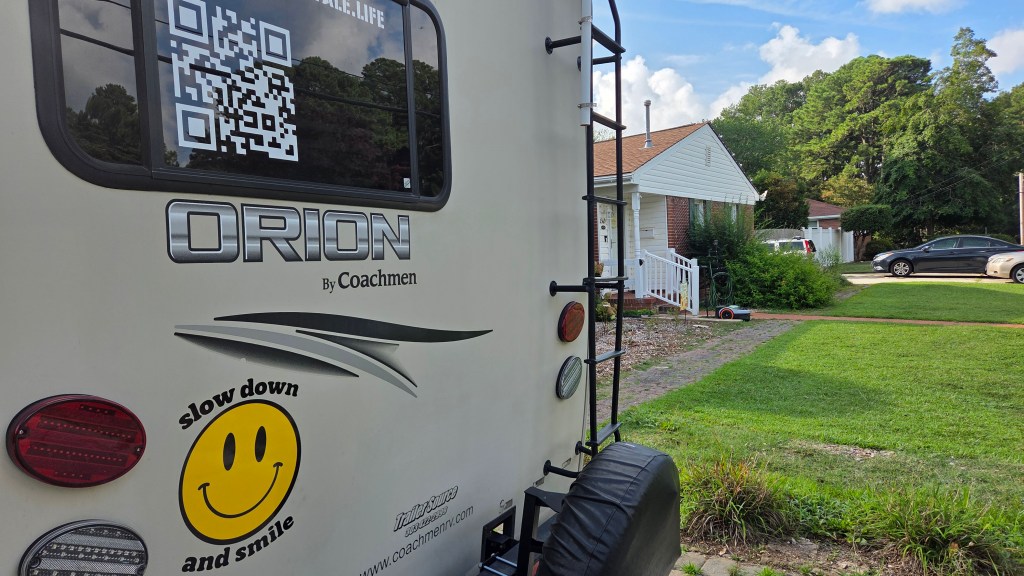
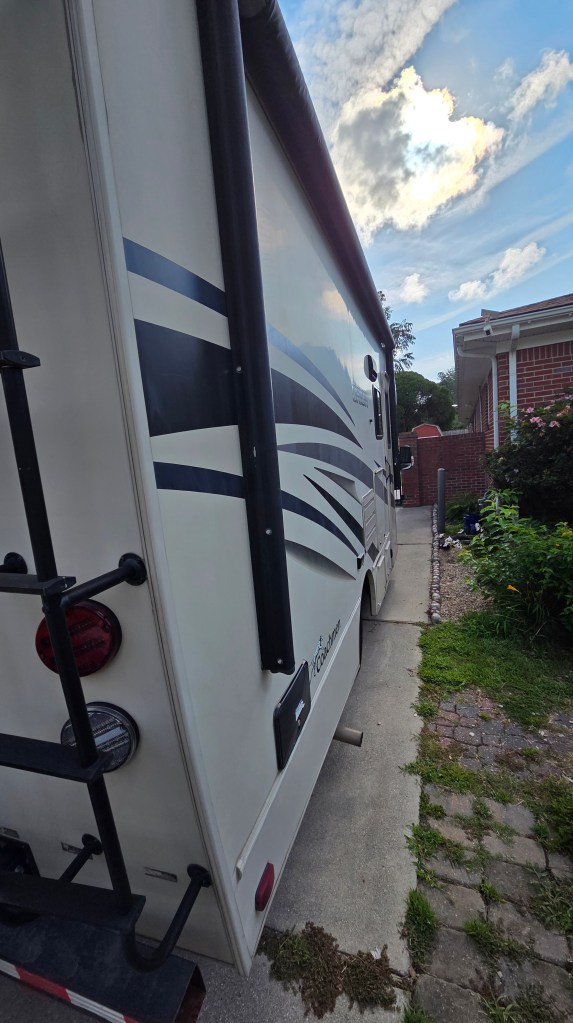
Our Orion is home.
And after the last few months, those are particularly sweet words to type.
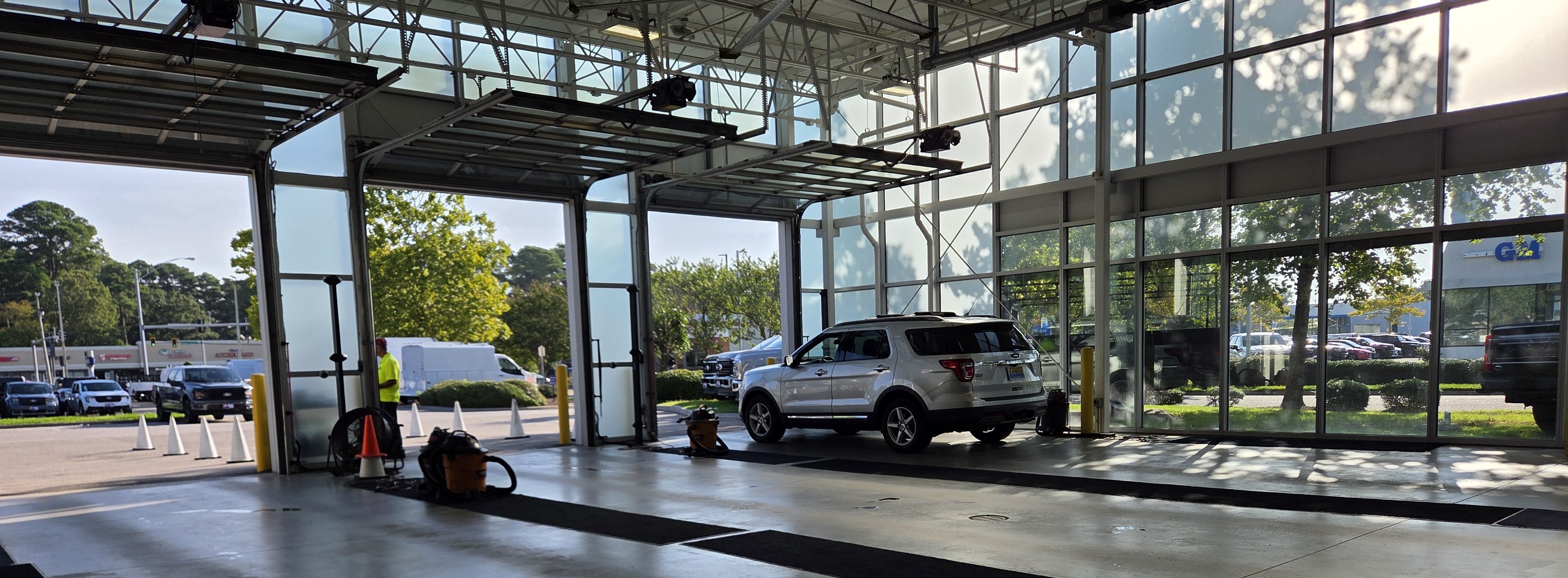
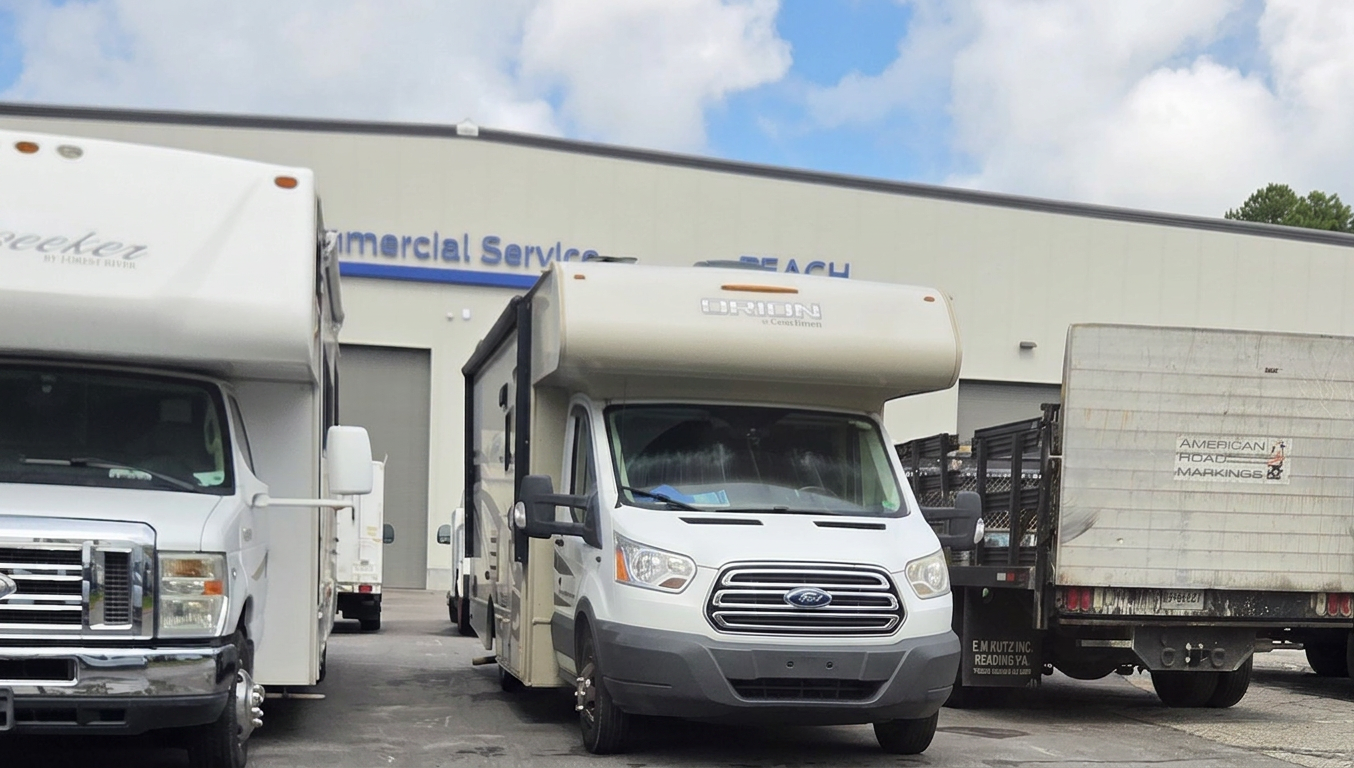
What was supposed to be part of another summer adventure took an unexpected turn when the Orion developed serious engine trouble and eventually ended up at Beach Ford down for the count.
There aren’t many things quite as sad as watching your RV disappear into a service lot, especially when you know the problem isn’t going to be solved quickly or inexpensively.
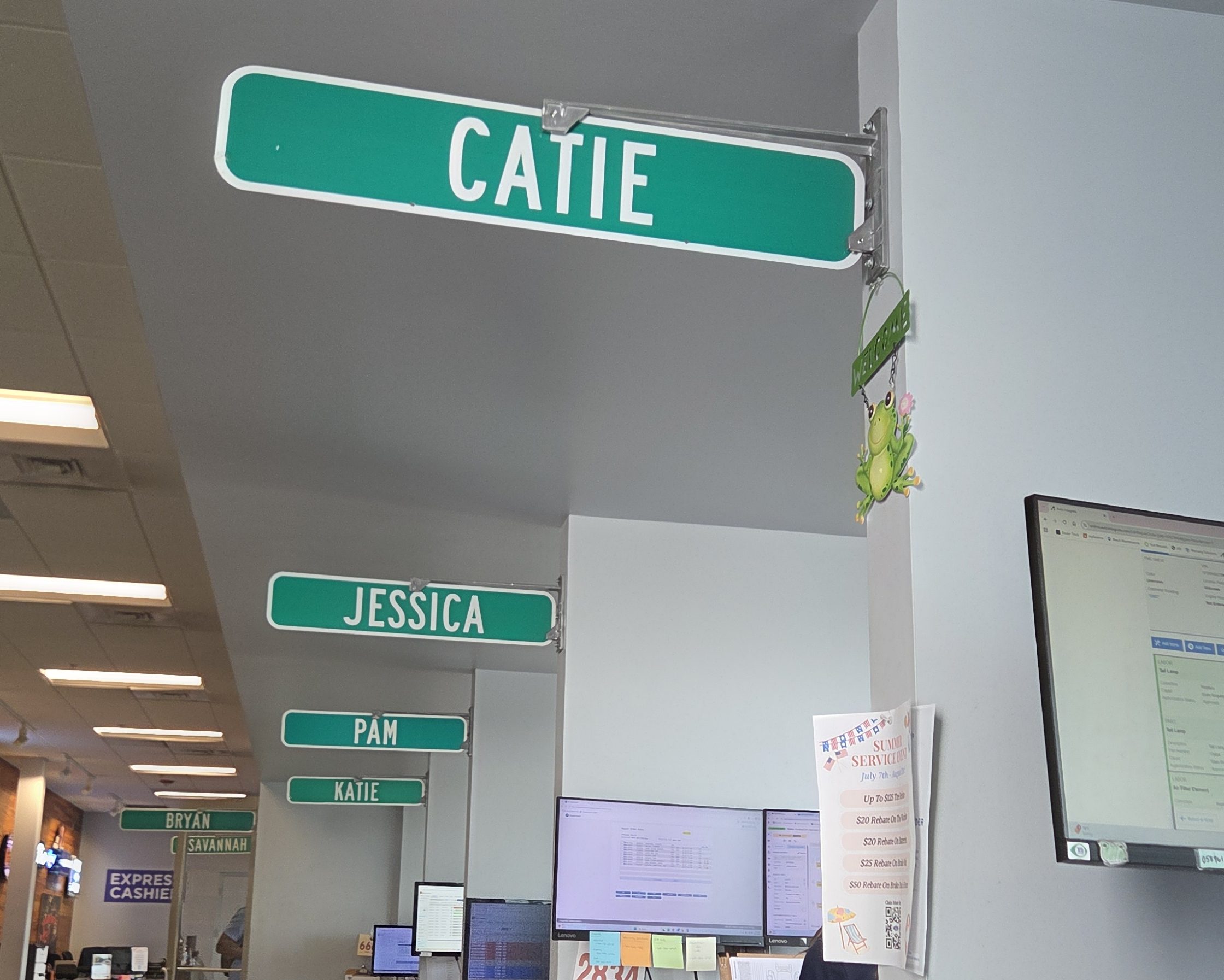
By the numbers: What started as an $18,000 repair quotation in Texas, swelled to a $20,000 estimate at Beach Ford. In the end, and mostly due to the dogged determination and hard work of my favorite Service Adviser, Catie with a “C”, we’ll end up at about $13,000 all in. A painful check to write, but it could have been worse and Catie worked really hard to help us. Her empathy and concern were evident from our very first meeting with her and she kept chipping away at it for us. I hope Beach Ford keeps her well compensated and providing good customer service for years to come. They have won me over as a customer. They have become the shop of record for our RV. Thank you Catie and Beach Ford for getting us back whole. Hopefully, the next time I see you, is just for an oil change.
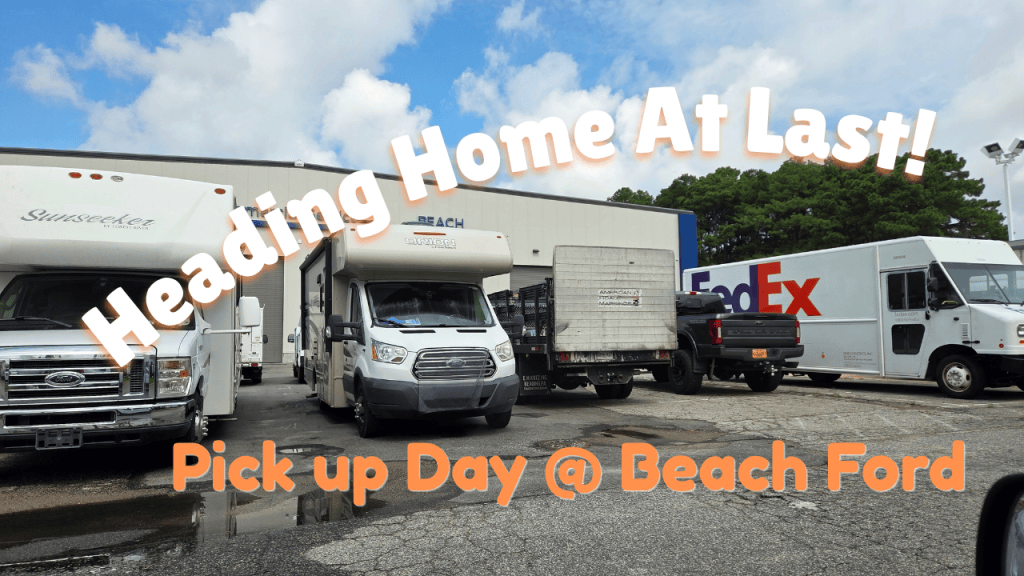
So, this morning I headed over to Beach Ford. Tucked among the commercial trucks and other RVs, looking remarkably innocent for something that has caused this much drama and expense lately was our Orion.
Today was pickup day.
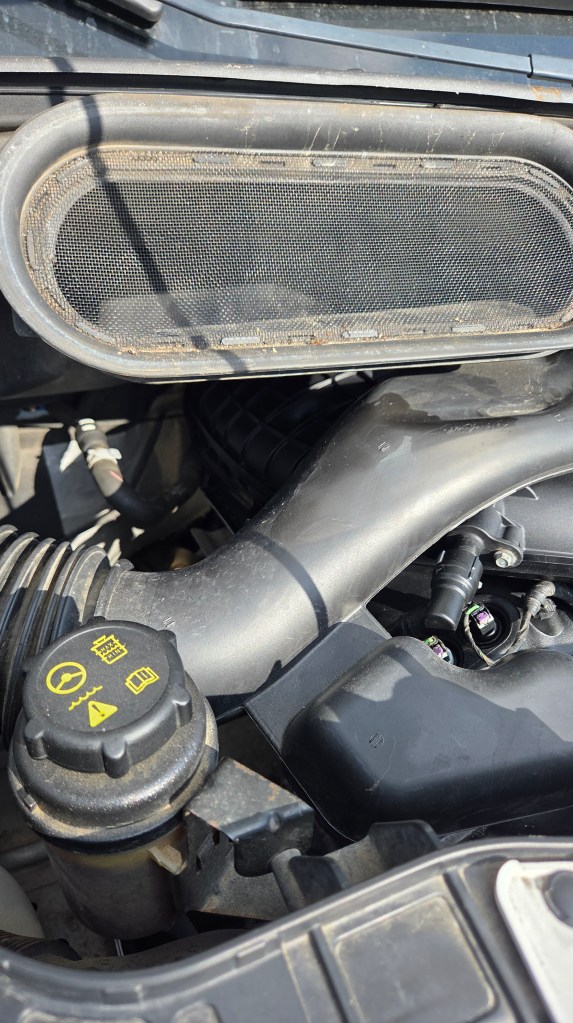
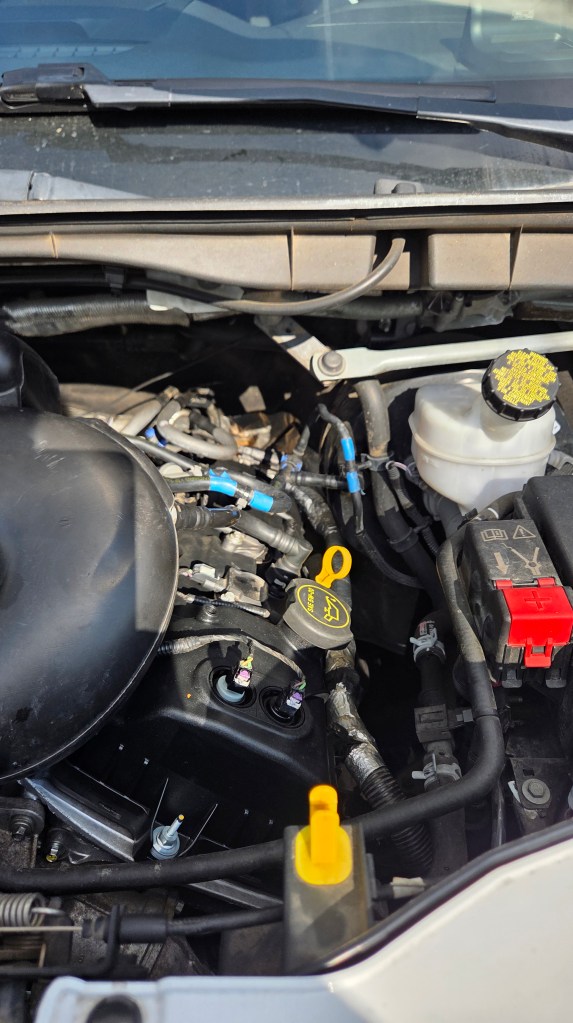
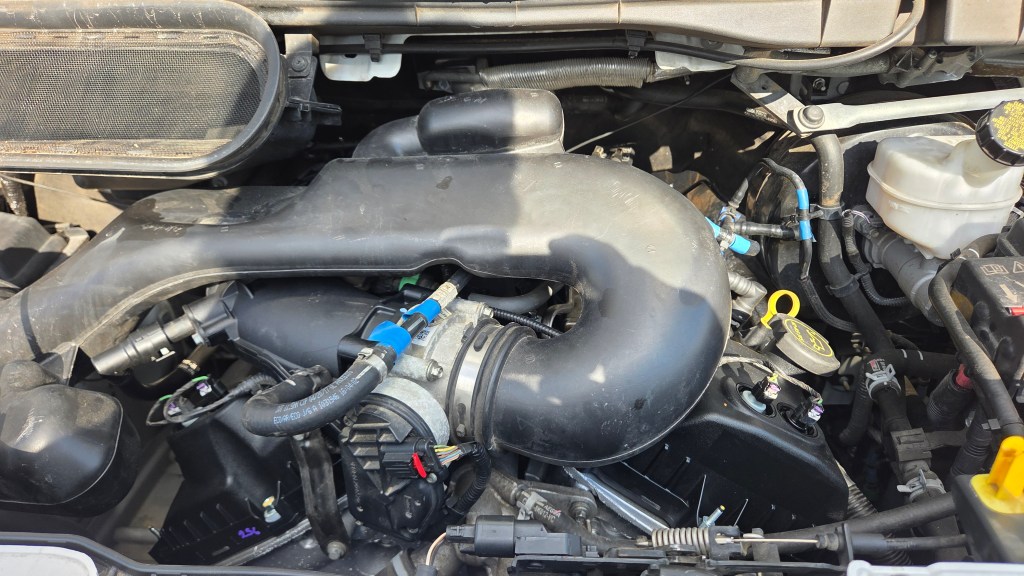
Before leaving, I did what every slightly obsessive RV owner should do after major engine work:
I opened the hood and stared at everything.
I tilted my head and squinted.
I squeezed some hoses and tapped a few things. Important things.
Does it look right?
Is anything leaking?
Is anything loose?
Do I actually know what half of these hoses do?
Yes, no, apparently no, and absolutely not.
Close enough.
I checked the oil.
Oil so clean I had to tilt the dipstick into the sun to see there was any there at all.
I kicked the tires.
Then came the moment that really mattered.
Turn the key.
Engine starts on the first bump and idles almost silently.
The Air Conditioning works.
Put it in gear.
And drive.
There is something wonderfully exciting about an RV moving under its own power again when, not very long ago, you weren’t entirely sure when that was going to happen ever.
I only had a few miles to get back home. Not a long road test, but it seemed to go very well. No check engine lights. No smoke. No rattles that weren’t from the kitchen. I didn’t try any jack rabbit starts or push it very hard, but everything seemed as it should be.
Most importantly, our “Slow Down and Smile” face is still riding on the back.
That seems particularly appropriate right now. We definitely slowed down and hopefully we have smiled through most of it.
Eventually you fix what needs fixing, turn the key again and see where the road goes next.
And that’s where we are.
Next comes the small repair I need to make. I think I mentioned breaking the low-hanging sewer drainpipes while putting her on the trailer. That should be cheap and easy and will be an upgrade as the gate valves need replacing anyway. She needs a little cleaning, a little organizing and we’ll officially be on the road again.
I’ll be watching fluids, kicking tires, checking underneath, squinting at important things, listening for strange noises and generally behaving like someone who has recently been given his RV back after major surgery.
And barring any surprises, she won’t be sitting here for long.
There are places to go.
For a little while, Orion’s story was about getting home.
Now we get to start talking about where she’s taking us next.
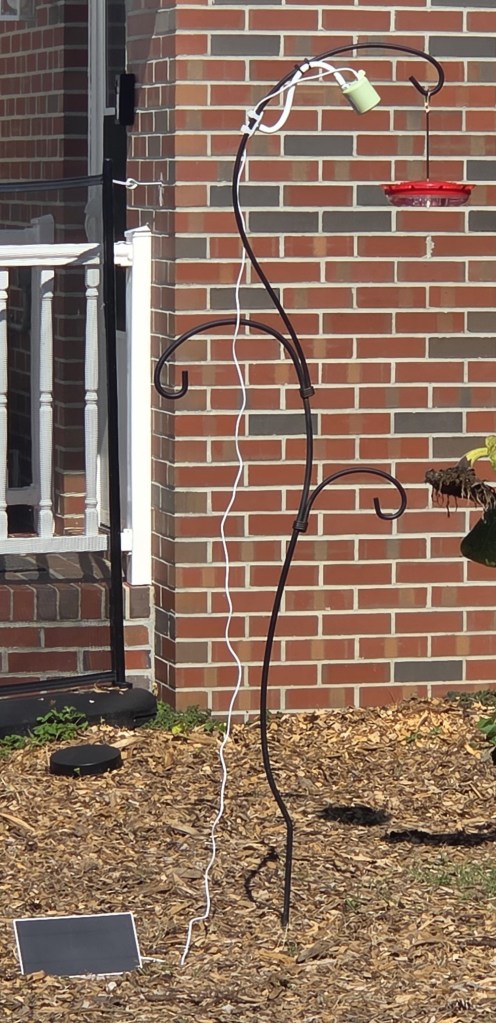
I hung out our first hummingbird feeder three days ago, hanging it from a shepherd’s hook pole near the sunflowers, between the birdbath and the existing feeding station. I mixed up some simple nectar, filled it, hung it up and figured we’d see what happened.
Apparently, word travels fast in the hummingbird community.
It wasn’t long. In less then an hour, I looked out and saw one actually drinking from it.
I think I actually may have sqealed a little when I saw it.
Then it came back.
Or maybe that was another one?
Then there were more.
Before long, I had three hummingbirds flitting around at the same time, chasing each other, darting through the yard and generally looking like tiny fighter jets dogfighting in the yard. I’ll have to look it up. Has there ever been a plane named after a Hummingbird. We have Falcons and Eagles and Hornet…I don’t recall a Hummingbird.
So much for wondering whether they would find it.
I bought a two pack of feeders and now feeder number two is up, as well, and it has already had its first visitors.
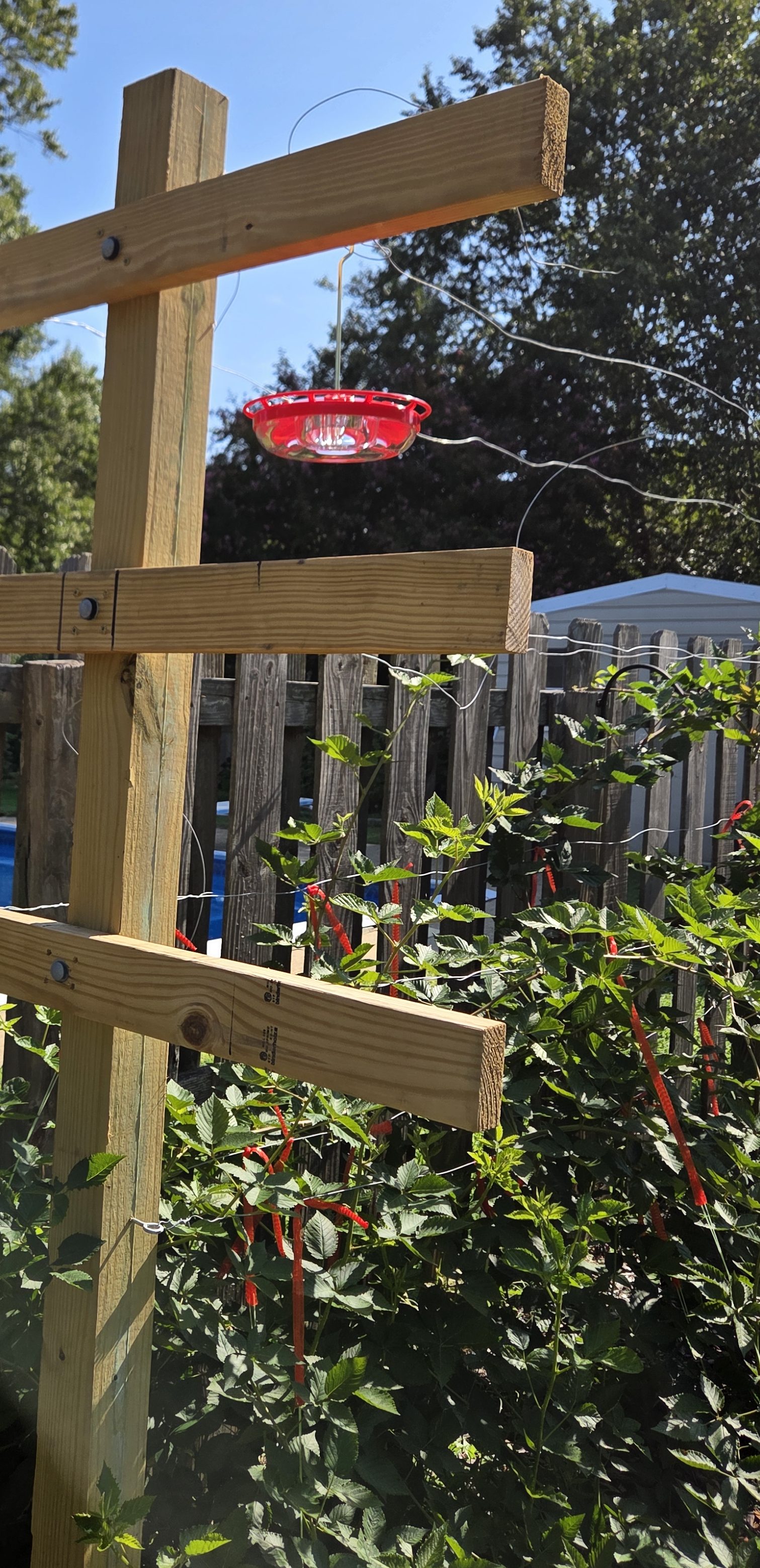
It went in out of sight of the other feeder on one of the trellis poles on Blackberry Row. It’s well positioned to be seen out our kitchen window.
I’ve also moved one of the bird cameras to get a better view of the action, but can already see it won’t be enough to get the shots I want. The cool “beauty” shots you see online. Super slow-mo, frame by frame fun.
Because obviously the logical response to attracting hummingbirds is more cameras, right? You can save this post for the eventual Intervention.
The Buttervale Bird Sanctuary Keeps Growing
The hummingbirds are only the latest residents in what has slowly, and somewhat accidentally, become the Buttervale Bird Sanctuary.
We’ve got feeders.
We’ve got birdbaths.
We’ve got flowers and berries.
We’ve got cameras.
We’ve got native plants going in around the property.
We’ve got plans to add some nesting boxes.
Becaues increasingly, I’m trying to make Buttervale not just a place where we see birds, but a place where we can actually pay attention to who is visiting, when they’re here and what they’re doing.
Which brings me to the newest gadget at Buttervale.
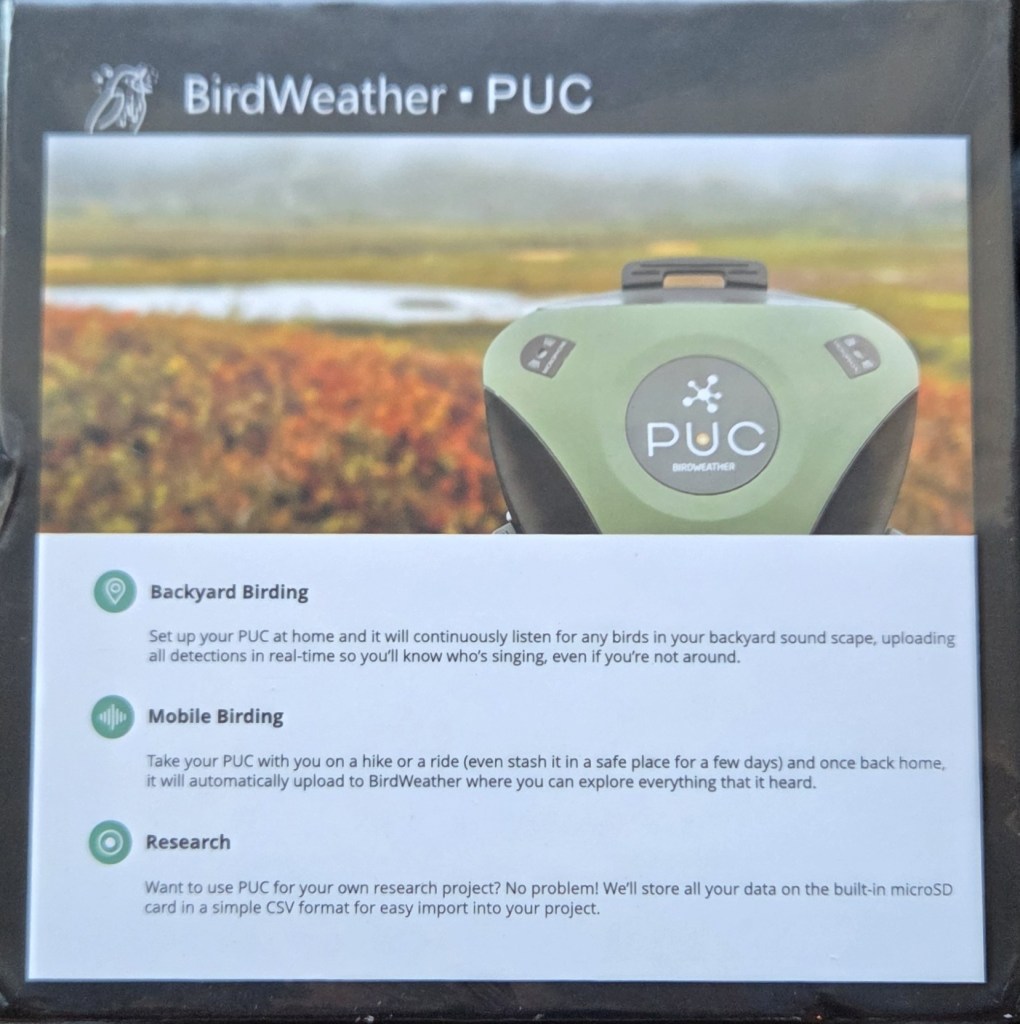
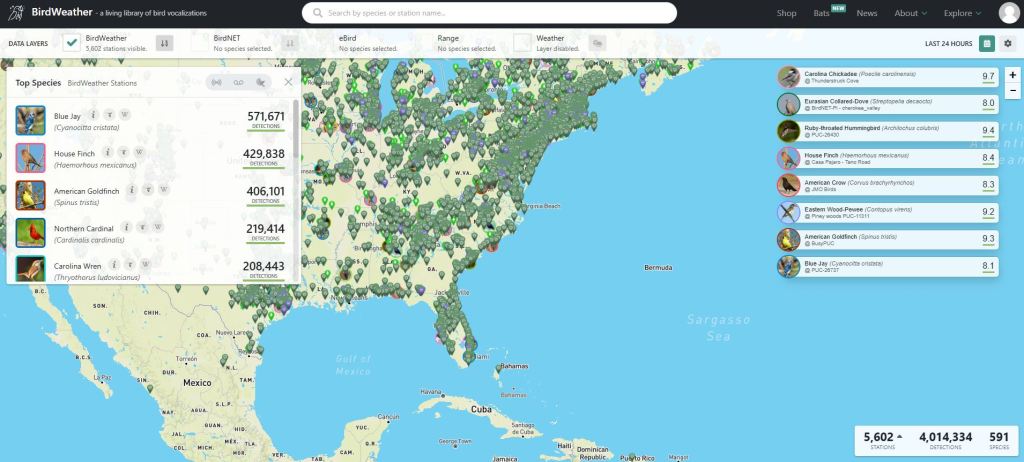
The BirdWeather PUC or Portable Universe Codec.
Yes, I bought another piece of bird technology.
Nobody should be surprised by this anymore. Add this to the list for my Intervention.
Big Brother is Listening
The PUC is basically a little outdoor listening station for the yard.
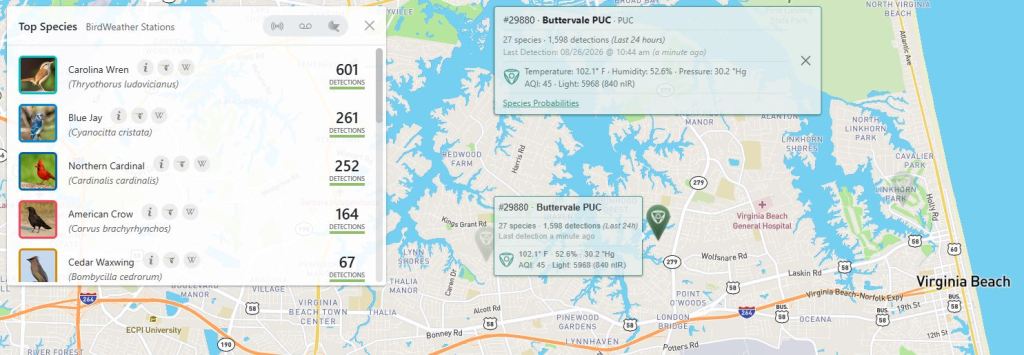
In the first 24 hours it was working, it detected almost 1600 birds of 27 different species.
Instead of waiting for me to hear a bird, grab my phone, open the Merlin App and hope the bird sings again, the PUC will sit outside listening throughout the day and identify birds by their songs and calls.
That changes things.
There are undoubtedly birds moving through Buttervale that I never see.
But they make noise.
And now Buttervale is listening. Always listening. (Insert manaical laughter here.)
Even better, You can listen along and see what the PUC is hearing and identifying on the Buttervale BirdWeather station page:
One warning, though: don’t trust the temperature reading just yet.
The PUC is currently sitting where it gets too much direct sun.
I’m still figuring out the best permanent location.
Today’s experiment involves a tree strap and one of the palm trees right in the heart of what has become Bird Country. That should give the PUC some shade while putting its microphone right in the middle of the action.
We’ll see how it does.
It is also a ton of fun to pull up the BirdWeather Map and listen to stations all over.
What Are We Missing?
This is the part I’m really excited about.
Over time, the PUC should start building a much better picture of the bird population around Buttervale. Not just the obvious cardinals, blue jays and mourning doves, but the quieter visitors and seasonal travelers that we might otherwise completely miss.
I have already started researching how I can attract some of the birds we now hear and know are nearby to drop in for a meal or a bath or a roost.
How can we better meet their needs?
It’s one thing to walk outside and say, “There are a lot of birds around here.”
It’s another thing entirely to start building a record of which birds are actually here.
What time do they show up?
Which species are seasonal?
Who passes through during migration?
Who is singing at 4:42 in the morning while I’m still quite happily asleep?
And who has been hanging around Buttervale all along without us ever noticing?
Now we have another way to find out.
From Backyard to Nature Station
I’m starting to realize that there’s a bigger project developing here.
We already have cameras watching the feeders.
We’ve started experimenting with live streaming.
The gardens are increasingly being planted with birds, hummingbirds, pollinators and other wildlife in mind.
The hummingbird feeders have opened up an entirely new little highway through the yard.
And now the PUC gives Buttervale a set of ears outside.
Eventually I’d love to tie more of this together, the cameras, live solar productiuon data, bird identifications, weather conditions and maybe even a live 24/7 Buttervale stream where anyone can drop in from anywhere and see or hear what’s happening in the yard.
Not because Buttervale is some great wilderness.
It’s just a little ol’ suburban backyard in Virginia Beach.
I think maybe that’s the coolest part.
Nature doesn’t require a National Park.
Sometimes you just have to give nature a little food, a little water, a few flowers and a place to land.
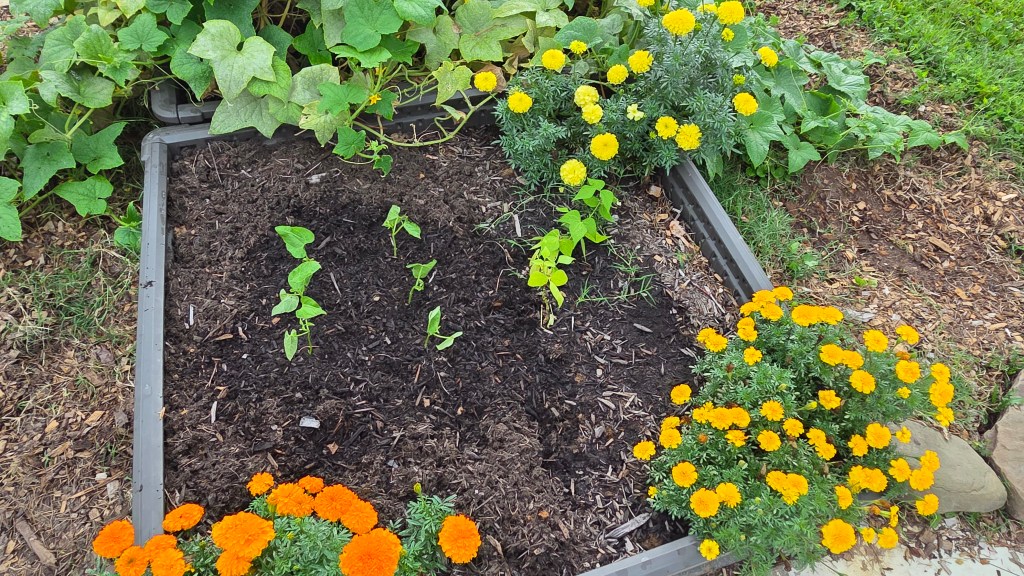
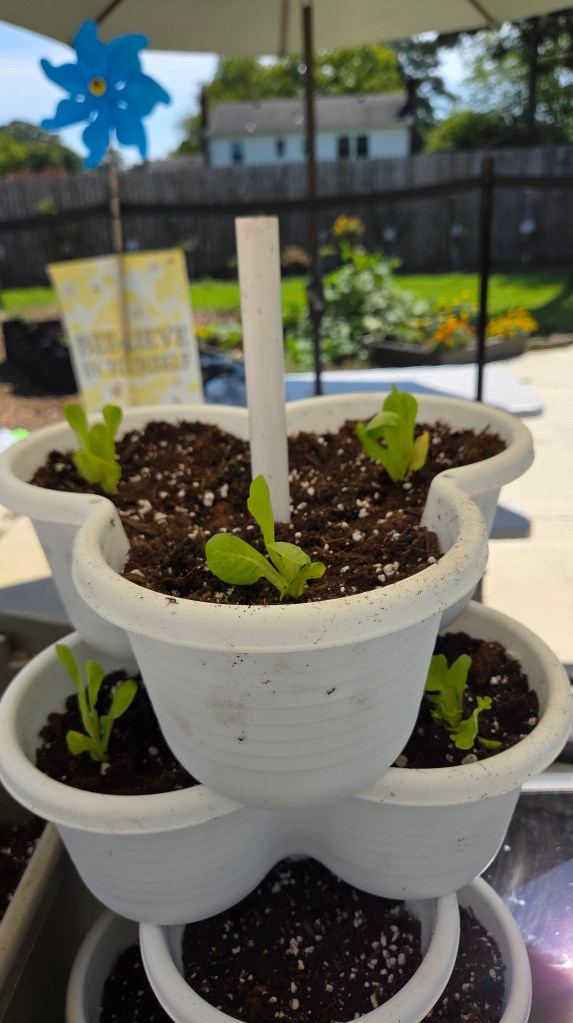
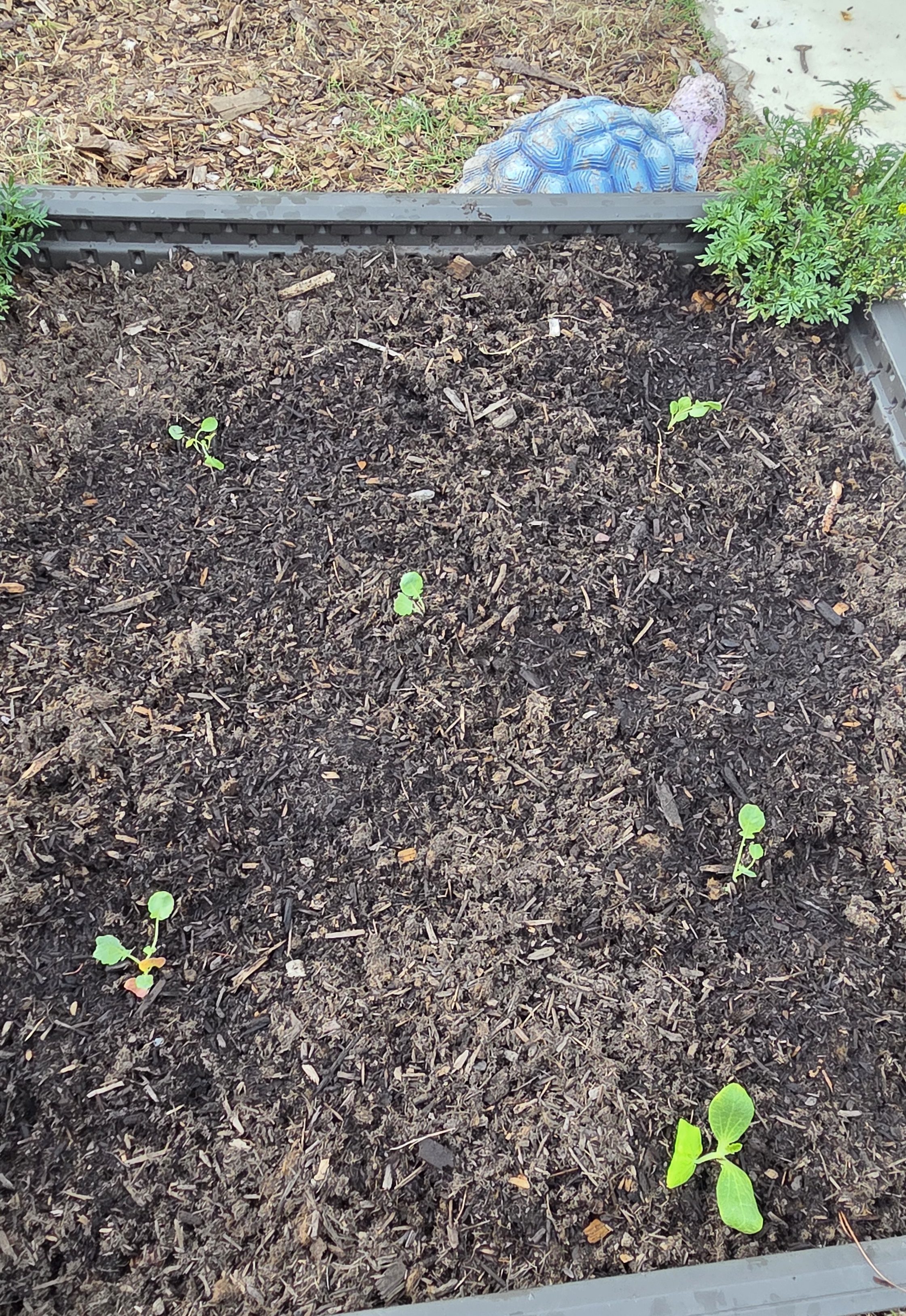
The Thanksgiving Garden is officially in full swing. This weekend, butter and romaine lettuce, rainbow carrots, bush beans, broccoli, butternut squash and spaghetti squash all got planted. Some of it should absolutely make it to the Thanksgiving table. Some of it may become an educational experience for me and a buffet for the rabbits. Gardening always keeps you humble and thankful.
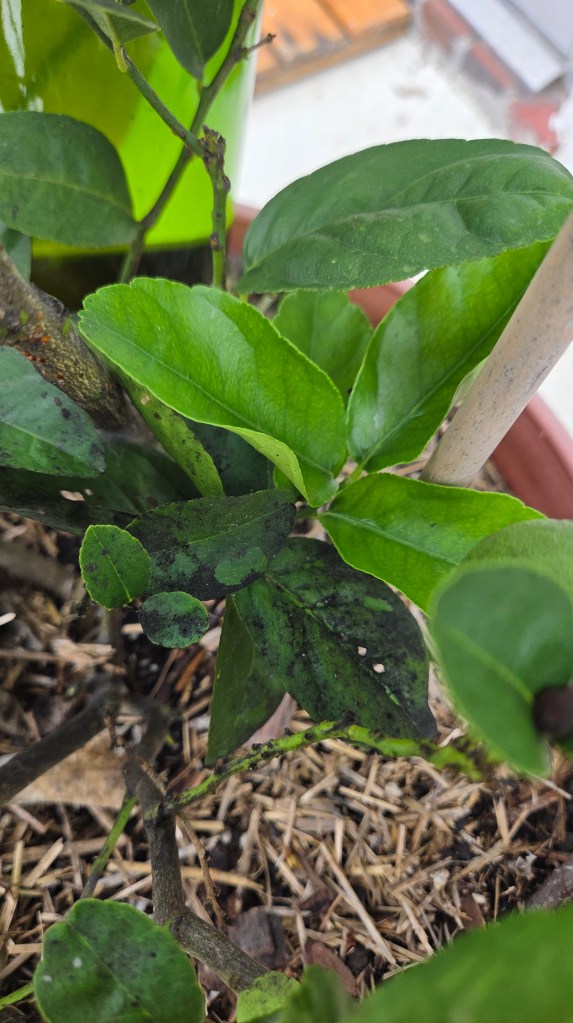
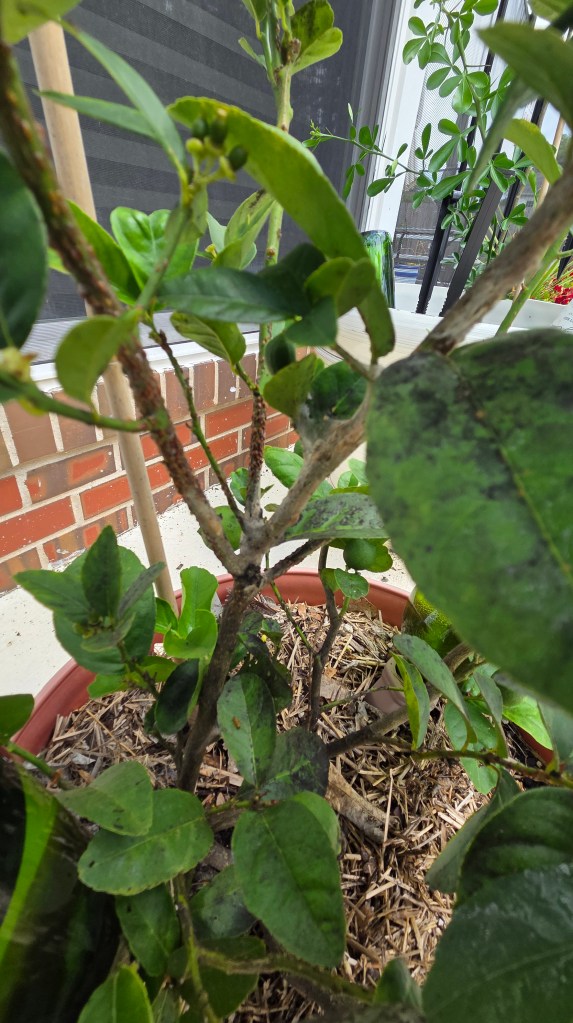
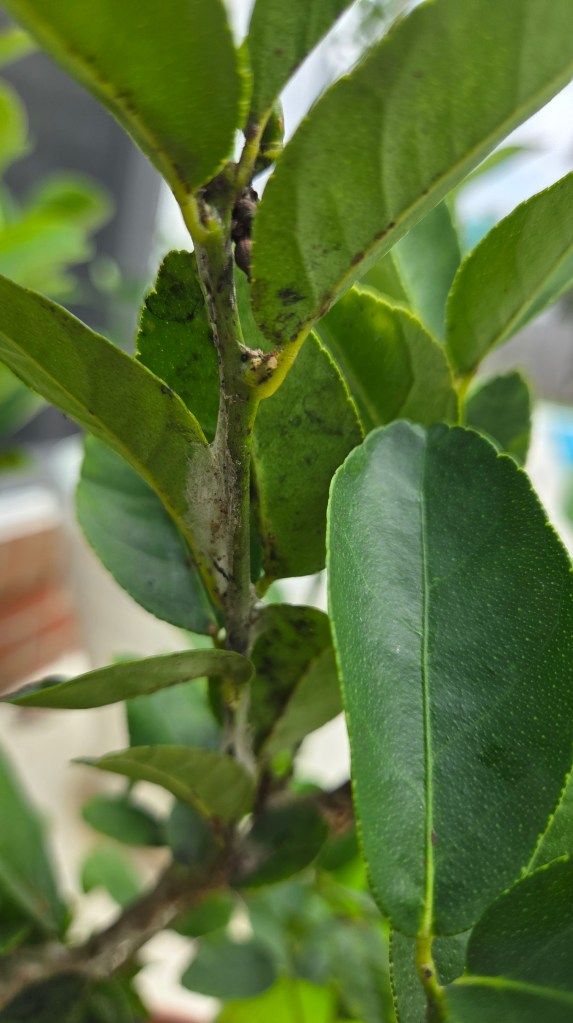
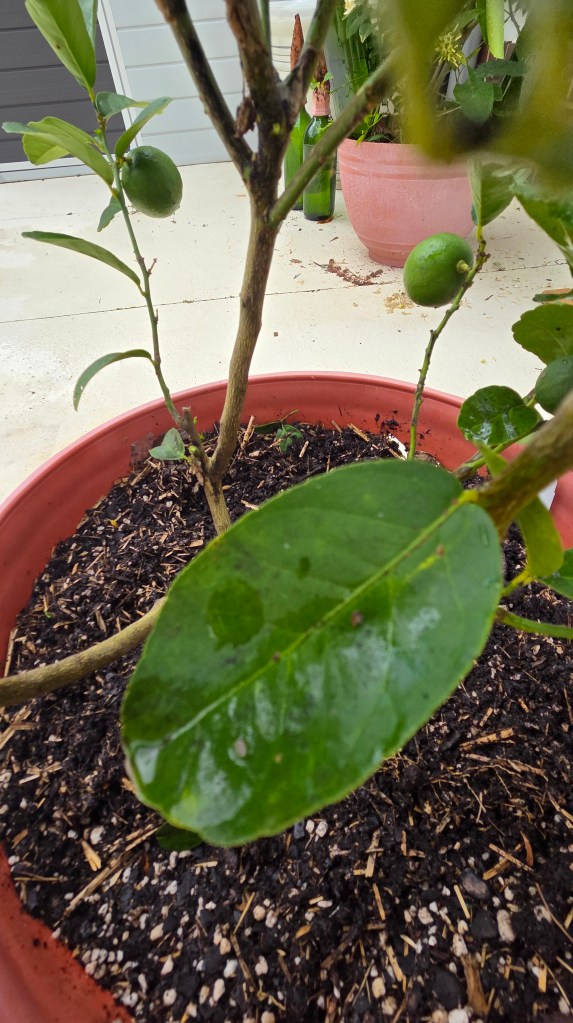
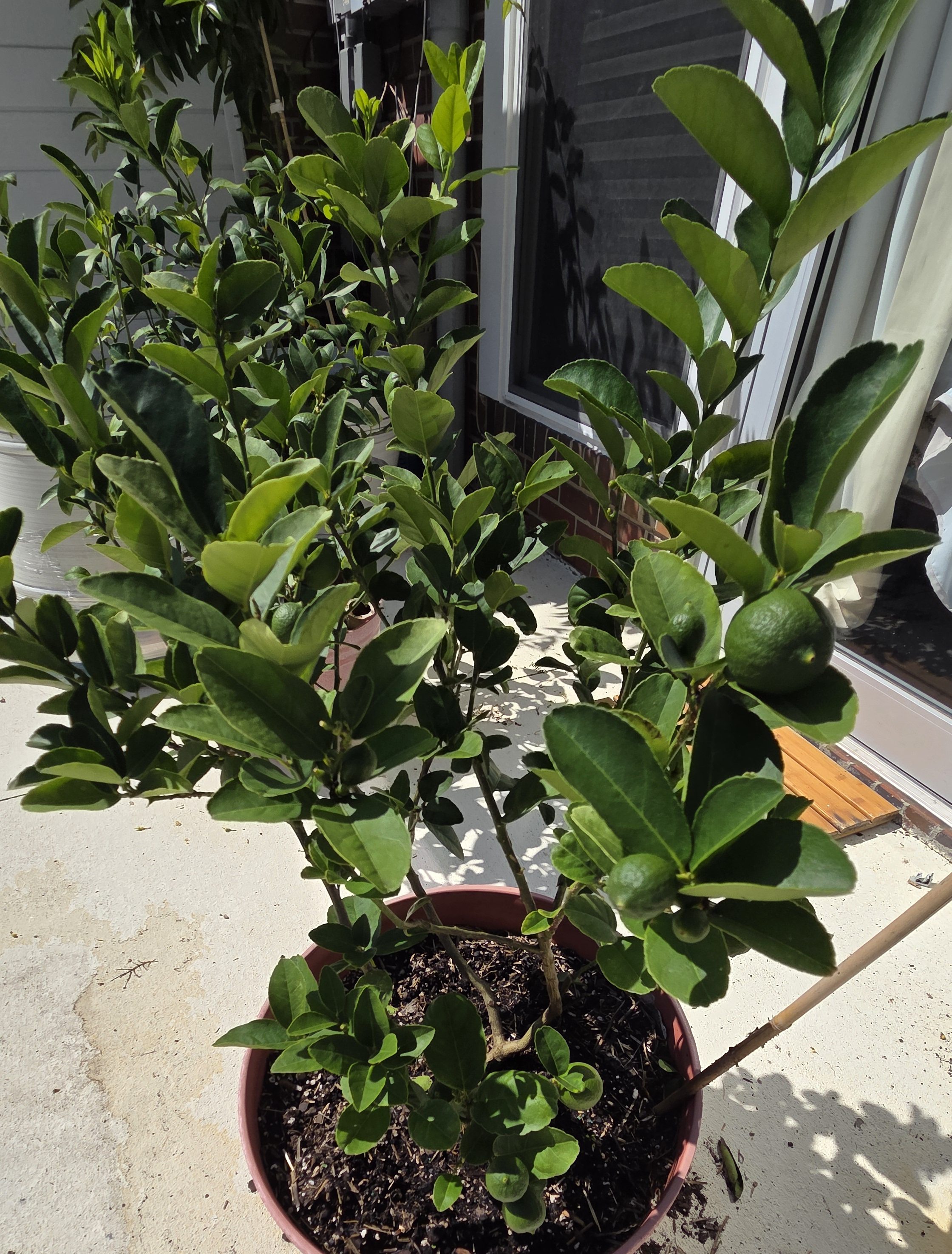
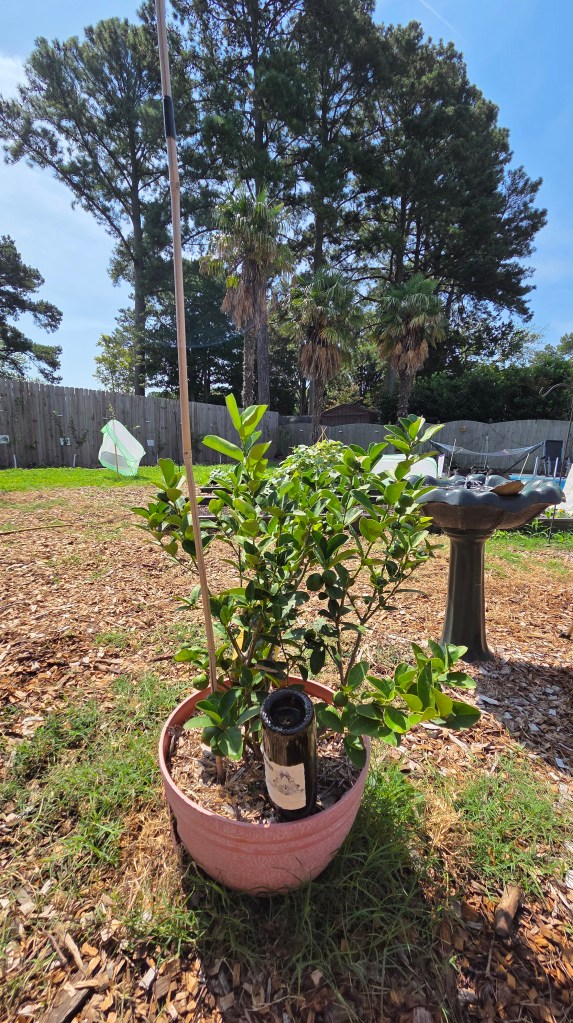
The citrus trees got some attention, too. Though, that wasn’t exactly on the agenda. While checking on the citrus Friday morning, I discovered some of the leaves on the Key Lime bush had a black dusty powder all over them.
It was a little concerning for what is an otherwise thriving little bush. It has been crushing it all Summer.
So, I took a few photos and appealed to Master Gardener Google.
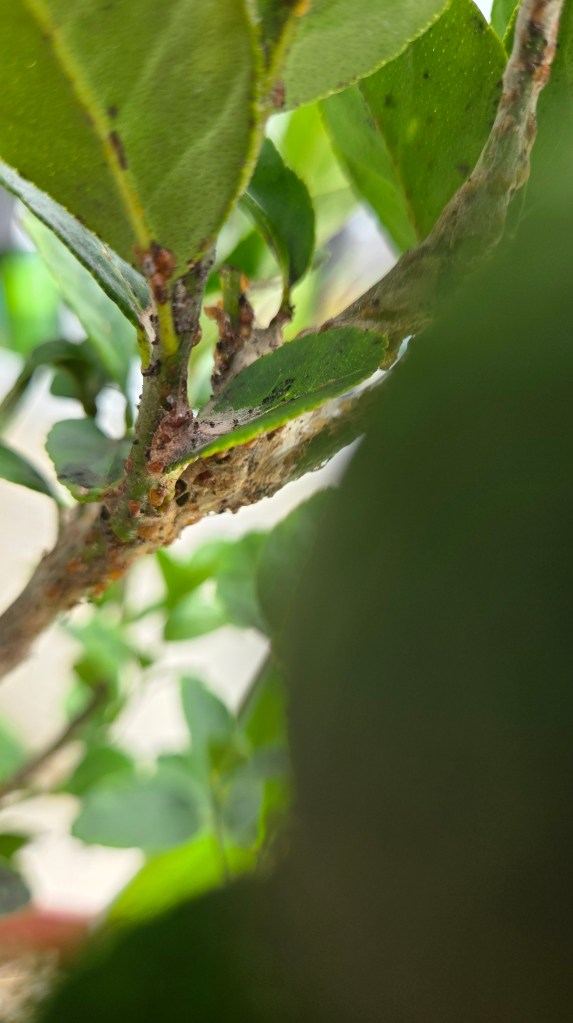
A few more photos later and a few questions answered and it turns out the little tree has a pretty good scale infestation.
What is scale?
Great question.
Scale (noun): A sap-sucking insect pest that attaches to plant stems and leaves, often appearing as small brown or tan bumps. Scale can weaken plants and produce sticky honeydew that encourages black sooty mold.
It’s that last bit, the “black sooty mold” I was seeing and the dead giveaway for the problem.
I will say, it was much less stressful to deal with a tree issue that wasn’t my fault, and deal with it I did.
The tree is scrubbed and trimmed and all the other citrus inspected. Tomorrow will arrive some organic horticulture oil which will treat anything I didn’t get brushed away and rinsed off.
Getting Ready for a Larger Pot.
Not a death sentence and glad it seemed to be caught pretty early.
I planted some wild flowers for Fall. I also gave all the bird feeders a serious deep cleaning and judging by the traffic at the Buttervale Bird Buffet, the customers have apparently decided the establishment may remain open. Even as I type this I am watching them come and go.
The blackberries continue getting trained onto their new trellis little by little. I should say, it is tough to play favorites, but Blackberry Row is in the running. I have done something right there in way of location or fertilizer or maybe I just got lucky, but I can see years of blackberries to come and nice addition of privacy since they are right next to the neighbor’s pool. It thrills me to look at them every morning.
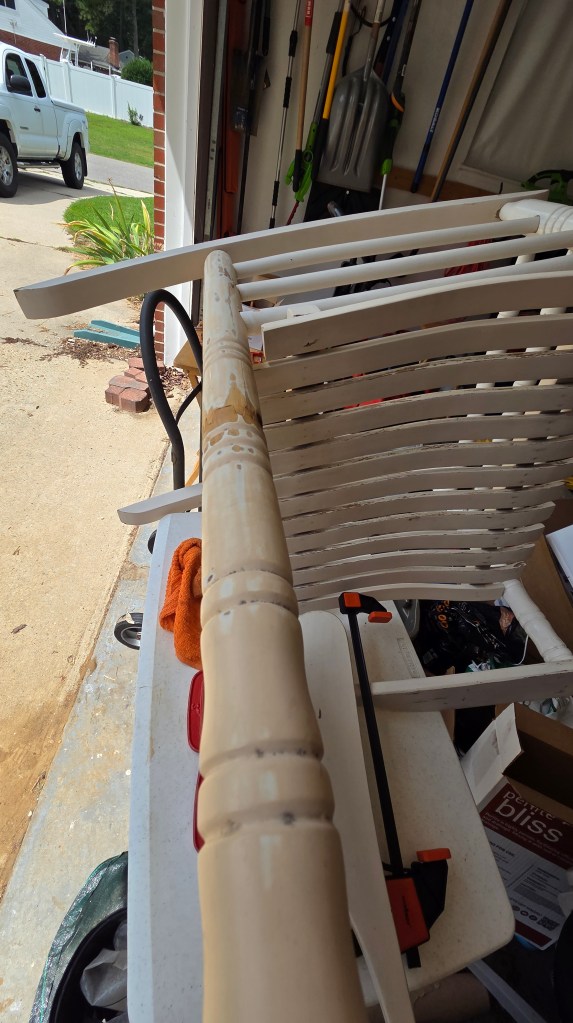
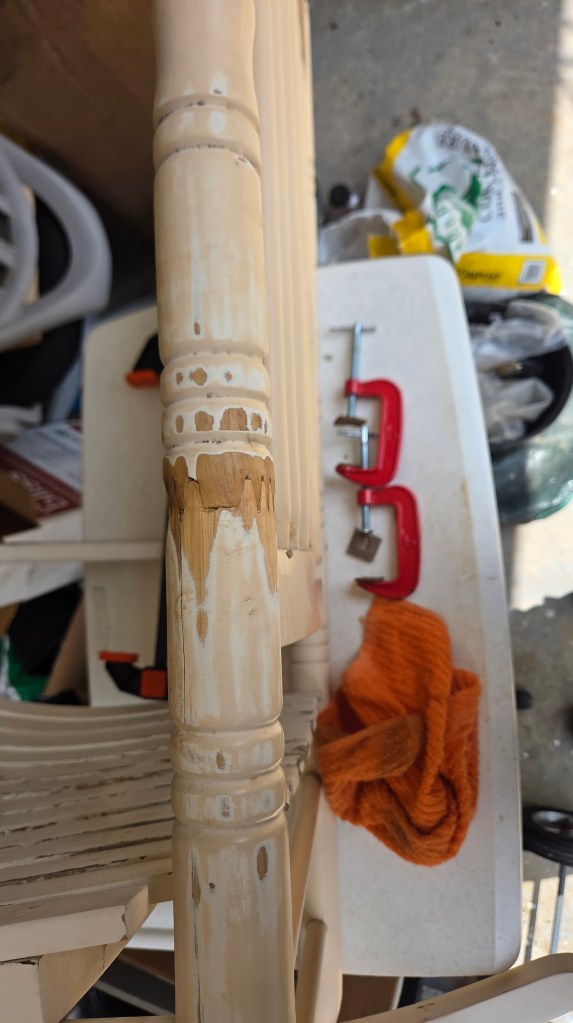
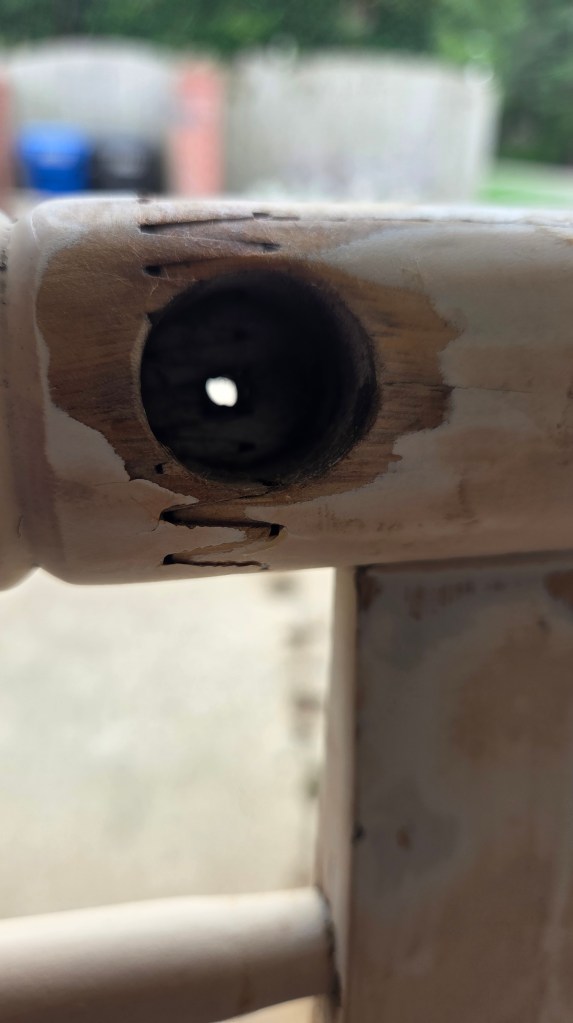
And because gardening wasn’t enough, the Winni Experience rocking chair restoration moved forward with a major glue-up. The worst of the damaged joints is now back together, clamped tight and curing. There is something very satisfying about taking an old piece of furniture that has clearly lived a life and figuring out how to give it a little more. This is way out of my comfort zone. I have never been that “wood worker” guy, but I feel like I am on a path to owning a router and a table saw and eventually 9 fingers. Glue and clamps and a few dowels for now.
Then there are the worms.
Yep. I’m a worm rancher now. But you knew that already.
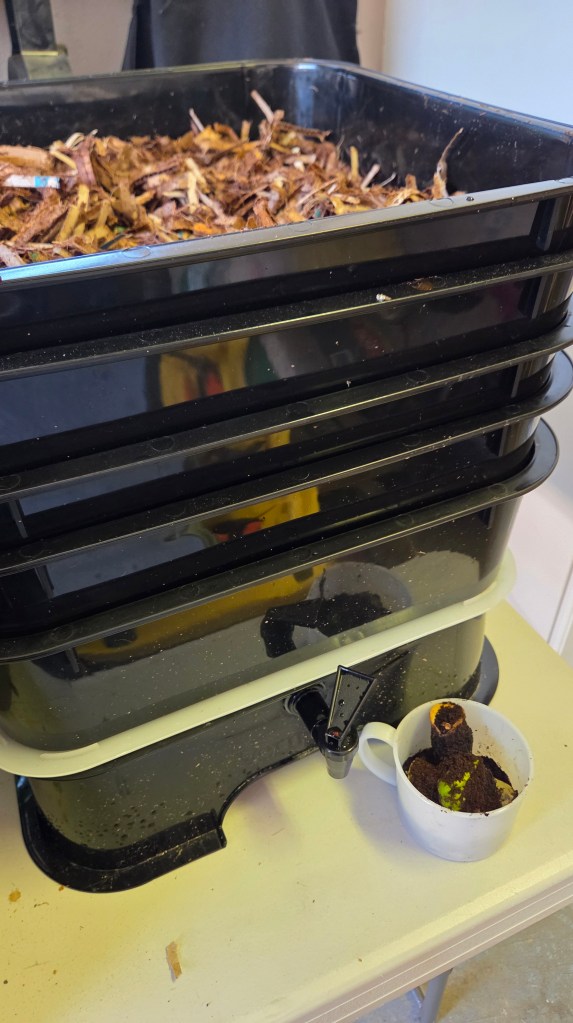
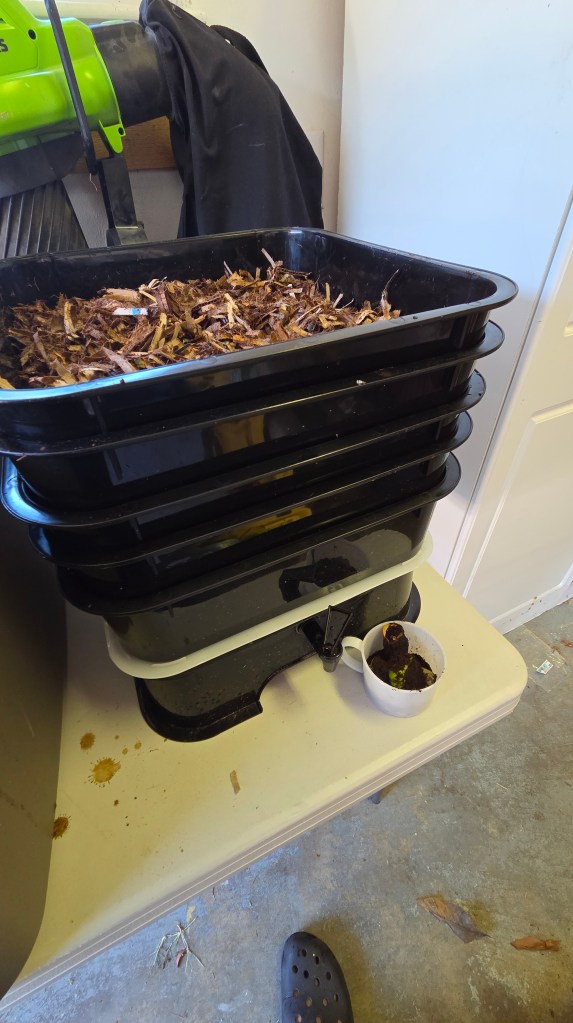
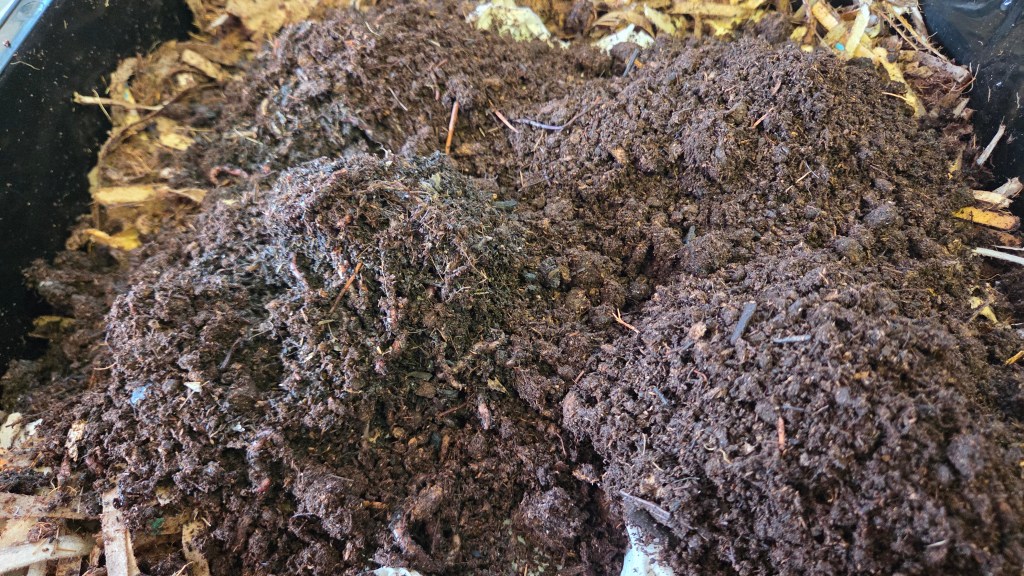
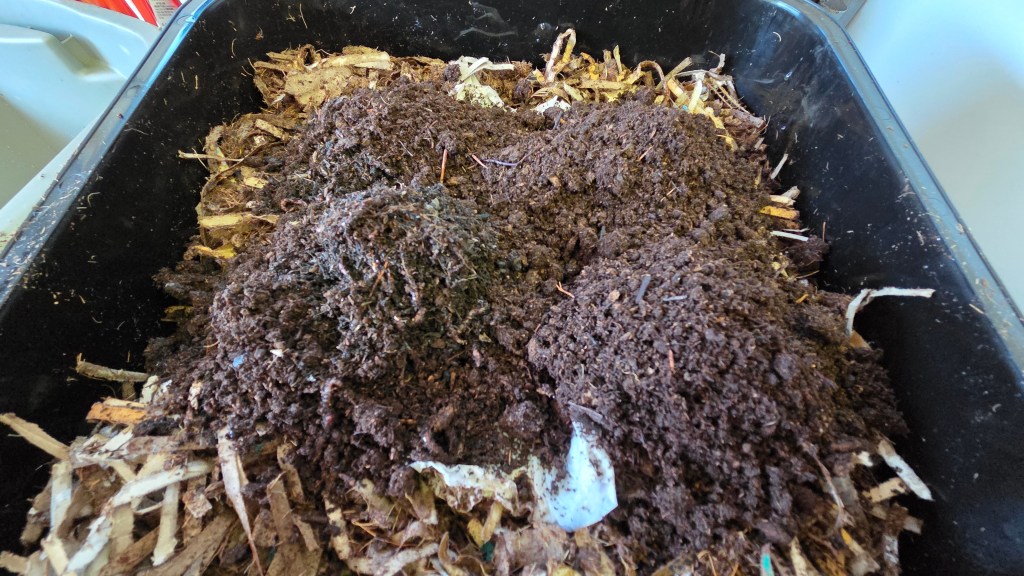
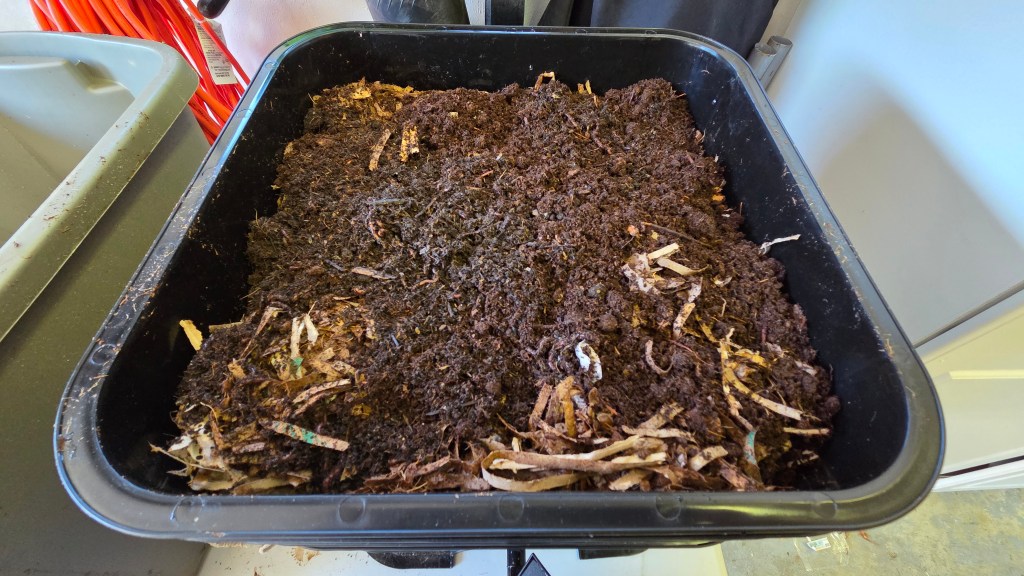
The new vermicomposting farm is up and running, stocked with red wigglers who have been given the important Buttervale task of turning kitchen scraps and shredded cardboard into some of the best stuff you can possibly add to a garden. If all goes according to plan, yesterday’s coffee grounds eventually become tomorrow’s tomatoes. That’s a pretty good system.
Worm poop. What’s not to like?
By late afternoon Sunday, I finally decided I’d done enough.
I climbed into the pool, put on my floaty belt and did absolutely nothing for a while. Just floated quietly, avoided the pool cleaning robots and watched the birds zip back and forth overhead on their way to the freshly cleaned feeders. Wrote a chunk of this blog post in my head as I tried to get some Sunlight on my belly. Susan remarked, that based on my tan I really am a farmer now. She’s not wrong.
Here in Virginia Beach, today is the last day of summer vacation for the public-school kids. Tomorrow it’s back to alarm clocks, backpacks, buses, homework and the grind.
I hope their summer was everything they wanted it to be.
Although I’m pretty sure most of the kids (and quite a few Teachers) are thinking the same thing tonight:
It went by way too fast.
Tomorrow, my dear first grandbaby starts Kindergarten. She has been doing pre-school classes for a couple of years, but this is the Big League. Full day Kindergarten in a room with 26 other kids. Yikes. I can’t type it without tearing up. Where does the time go? So quickly we watch helplessly as they take another huge step on their own.
My prayers are for her and for everyone starting a new adventure tomorrow.
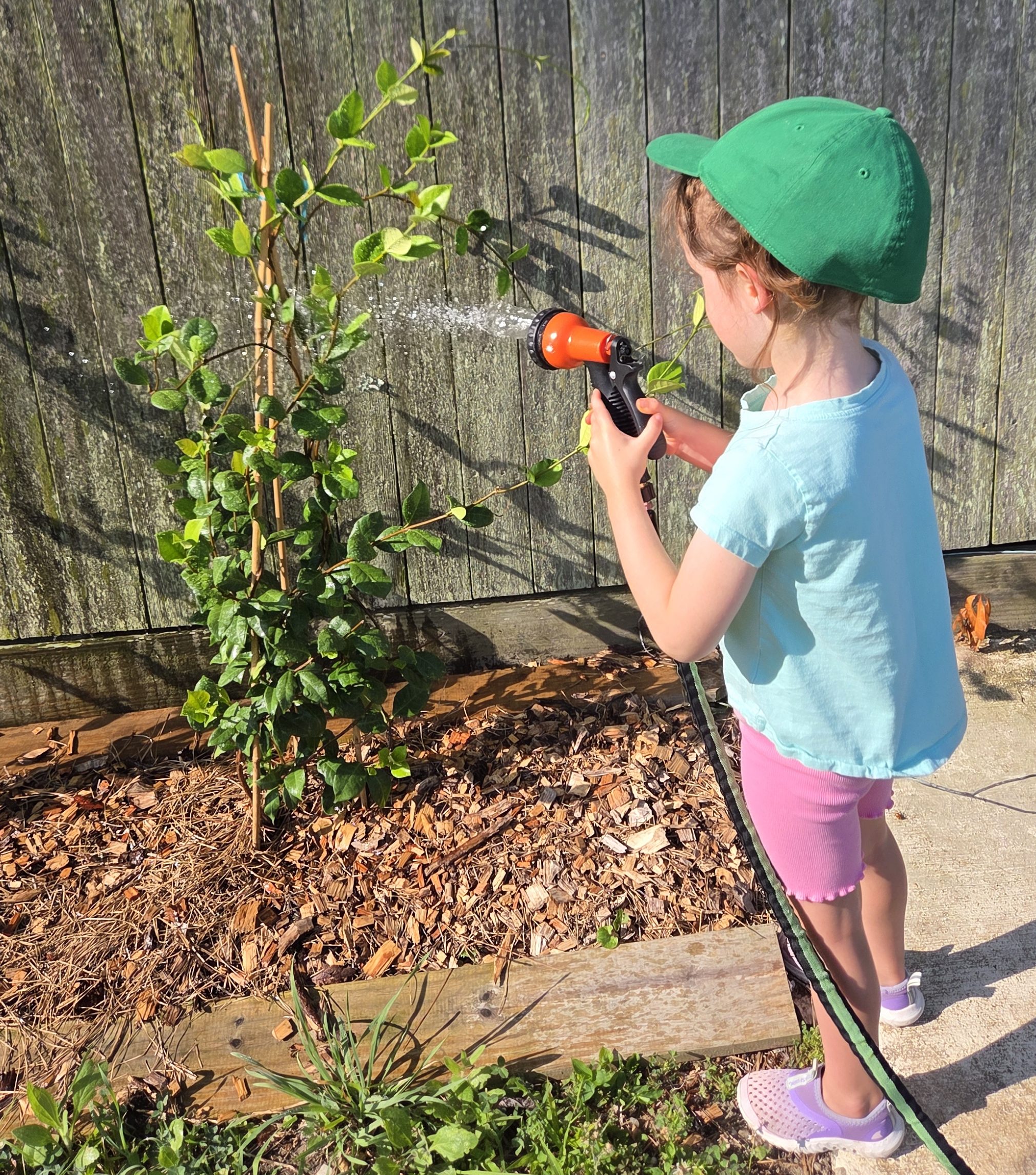
She Gets an “A” in Plant Watering
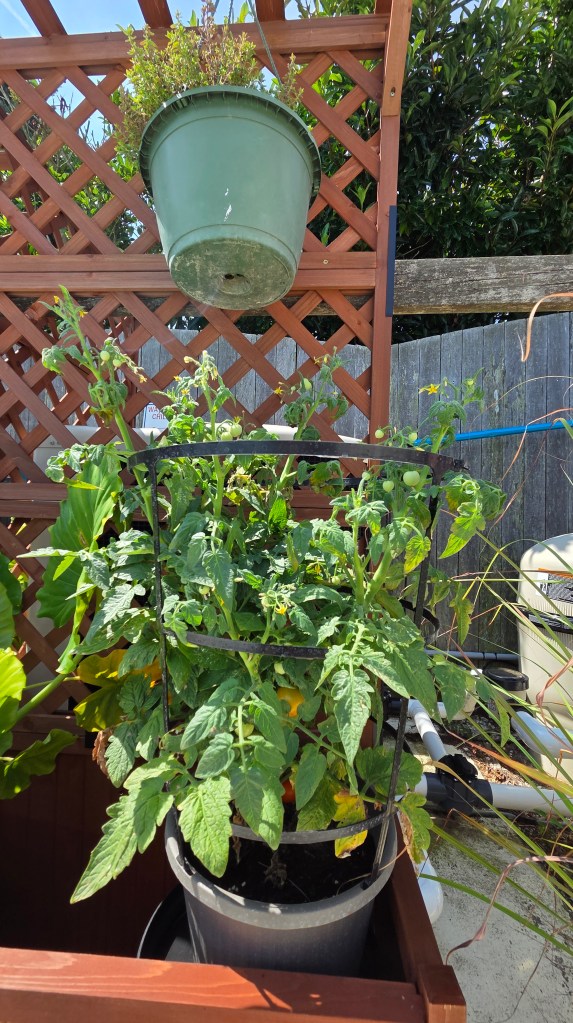
Around Buttervale, though, for the retired among us, the seasons just sort of roll into one another. Summer tomatoes give way to Thanksgiving broccoli. Flowers change. Birds come and go. Leaves will start falling. The worms keep pooping.
And tomorrow morning, we start counting down again.
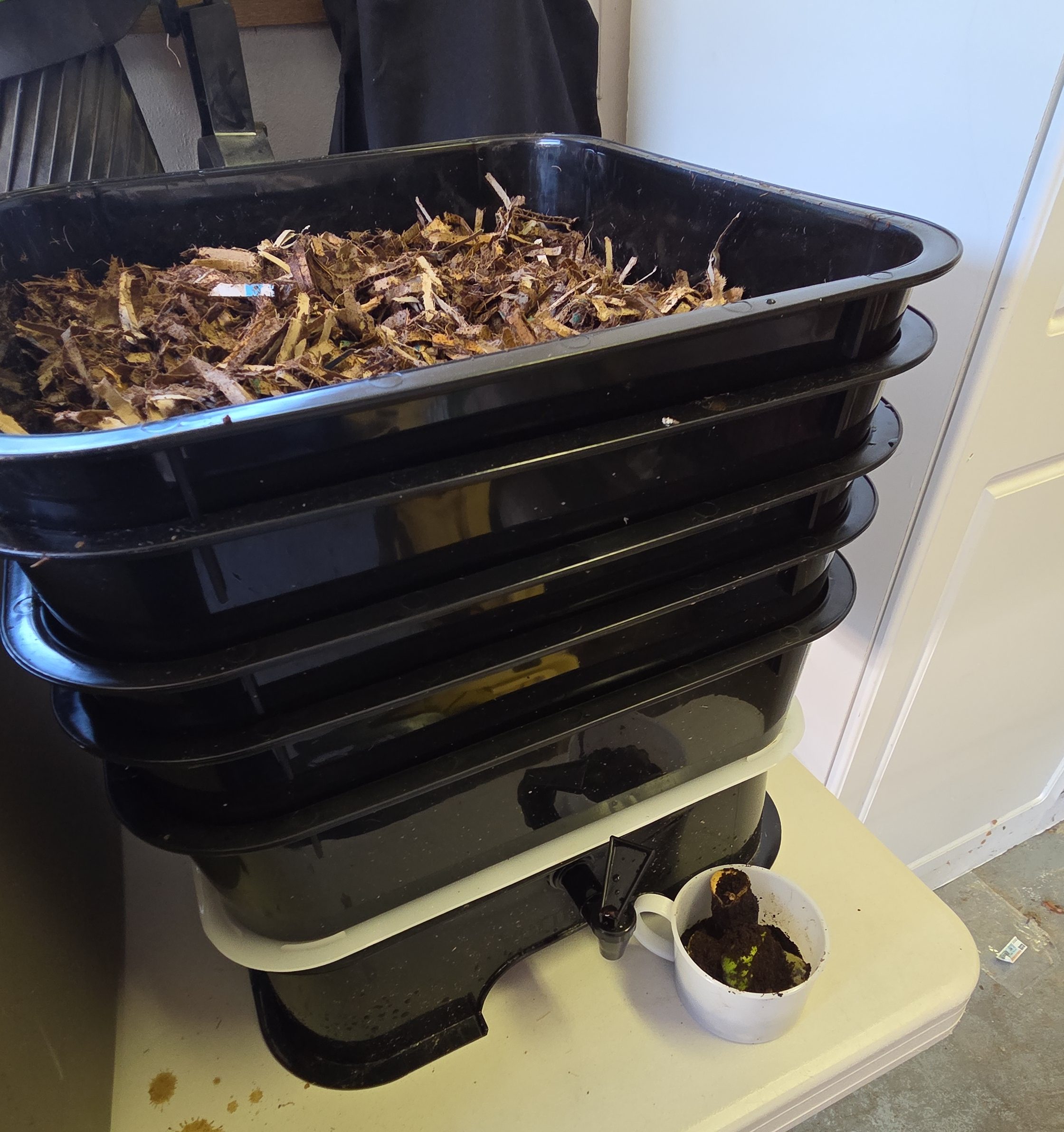
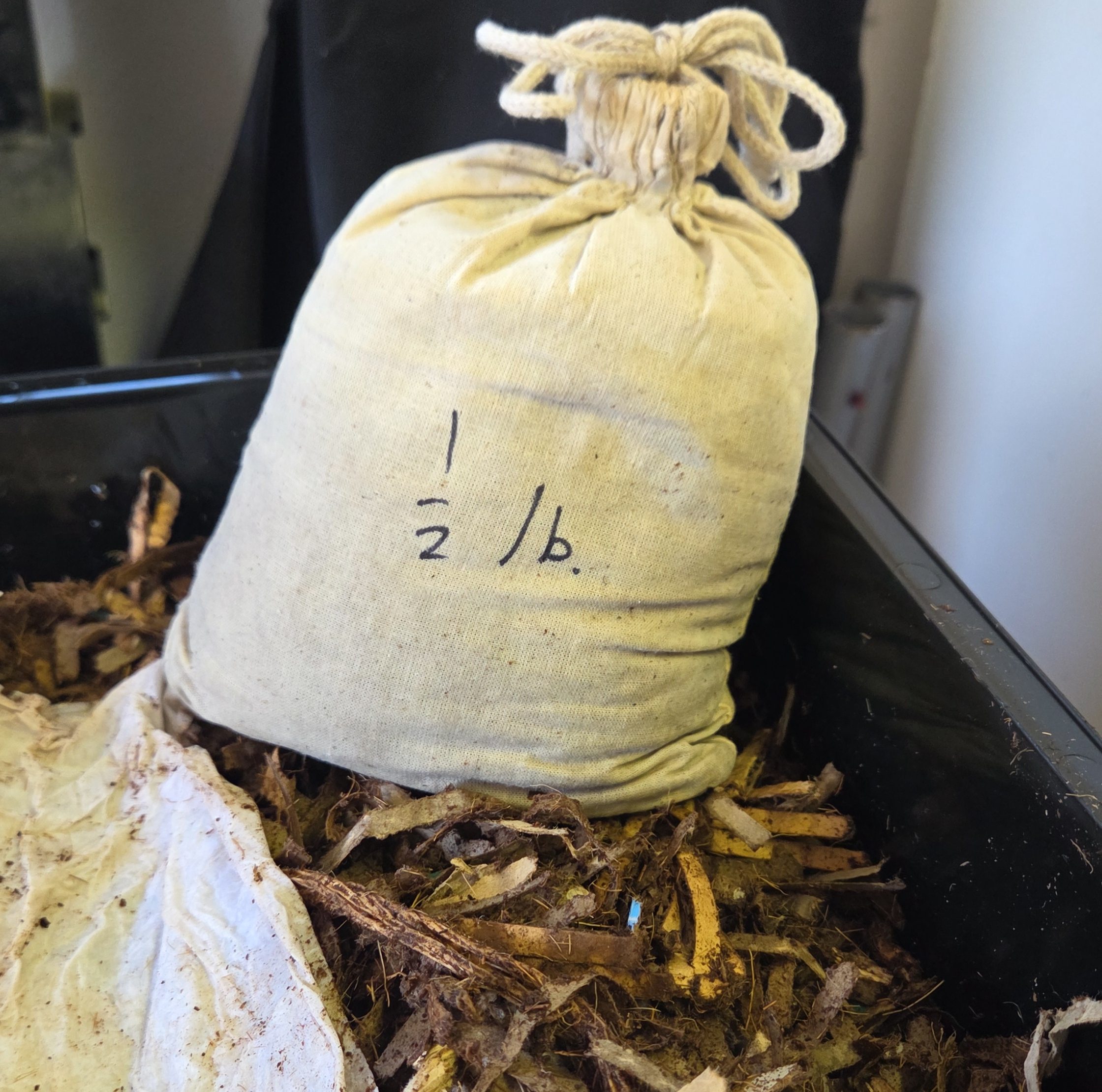
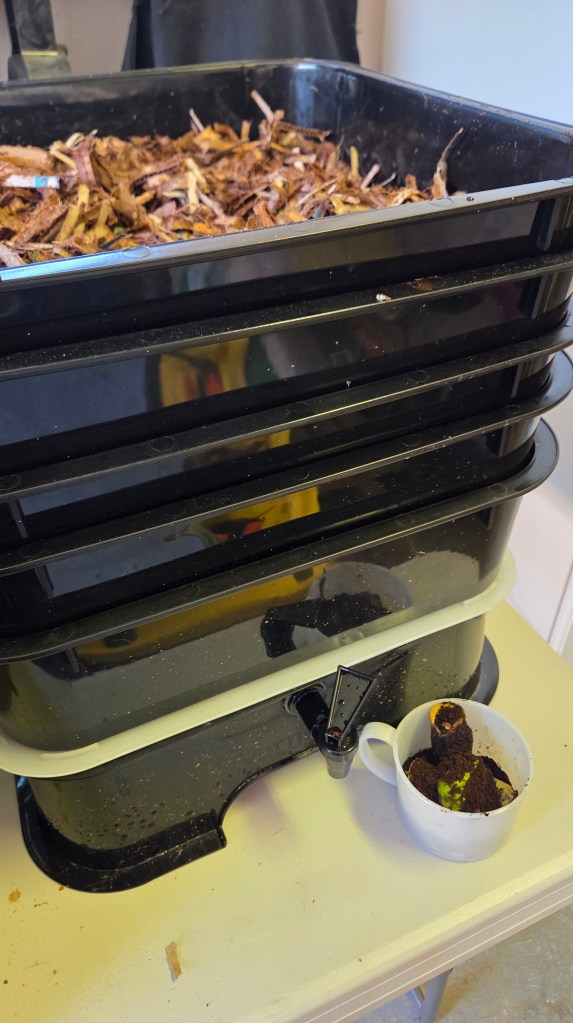
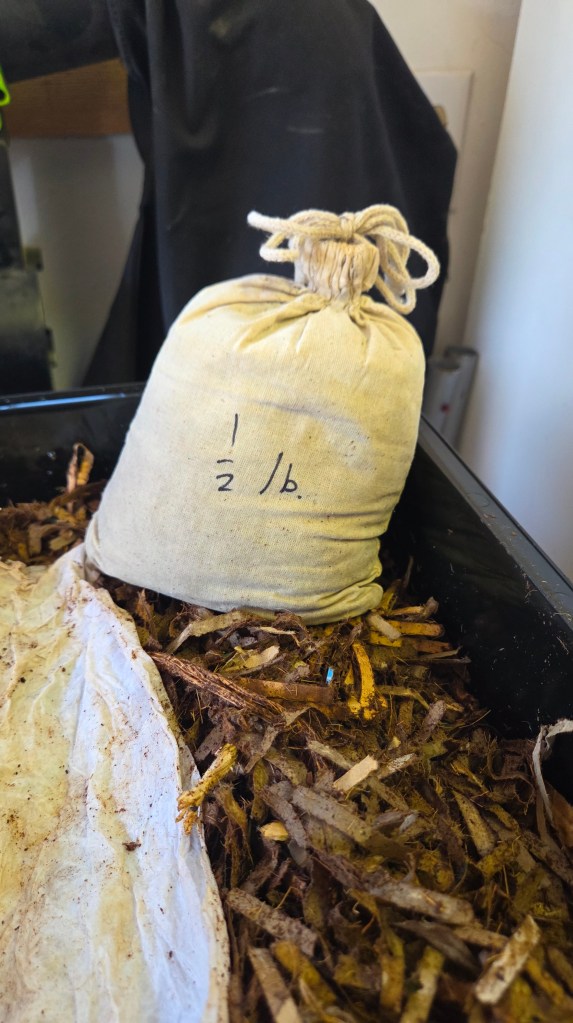
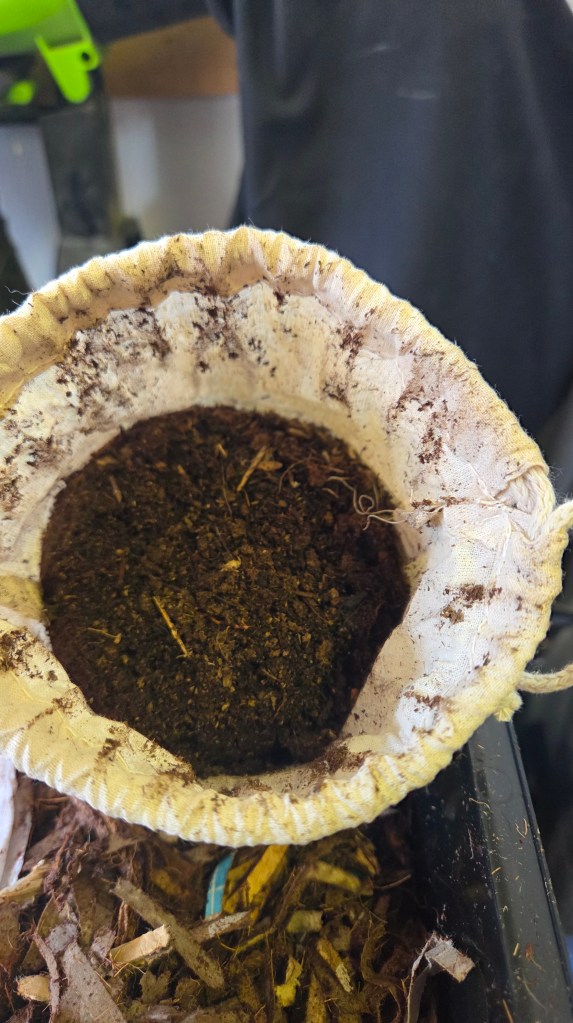
The first residents of the Buttervale Worm Ranch arrived today , about a half-pound of red wigglers, and they are officially moved into their new VermiHut.
For those unfamiliar with it, vermicomposting is basically composting with a workforce. Instead of waiting for a traditional compost pile to break down, red wiggler worms and the microorganisms living with them process kitchen scraps, cardboard and other organic material and turn it into incredibly rich worm castings.
Worm poop.
We’re harvesting worm poop.
And I’m surprisingly excited about it.
Move-In Day
Instead of sending all of that material out with the trash to the landfill, we’re going to try closing the loop a little bit:
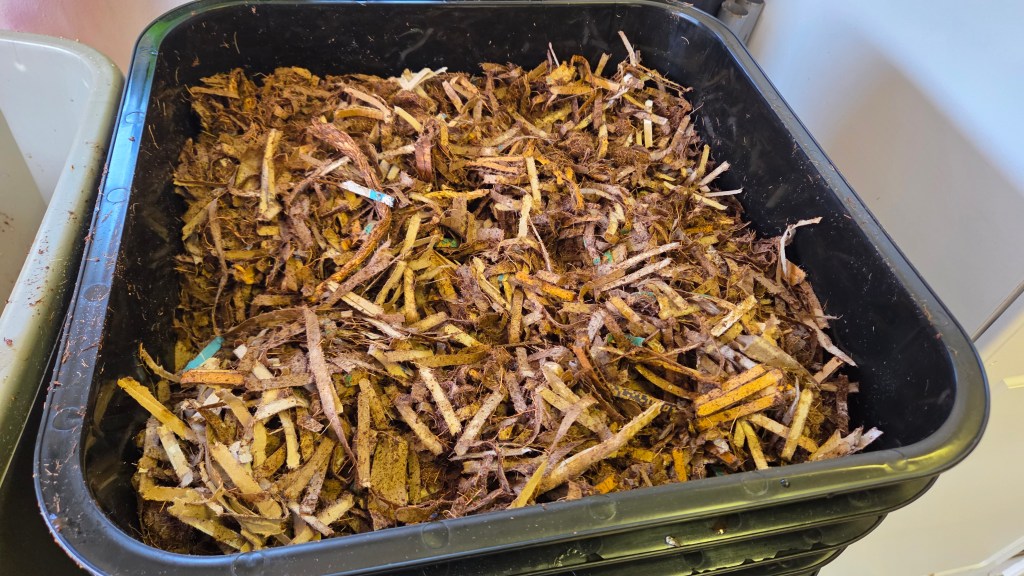
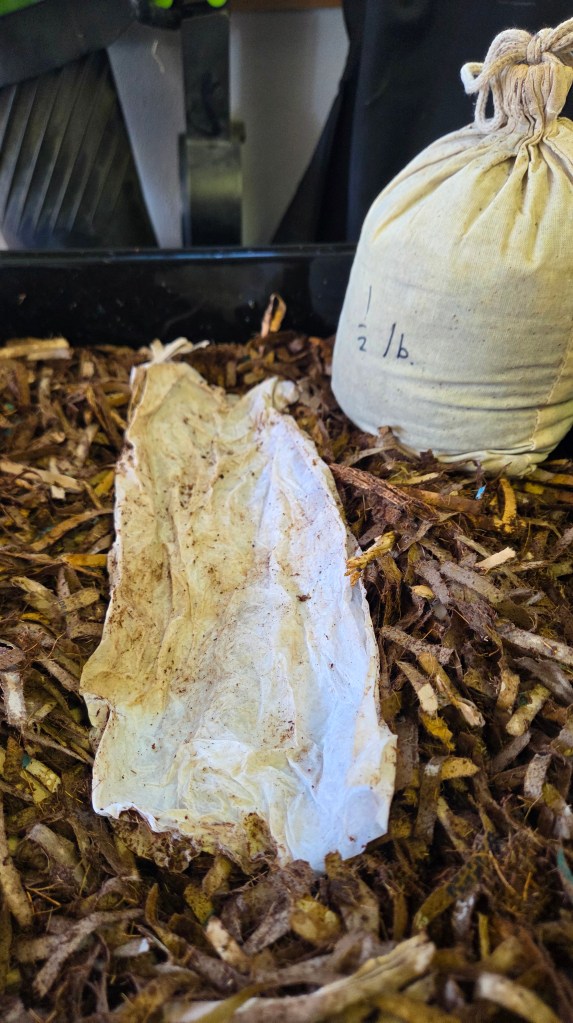
The new VermiHut has several stacking trays. I’ve loaded the lower trays with damp shredded cardboard to start breaking down and becoming biologically active, while our first half-pound of red wigglers gets established in the working tray at the top.
Eventually, as one tray fills with castings, we’ll start feeding in the next one and let the worms migrate through the system.
At least that’s the theory. I saw it on YouTube so it has to work, right?
For now my primary responsibility as a newly minted worm rancher appears to be keeping 500-ish worms comfortable and resisting the urge to feed them everything in the compost bin.
Their first meal, an apple core, some cucumber ends, coffee grounds and crushed egg shells.
Like most ranching, it takes care and patience.
If this works the way I hope, we’ll reduce some household waste, create a steady supply of excellent soil amendment for the gardens, and learn another little piece of building a more productive and sustainable Buttervale.
Worst case?
I now own several hundred worms. If they don’t pull their weight, I can always take them fishing.
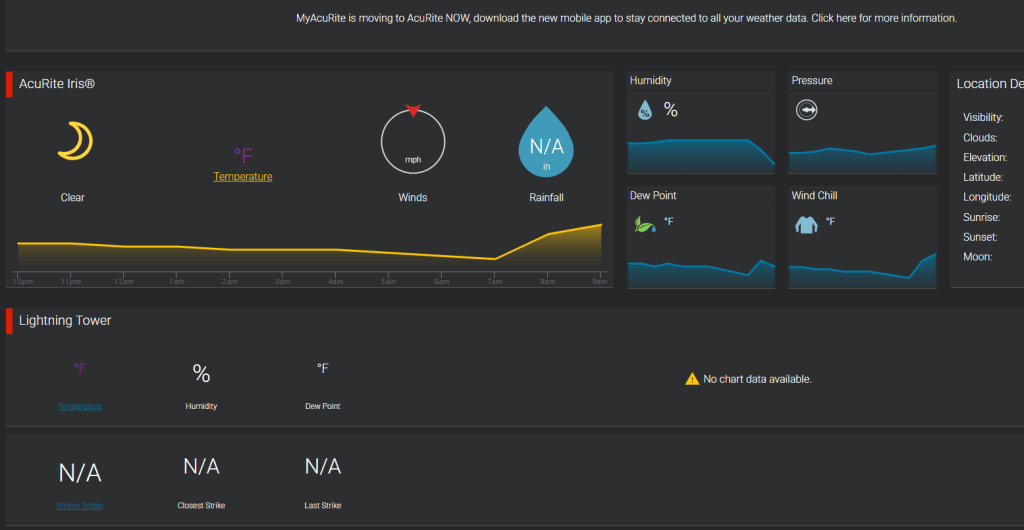
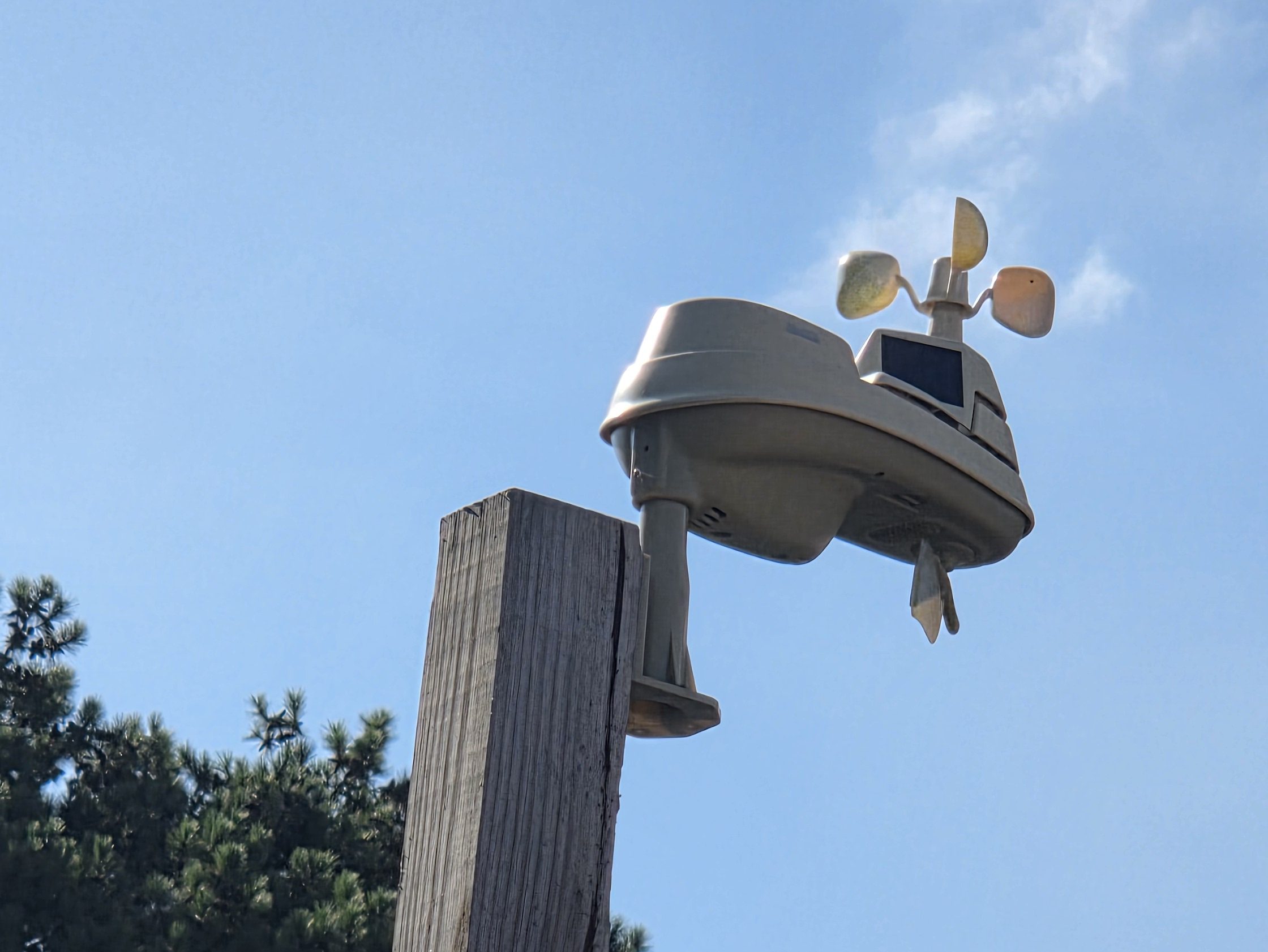
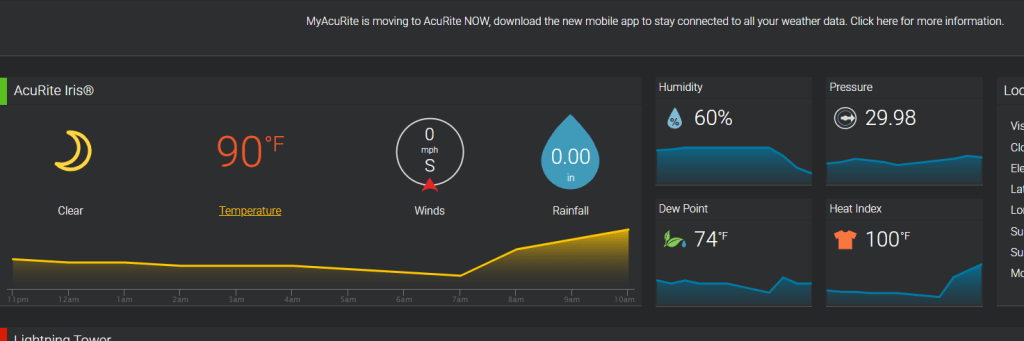
I try to use my very small corner of the Internet to be part of the solution. I don’t like ranting for no good reason. However, today, I am disgusted by the way Accurite, maker of my current weather station, is treating me and all of their user base.
So, are there any other AcuRite weather station users out there? I’m curious what you think of the new app and especially whether you were using the My AcuRite web dashboard before this “upgrade.”
Because I have to say, I’m pretty upset by this decision.
My weather station is only about two years old, and a big part of the reason I bought it was the ability to sit down at a computer, pull up the My AcuRite website dashboard, and actually look at my weather data on a real screen. Historical data, trends, graph, the whole thing. That was part of the product I bought. Part of why I bought it.
Now that access is gone.
Yes, I know I can see my data in the new app. It works. That isn’t the point. I do NOT want app-only access. I require a website. And I find the new app experience inferior to what I had with My AcuRite anyway.
And I did reach out to Support, but they replied:
“Thank you for contacting AcuRite!
We are working on a website for the future. However, as of right now AcuRite NOW is through the app. I do appreciate your feedback regarding the app.”
It is completely unacceptable to remove functionality people already had without providing a replacement. If you want to build a shiny new app, great. But why does “upgrading” have to mean taking useful features away?
This feels like yet another example of taking something that worked well and “evolving” it into a lesser product.
I guess, looking at it another way, I spent about $100 per year for two years of use from a weather station that is now essentially useless to me. The hardware still works. The sensors still work. The data is still there. But AcuRite has decided I can no longer access it the way I did when I purchased the product.
That is an incredibly poor corporate choice.
So, other AcuRite users:
Do you like the new app?
Were you using the web dashboard?
Are you as frustrated about losing it as I am?
I’m extremely disappointed, and I have been to Amazon to leave a review saying exactly that. At this point, it looks like a perfectly functional two-year-old weather station is going to be replaced, not because it broke, but because the company decided to make it less useful.
What a waste.
And for those of you NOT using AcuRite, I’d really like some suggestions.
If I’m going to replace a weather station that is only two years old, I want to make sure I don’t end up in exactly the same situation again.
What weather station are you using, and do you like it?
My biggest requirement at this point is a good web-based dashboard. I want to be able to sit down at my computer, open a website, and see current conditions, history, graphs and trends. A good phone app is certainly a plus, but app-only is a deal breaker for me.
I’d also like something where the manufacturer seems committed to keeping the data accessible rather than deciding a couple years from now that everyone should just use their phone.
So, Davis? Ambient Weather? Tempest? Something else?
If you have a home weather station you really like, especially if you regularly use its web dashboard, tell me what you have and what you like or dislike about it.
Apparently, I’m weather-station shopping again.
UPDATE:
I did get the following reply from Support:
I do appreciate your feedback regarding the app. As of right now, we only have the App available. We are working on the website for the future. The move to AcuRite NOW is about transitioning to a newer connected platform that gives us a stronger foundation for future product development, improved app experiences, and expanded smart home capabilities.
We understand that some features from the legacy My AcuRite platform may work differently or may not carry over in the exact same way. That is not something we take lightly, especially for long-time AcuRite users who have relied on those features.
The benefit of moving to AcuRite NOW is that it gives users access to our current and future connected weather station experience, including a modern app platform, expanded connected-home possibilities, continued cloud access to weather data, and optional NOW+ features such as Weather Underground sharing and up to one year of weather data history.
Do you see it? “Optional NOW+ Features” So, this is all just setting up for a future money grab, I’ll get my website back eventually, but probably have to pay for it.
My Reply:
Thank you for the response. I appreciate that you are working on a website for the future, but I think this misses the central issue with my complaint.
AcuRite REMOVED a feature from a product I already purchased BEFORE its replacement was available.
The web dashboard wasn’t some obscure feature I occasionally used. It was a significant part of how I used my weather station. I purchased a connected weather station with both web and app access. The hardware is only about two years old, it still works perfectly well, and yet a major part of its functionality has now been removed until some future time.
I understand the reasons you have given for moving to a new platform. I worked in IT for over 30 years. A stronger foundation, future development, smart-home capabilities, and an improved app may all be worthwhile goals. But none of those things required shutting down the existing web access before the new web experience was ready.
And respectfully, describing this as a familiar feature that “changes” understates what happened. It didn’t change. It was removed.
I can see my weather station in the new app. I understand that. But I do not want an app-only weather station. I regularly used My AcuRite from a computer, and the new app is, for my purposes, an inferior experience.
I’m also concerned by the reference to optional NOW+ features. I already purchased the hardware and had access to my historical weather data. If features I previously had are eventually restored but placed behind an additional subscription, that would make this even more disappointing.
Had AcuRite launched the new app, kept My AcuRite available, and then retired the old platform once a comparable web dashboard was ready, I would have understood the transition completely. Instead, you’ve taken away functionality first and are asking customers to wait for some unspecified point in the future to get it back.
That’s the corporate decision I find unacceptable.
Can you provide any actual timeline for the new web dashboard? Are we talking about weeks, months, or sometime next year? And will the new website restore the web-based functionality that My AcuRite users previously had without requiring an additional subscription?
Those answers will determine whether I wait for AcuRite to fix this or replace a perfectly functional two-year-old weather station with another brand.
UPDATE 2:
I have no additional word from Support, but as of about 30 minutes ago, the Website Dashboard IS back up. Hopefully other people complained and it will stay up until the new site is ready.
UPDATE 3:
Nothing useful to add from what is likely their last reply. Clearly, they are moving to a much deeper subscription service. I get it, That IS the way of the World, but I am still going to refresh my hardware and look for an option that I can keep my data local and if I doo decided to subscribe for premium services, I will go into it with eyes wide open and not work with a Company that has demonstrated their lack of concern for current customers.
Their reply:
I do appreciate your feedback and have noted this for our developers.
I can not give you a time frame on this as it has not been released when the actual shut down is. Also, I do not have a timeframe on the website itself. I also do not know any type of function it would have. I do know that most of the upgrades will be part of the subscription based AcuRite NOW+.
Yes, the My AcuRite is working again it was just an outage.
Please let us know if you have any further questions!
An outage? The New App was working, but the Old App and the Web Dashboard were suffering an “outage”? Why not tell me that in the very first email? Seems a little fishy to me. I will be researching other options.
How Much Can We Produce for Our Thanksgiving Table?
There are 105 days until Thanksgiving.
And I’ve decided to ask a question:
How much of our Thanksgiving dinner can be produced right here at Buttervale?
Not because I think the grocery stores are going to fail. Not because I’m planning to become completely self-sufficient.
Certainly not because growing a carrot in the backyard is necessarily cheaper than buying a bag of them at the supermarket.
I am a little scared to do the math on that, to be honest. I don’t need to know I am eating a $70 carrot.
Healthier. Tastier. Better for the environment. Far more rewarding. Yes to all.
Definitely not cheaper.
In the end, I’m doing this because I think knowing where our food comes from matters.
I think food security matters.
I think teaching our children and grandchildren where food comes from matters.
And I think these thngs matter more every single day.
The Thanksgiving Garden
The idea started rather simply.
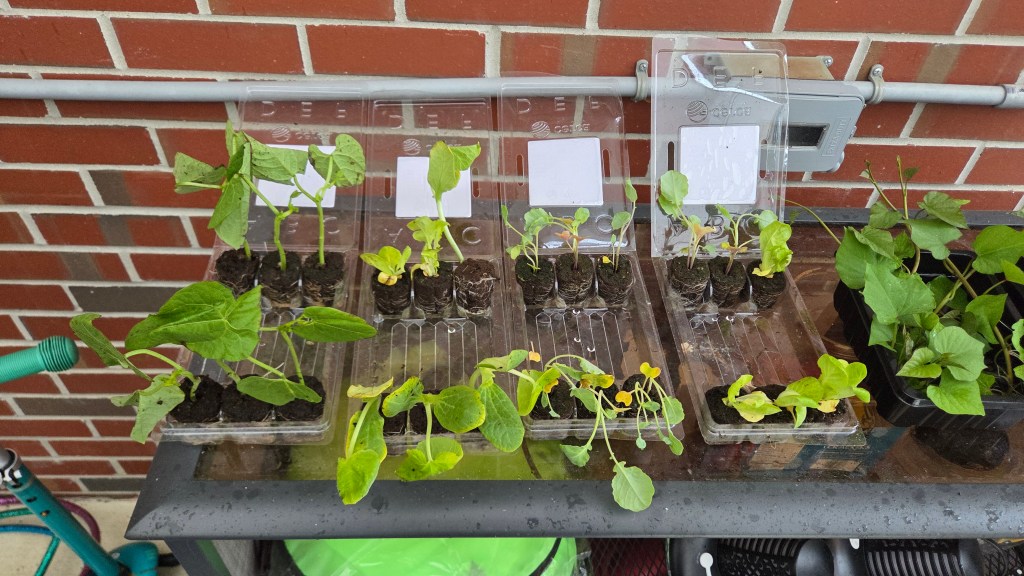
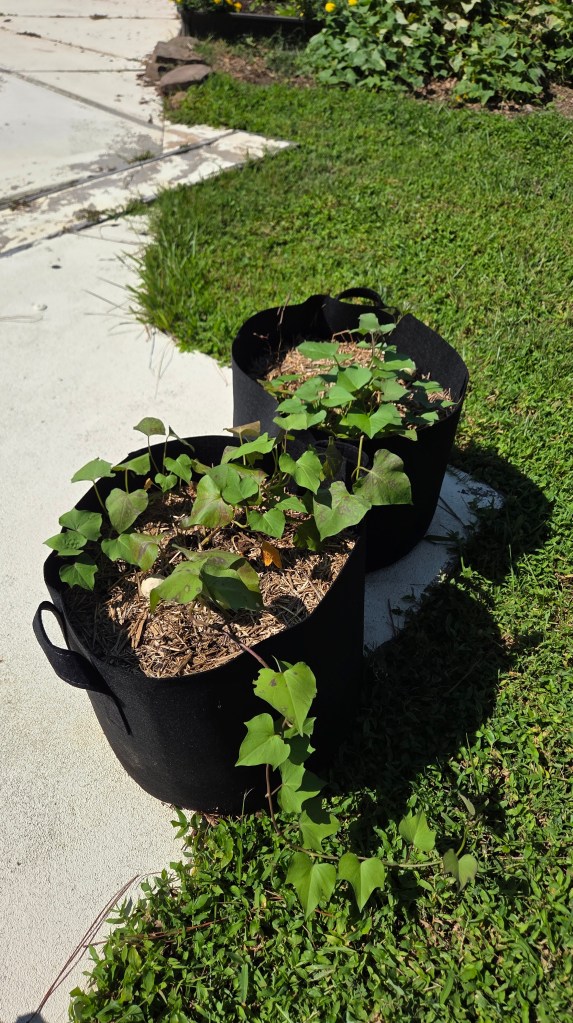
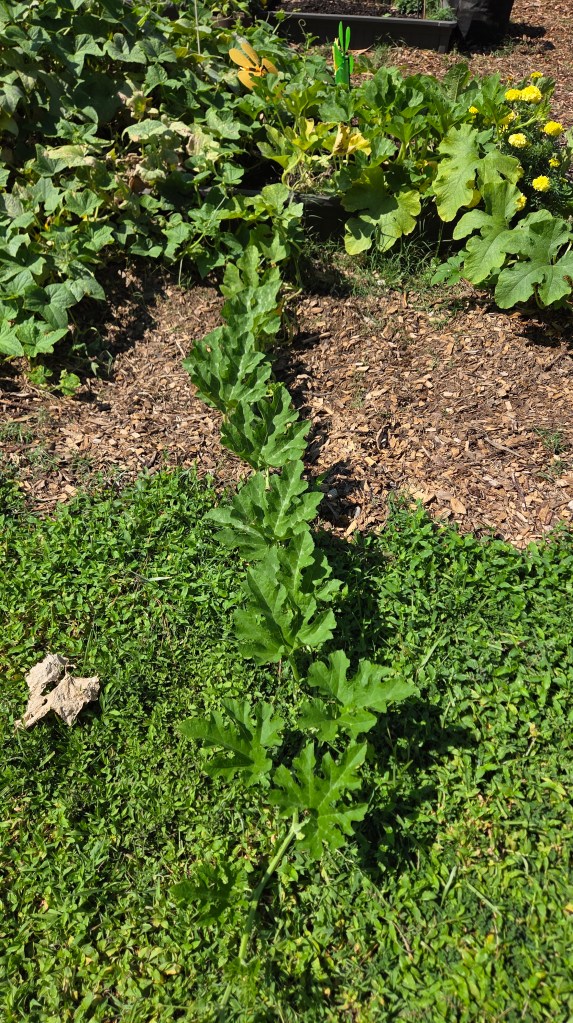
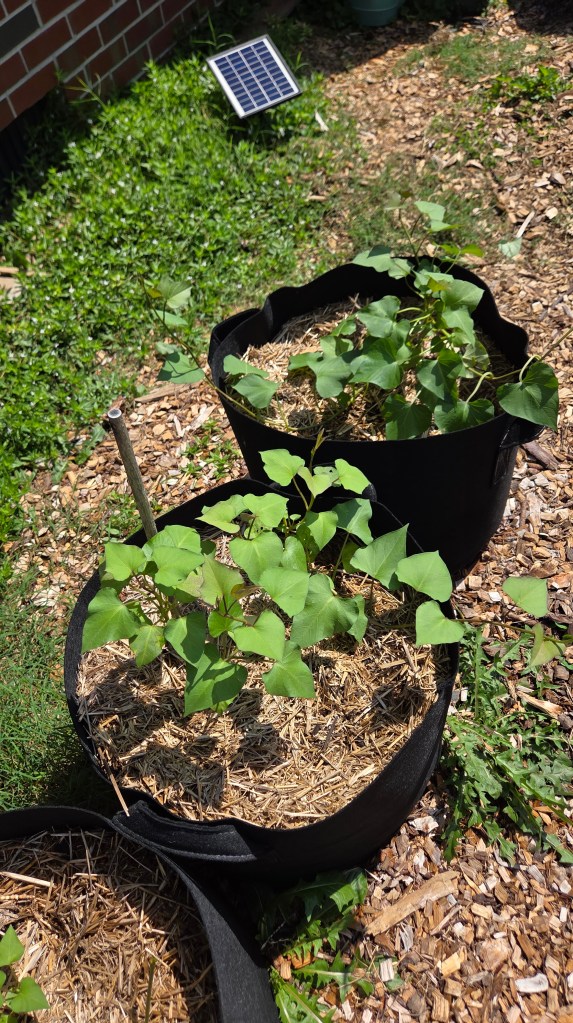
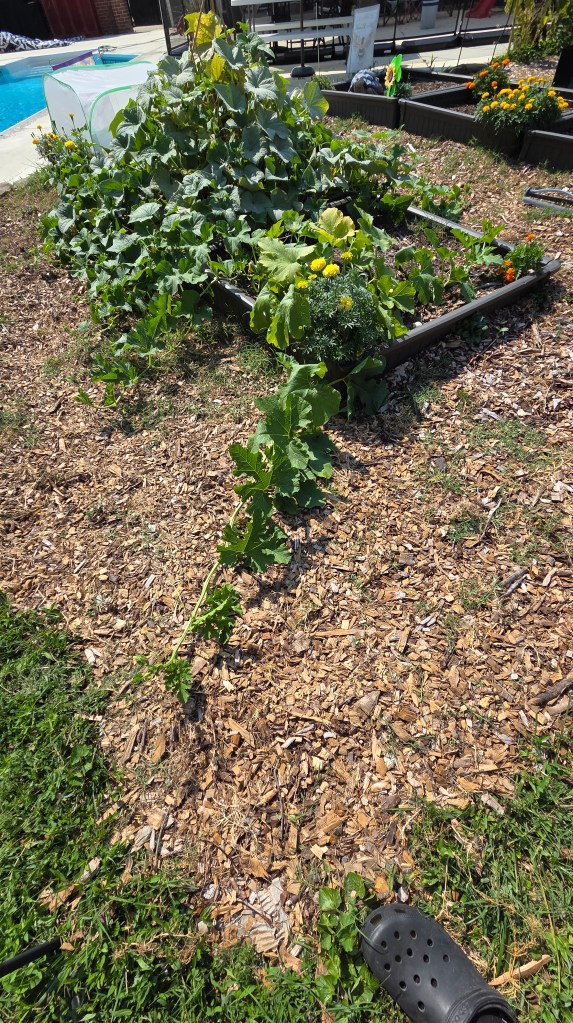
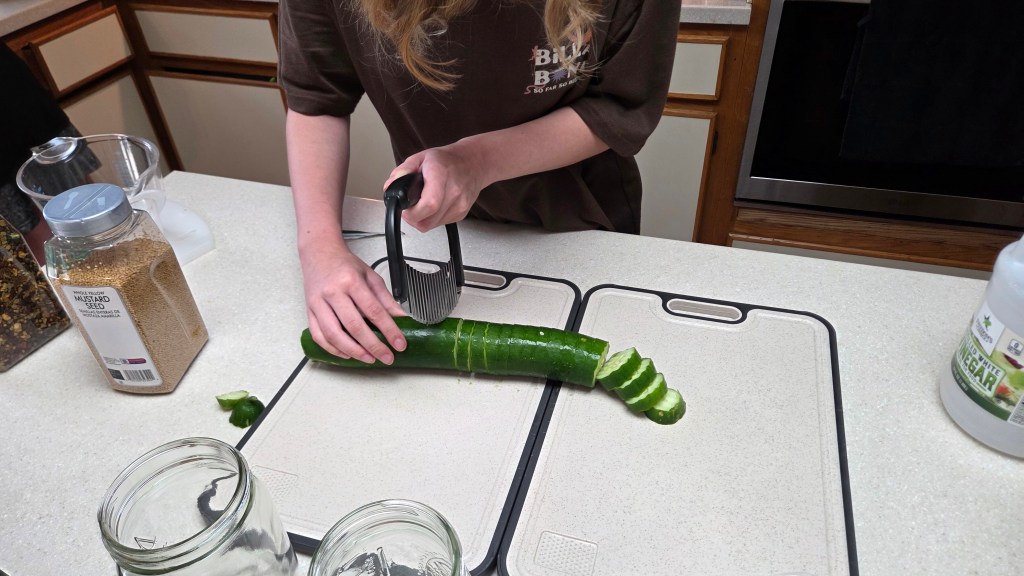
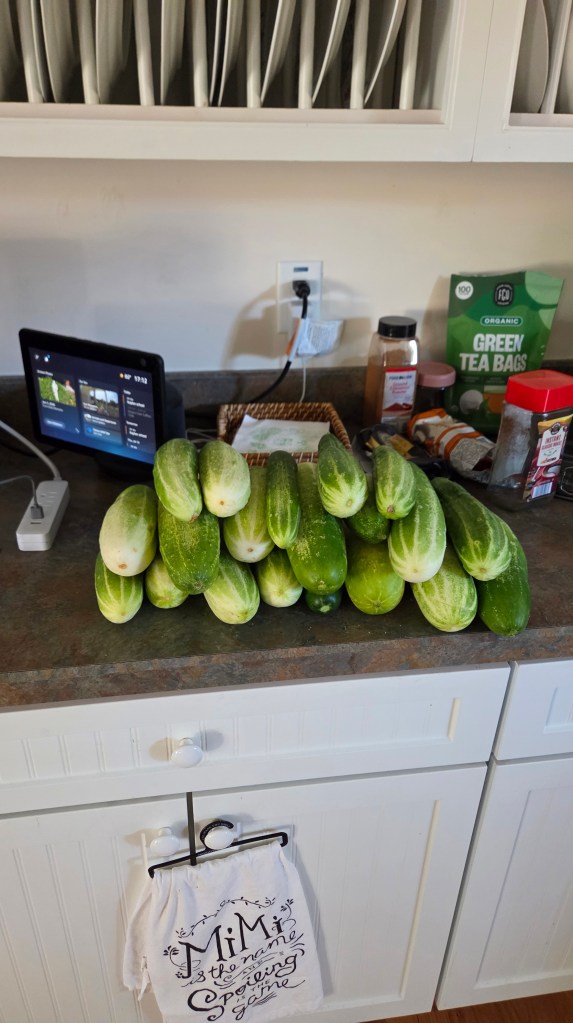
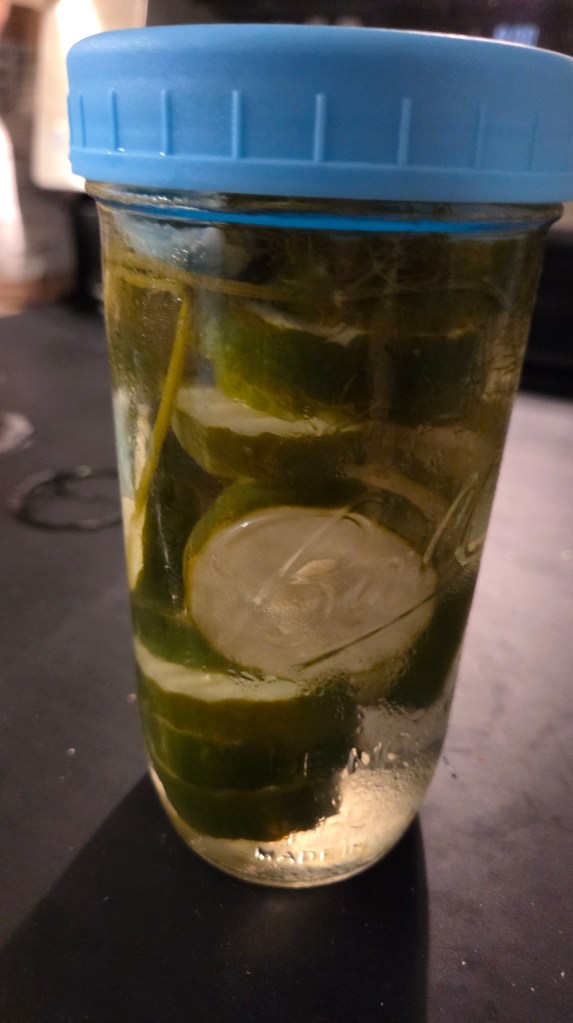
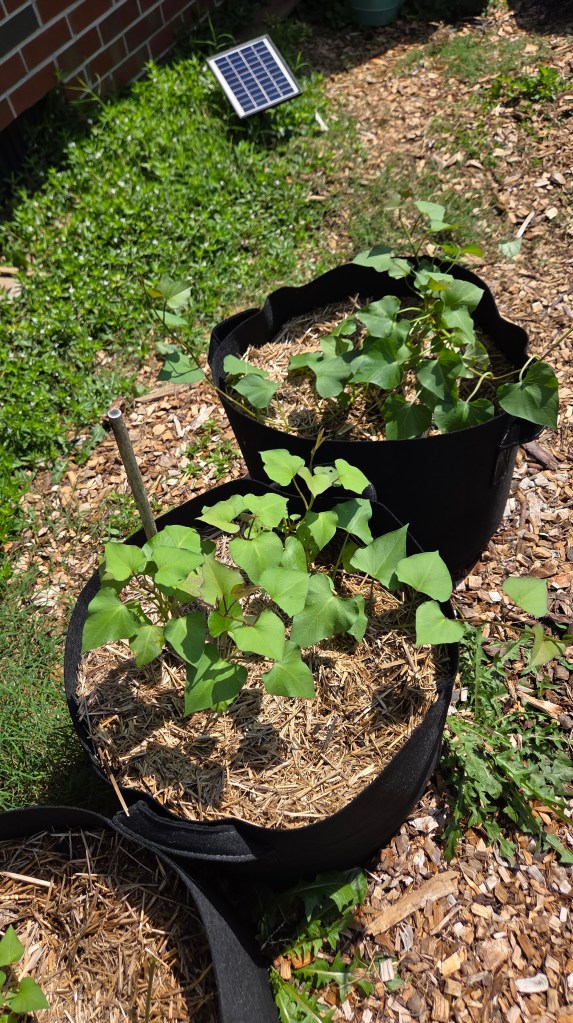
I already had sweet potatoes growing. There were bush beans in the garden. Pumpkins were spreading across the yard. Cucumbers had already become quarts of homemade dill pickles.
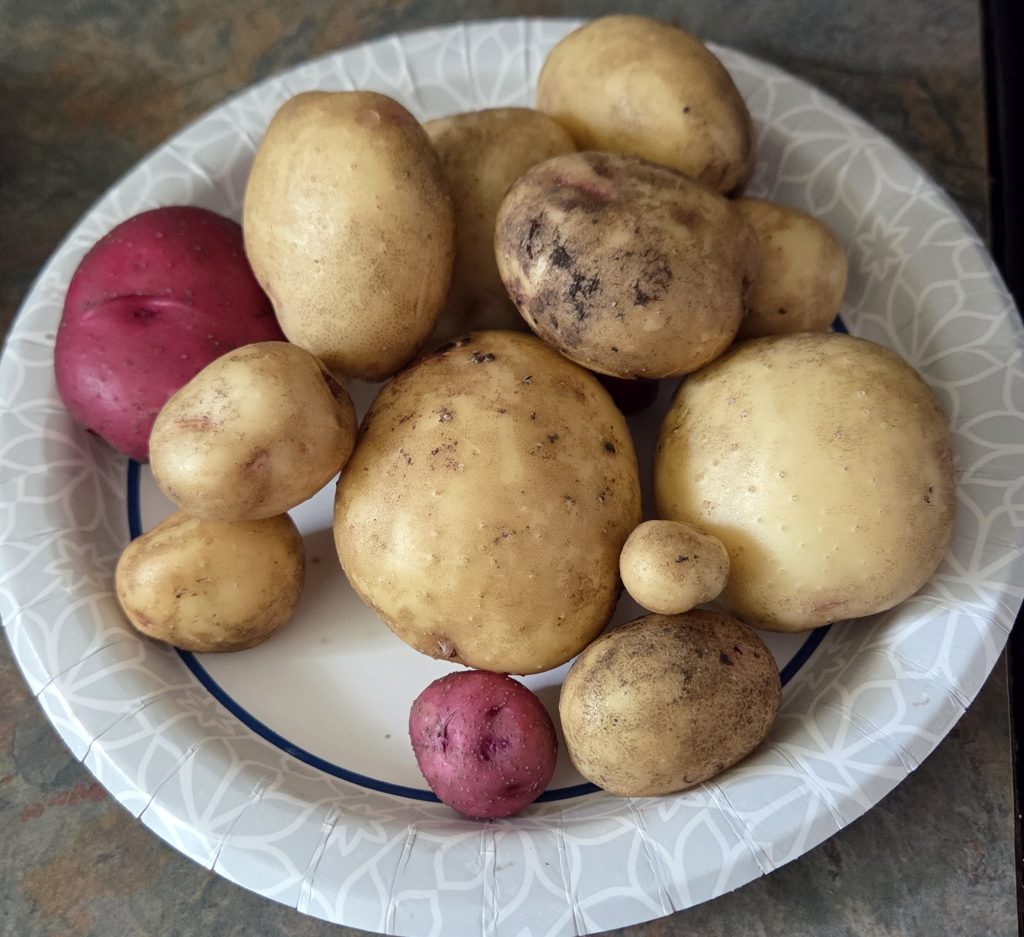
Then I ordered some fantastic, organic potatoes from Maine, specifically with Thanksgiving in mind.
That got me thinking.
Why stop there?
I have seeds for carrots, kale, Swiss chard, spinach, lettuce, radishes and cabbage. We’re adding broccoli. There are empty raised beds waiting to be planted and plenty of grow bags.
Suddenly this wasn’t just the Fall vegetable garden.
It’s the Buttervale Thanksgiving Garden.
The goal isn’t necessarily to produce everything we eat on Thanksgiving.
The goal is to see how much we can produce.
That’s the experiment.
Can the mashed potatoes come from the backyard?
What about the sweet potato casserole?
The green beans?
Carrots?
Greens?
Could the pumpkin in the pie have grown 30 feet from the kitchen where the pie is baked?
And then there are the things that don’t have to come from a garden at all.
What if the bread or rolls are baked from scratch?
What if the pie crust isn’t pulled from a freezer?
What if the herbs come from just outside the kitchen door?
I have parsley, sage, rosemary and thyme growing.
Taking the idea another step or two, it is easy to watch people with a little more property raise chickens and put their own eggs into those pies and breads. Some families raise turkeys, pigs, cattle, goats or sheep. Others preserve summer tomatoes, make their own jam, can green beans, freeze corn, make pickles, dry herbs or put away fruit from their trees.
Generically, I guess we call those people farmers and it seems to me that they are a dying breed.
Very few of us are going to produce everything we eat. (I am never going to grow coffee or chocolate, so there’s that.)
However, far too few of us produce even one thing we can eat.
How much could we produce?
This year? Next year? in ten years?
Can it be a standing challenge to see if, every year, we can produce a little more for our Holiday?
Perhaps the more interesting question is:
Does it matter?
I Like to Think It Does
Most of us have become remarkably disconnected from our food.
Potatoes come in bags from the grocery store.
Green beans come in cans and get mixed with soup from a can and sprinkled on top with fried onions from a can.
Corn from the freezer.
Bread comes from a truck wrapped in plastic.
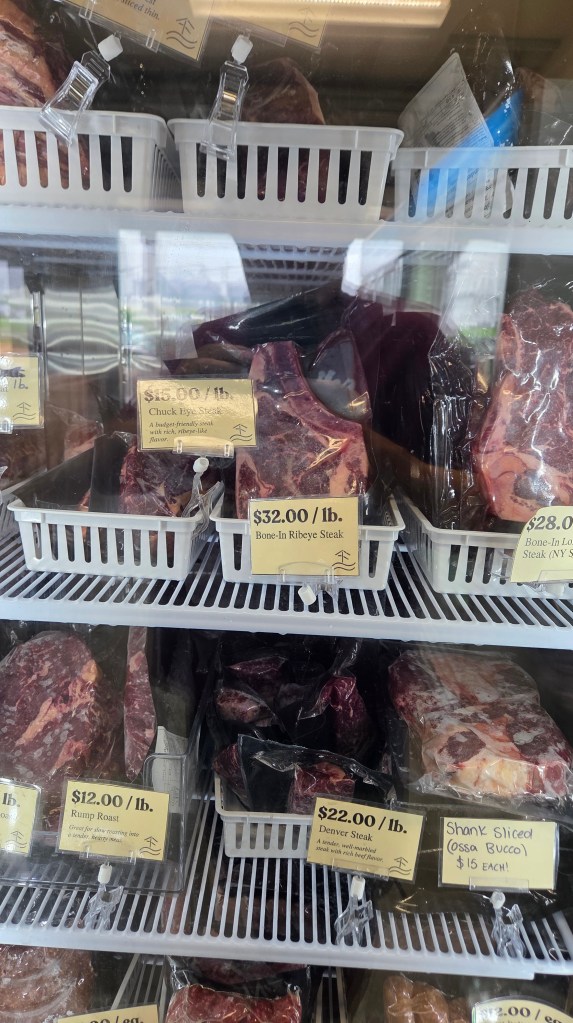
Meat comes neatly vacuum packed or packaged on a foam tray. From where? South America or down the road?
An example for locally sourced meat from Cullipher Farms in Virginia Beach.
It’s all so incredibly and amazingly convenient, and I’m certainly not giving up grocery stores. The fact remains, though, that our logistics are so finely tuned and “just in time” that if any cog in that machine fails, our grocery store shelves can be empty in just a few days. Picture the bread aisle in Virginia Beach the day before the blizzard arrives. It is a little scary.
Beyond that, something gets lost when food becomes nothing more than another thing we pick up on an errand. “Going to stop by the store, need anything?” “Alexa…add hummus to my Grocery List.”
Growing even a small portion of our own food changes that relationship.
You discover that a carrot takes months.
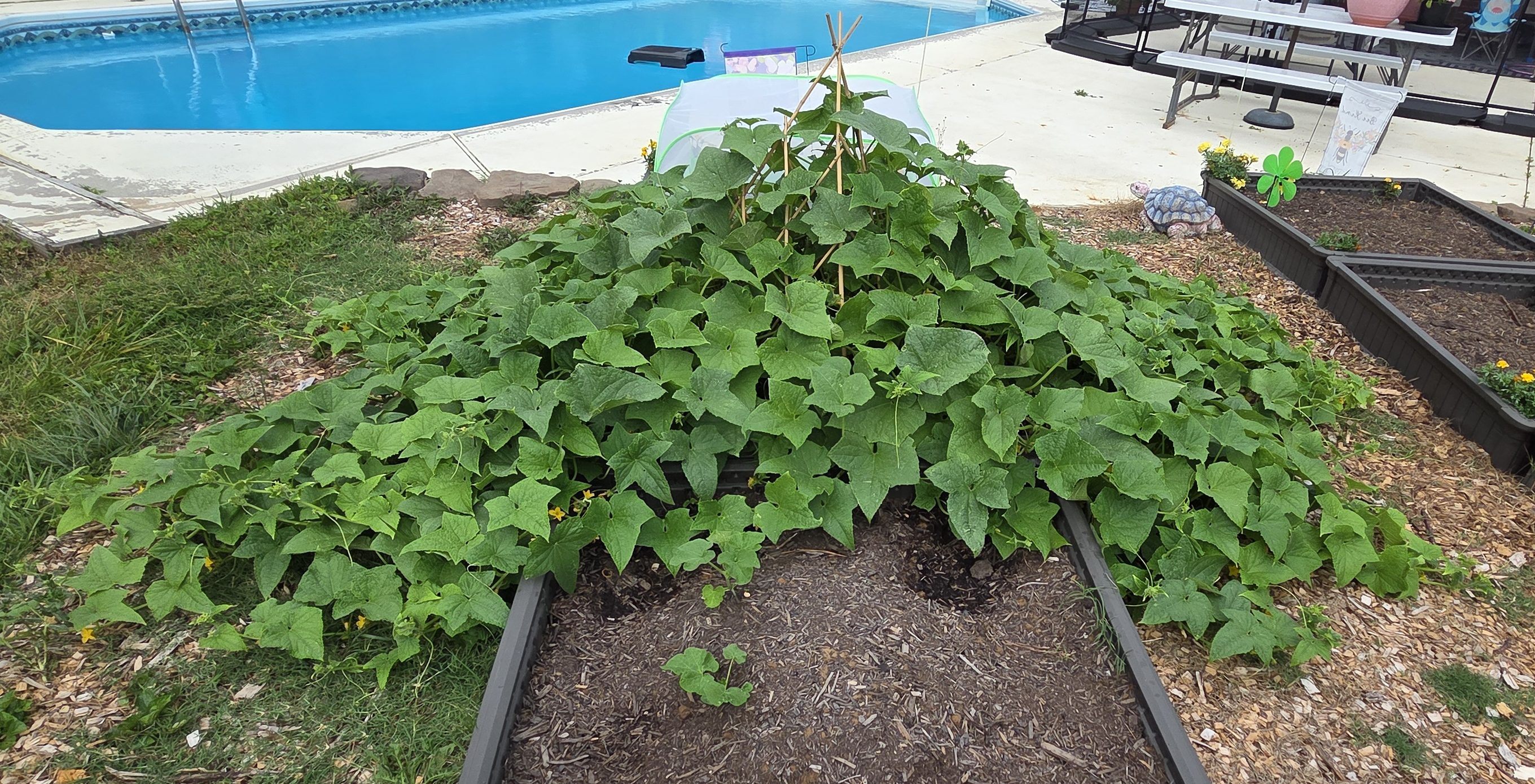
Cucumbers will take over all the land you give them.
A potato begins with another potato.
Broccoli doesn’t magically appear as a perfect green crown.
Pumpkins require space, water, sunshine, pollinators and an astonishing amount of vine.
Sometimes crops fail.
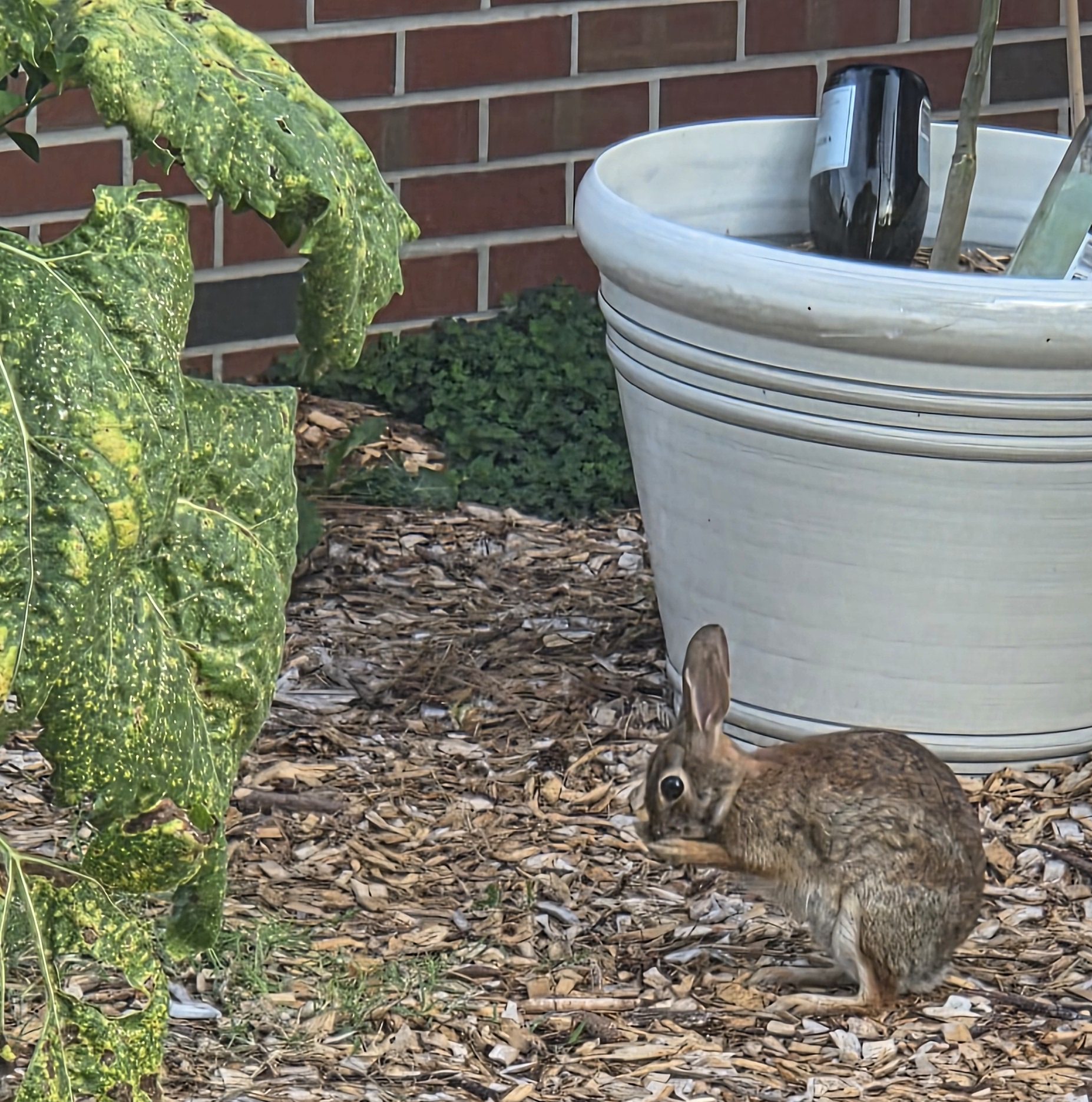
Sometimes rabbits eat them.
Sometimes bugs arrive before you do.
And sometimes you walk outside, pull dinner out of the dirt and think:
I made that.
Well, technically nature did most of the work.
But I helped. (In my Shake-n-Bake Girl voice.)
Self-Sufficiency Doesn’t Have to Mean Self-Sufficient
Unfortunately, I think we’ve made the idea of self-sufficiency unnecessarily intimidating.
You don’t need 40 acres and a mule.
You don’t need a barn.
You don’t need to raise livestock or give up electricity and start churning butter. (Unless you want to?)
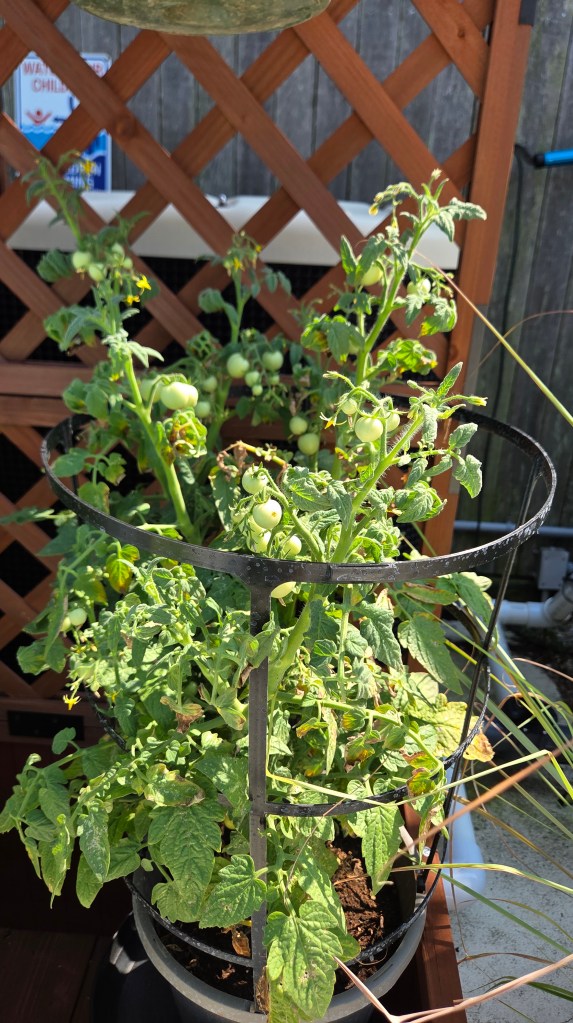
Self-sufficiency can be a tomato plant on an apartment balcony.
It can be six hens in a suburban backyard.
It can be learning to bake bread from scratch.
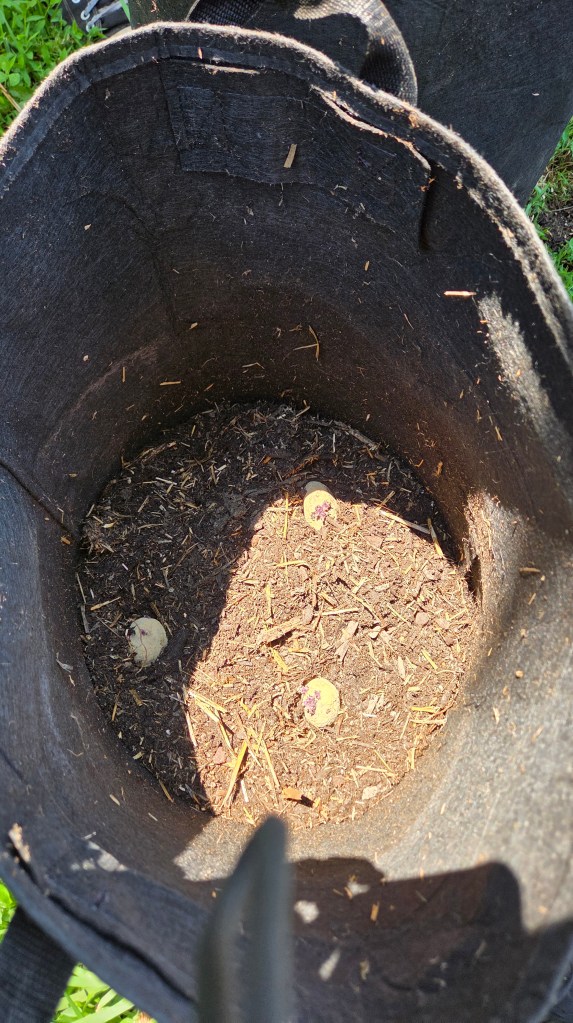
It can be growing potatoes in a 15-gallon fabric bag.
It can be planting an apple tree knowing you will wait years for the first apple.
It can be making pickles from cucumbers you grew yourself.
Every one of those things teaches us something our grandparents and great-grandparents largely understood as part of ordinary life:
Food comes from somewhere.
Someone has to grow it.
Someone has to raise it.
Someone has to harvest it.
Someone has to prepare it.
Then There’s Gratitude
That’s where Thanksgiving makes this experiment particularly meaningful to me.
Thanksgiving is supposed to be about gratitude.
It’s remarkably easy to say grace over a table filled with food and hurry along to get to the football game.
It’s a little different when you’ve watched some of that food grow. When you have nurtured it.
I planted these potatoes.
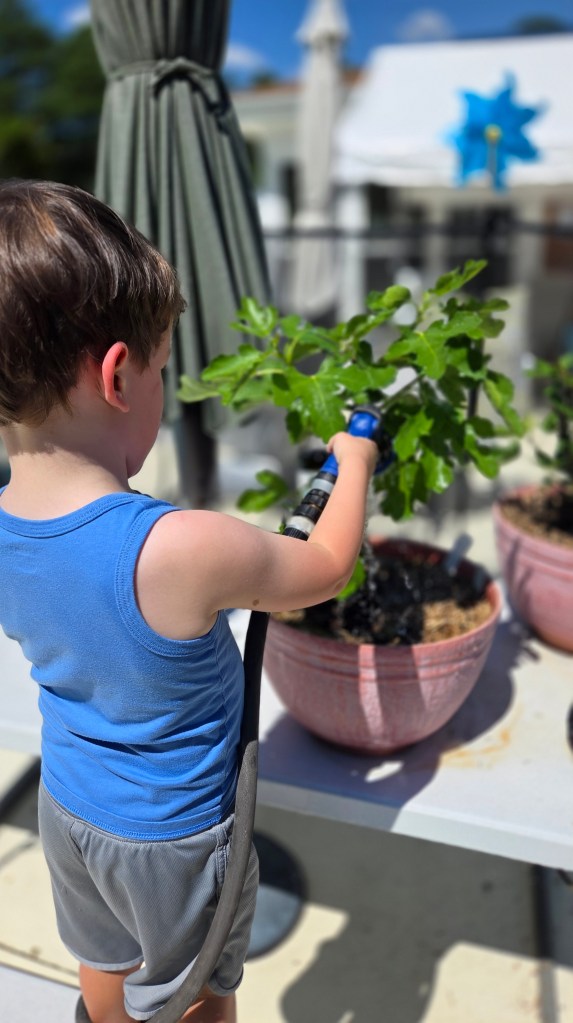
I watered those sweet potatoes through August and covered them every night to keep the rabbits at bay.
I watched that pumpkin develop from seeds my grandchildren pressed into the gound.
I fought the bugs for those green beans.
I planted those tiny carrot seeds and waited and waited and waited.
Suddenly our food represents time.
And work.
And weather.
And soil.
And water.
And a little bit of luck.
And God. (or Earth Mother, Gaia, Pan, Mother Nature, Anima Mundi. It is hard not to feel the presence of a higher power with my hands in the dirt. No matter what name you choose.)
Maybe growing food doesn’t just make us more self-sufficient.
Maybe it makes us more grateful.
105 Days
So that’s the challenge.
Between now and November 26, I’m going to keep asking one question:
How much can I produce for my Thanksgiving table?
Some things will work.
Some undoubtedly will NOT.
The rabbits will definitely get a vote.
The weather certainly will do what I don’t want it to.
Still, on Thanksgiving Day, we’ll take inventory.
How many things on that table came from our own backyard?
How many were made from scratch?
How much did we learn?
Did knowing where some of our food came from change the way we felt about the meal?
I suspect it will. I hope it will.
Because the Thanksgiving Garden isn’t really about producing dinner.
It’s about understanding just how much goes into producing dinner and being just a little more Thankful for every bite of it.
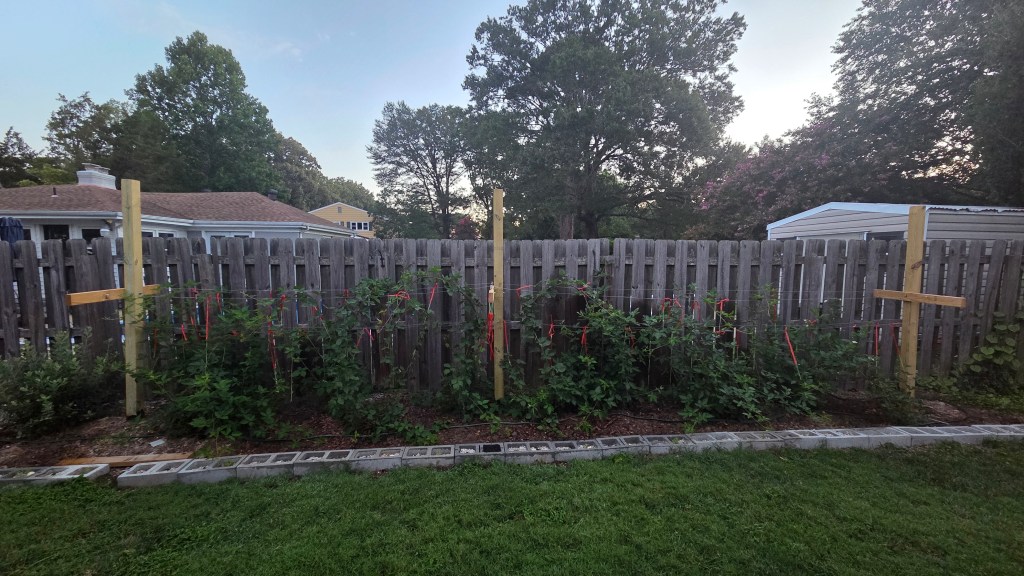
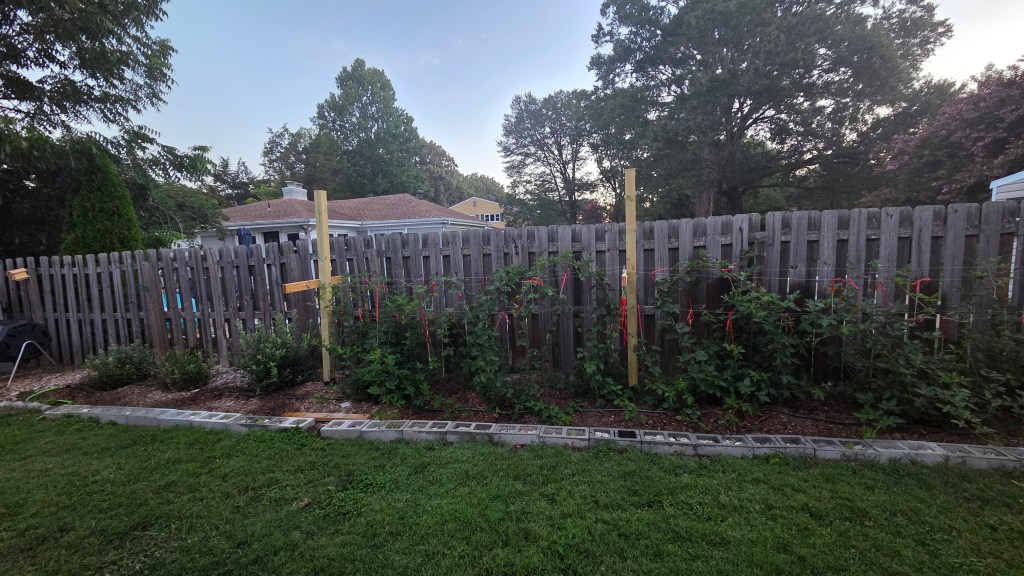
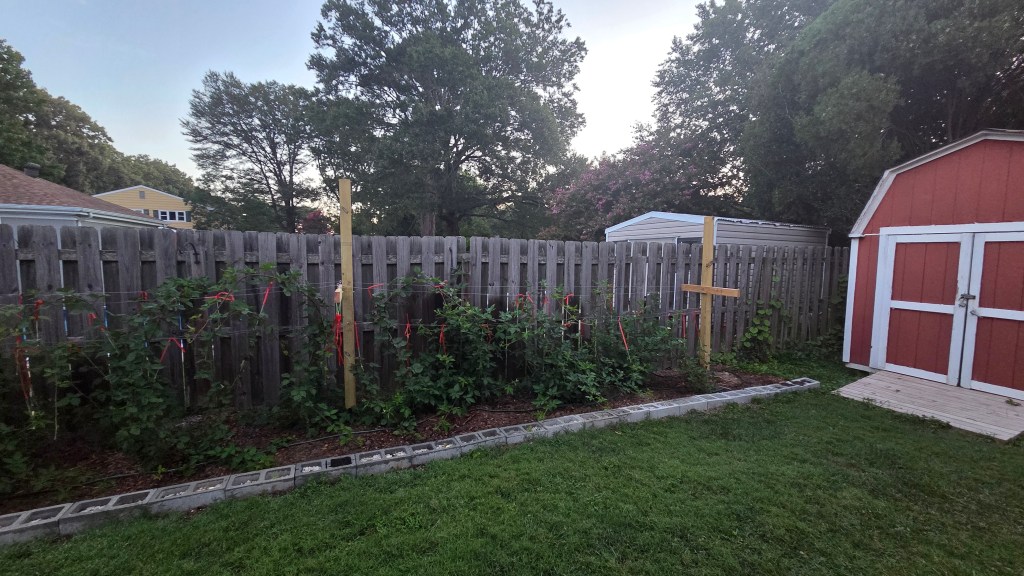
Buttervale has reached the point this Summer where a lot of the things we planted earlier in the year have stopped looking like little plants politely waiting for permission to grow. What were once bare-root sticks, are alive and thriving. (With one notable exception, but more on that later.)
Tress are growing.
Quickly.
Apparently that means it is time for the infrastructure to catch up.
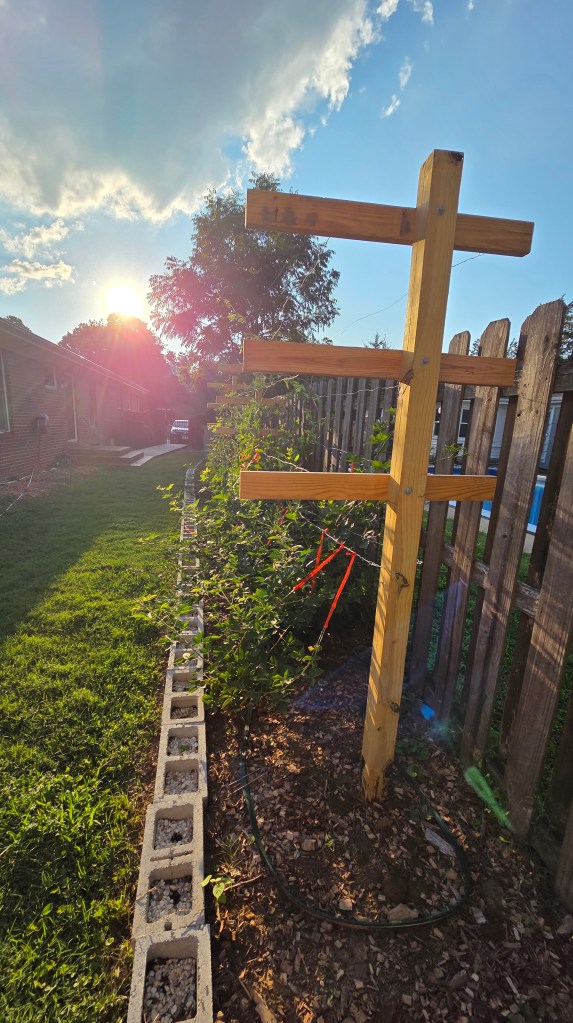
When we planted the little fruit trees along the fence, a serious trellis system is definitely something we would need eventually.
“Eventually” apparently means now.
I never imagined these trees would shoot to the heights they have hit this year. Many are up to 7 or 8 feet tall and several have put on enough growth that temporary stakes and trellising will not cut it.
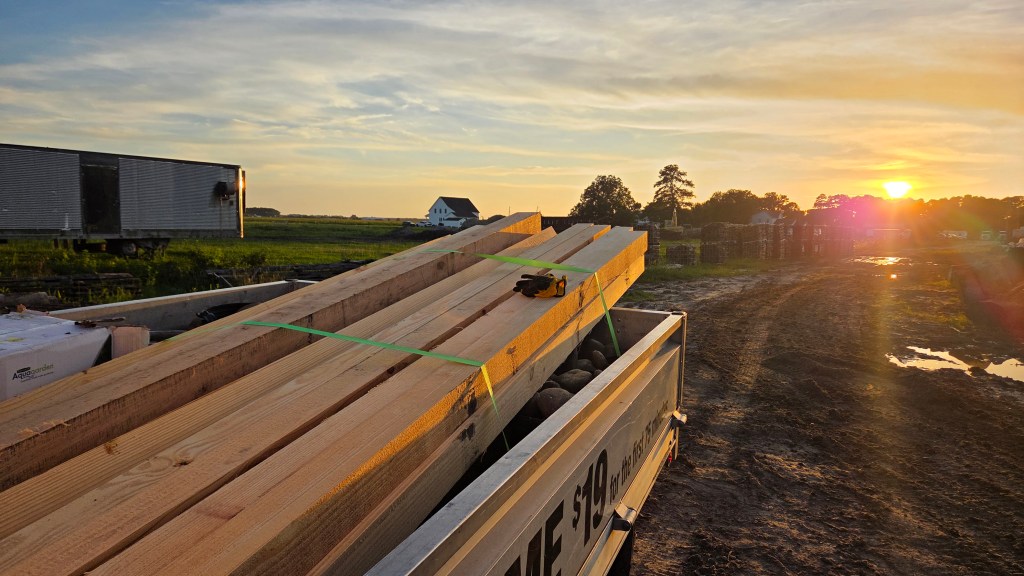
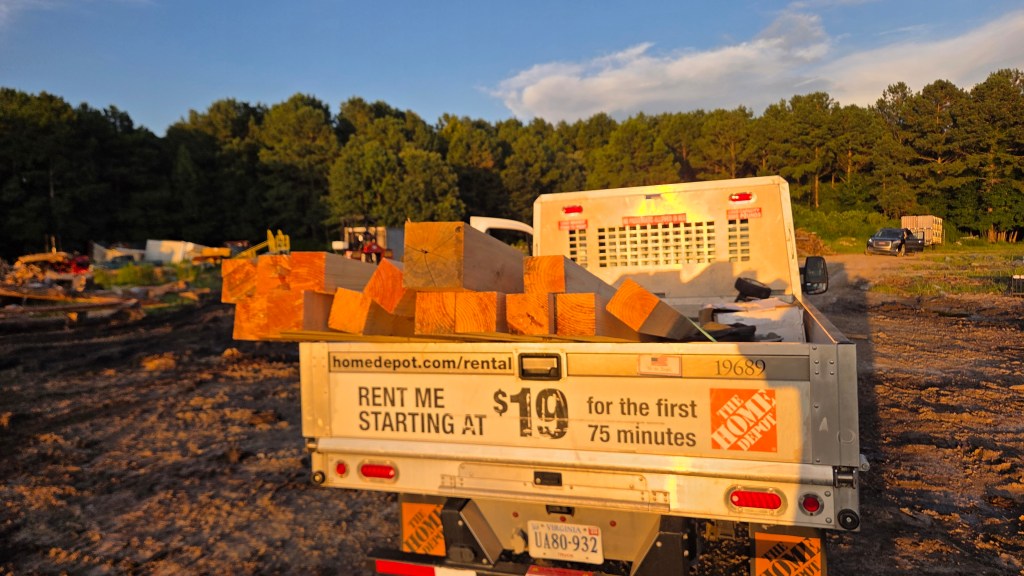
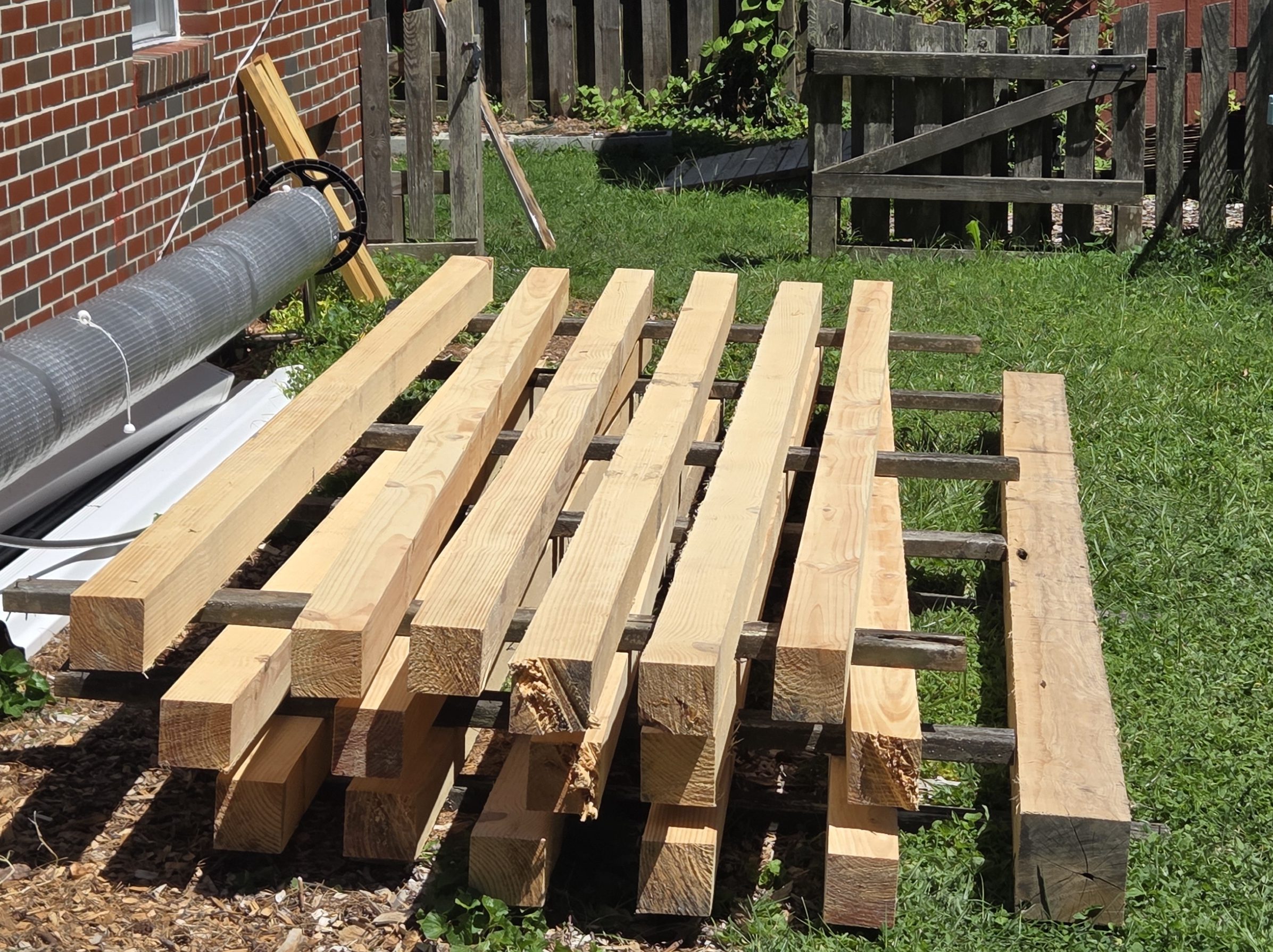
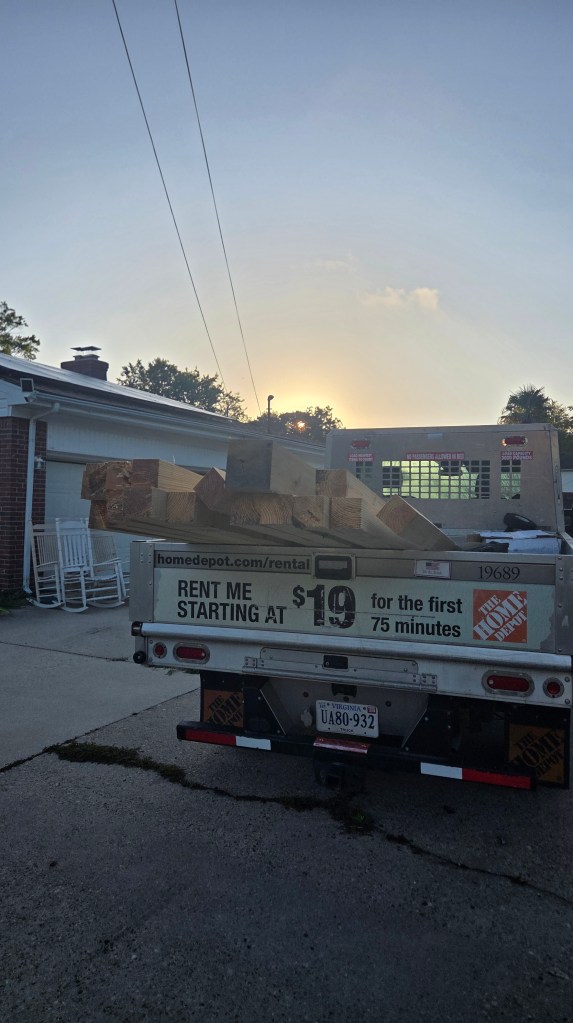
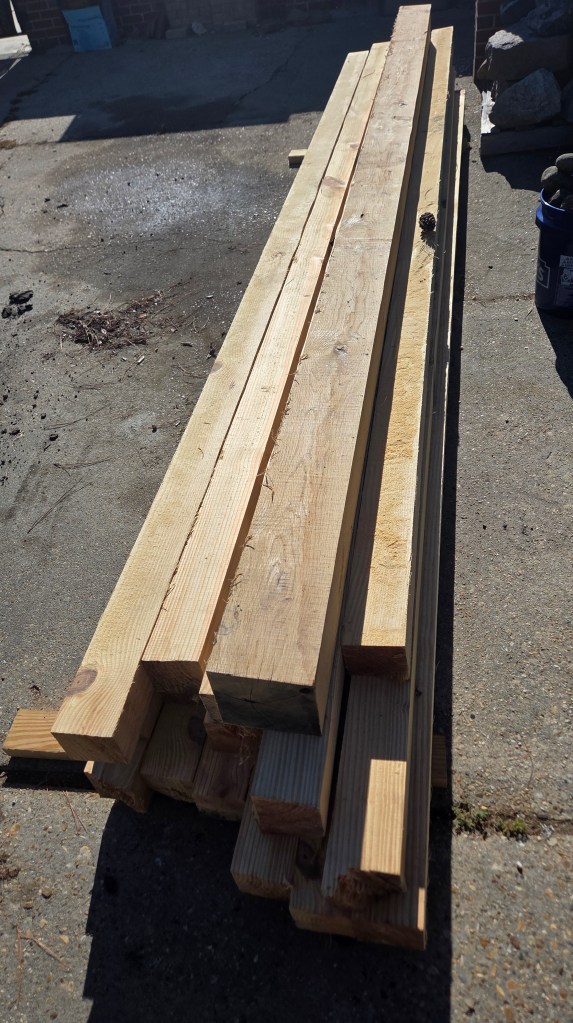
This week included picking up a substantial pile of rough-cut, true-sized lumber. Wood that will become the permanent orchard trellis.
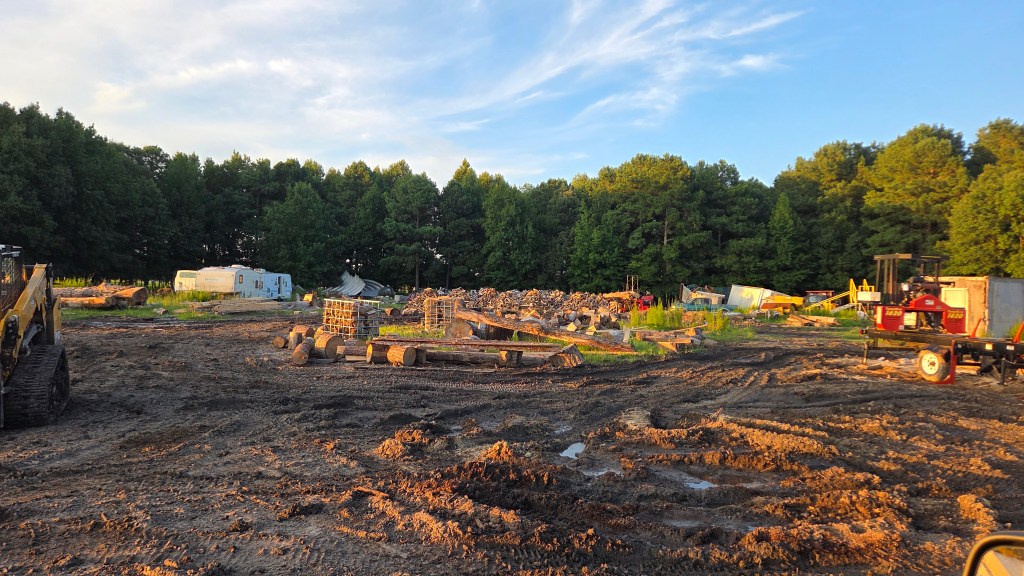
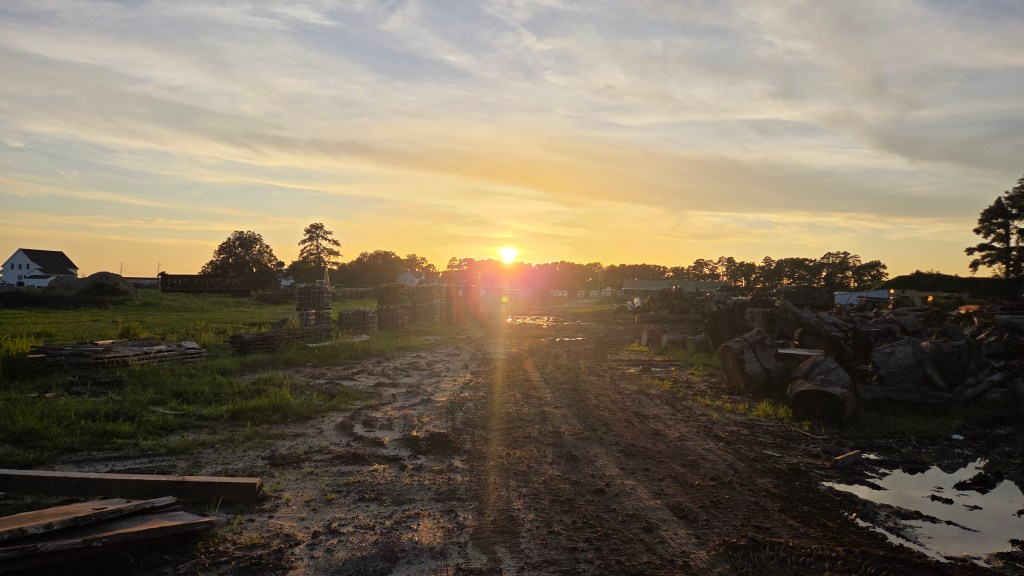
I drove to Elizabeth City, NC to pick it up and spent about a third of what Lowe’s would have charged me for my efforts.
I got to experience sunset in the lumber yard. Priceless.
The plan is for tall posts with six runs of spanning wires going up to 9 feet, giving us something sturdy enough to start training the trees properly instead of just watching them flap in the wind.
Looking at that stack of timbers sitting beside the house, I find myself wondering how gardening became construction. Both things I am learning on the fly.
I learned an immense amount with the blackberry trellis, though, and I am looking forward to upsizing and making the Fence orchard better, stronger, taller.
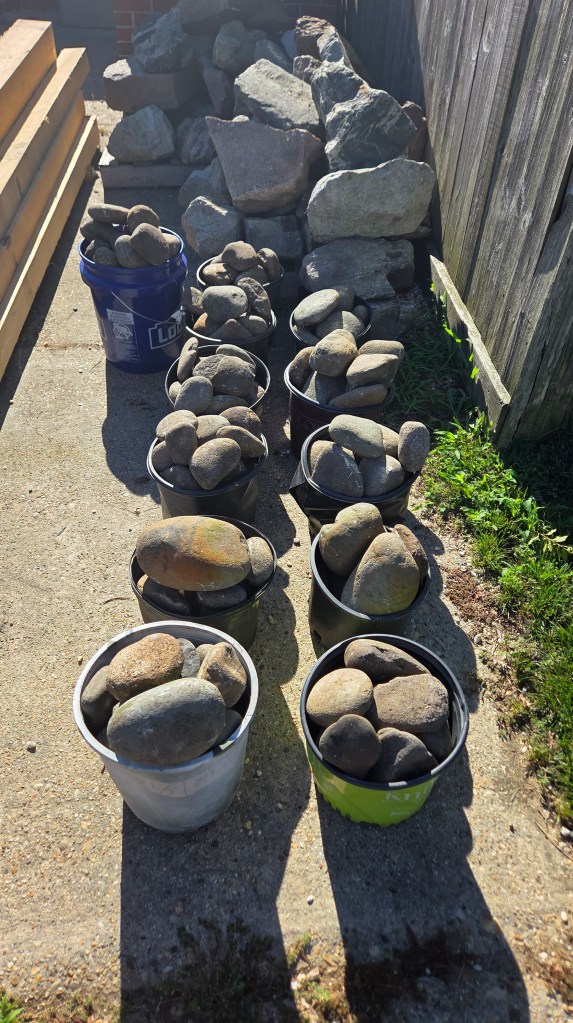
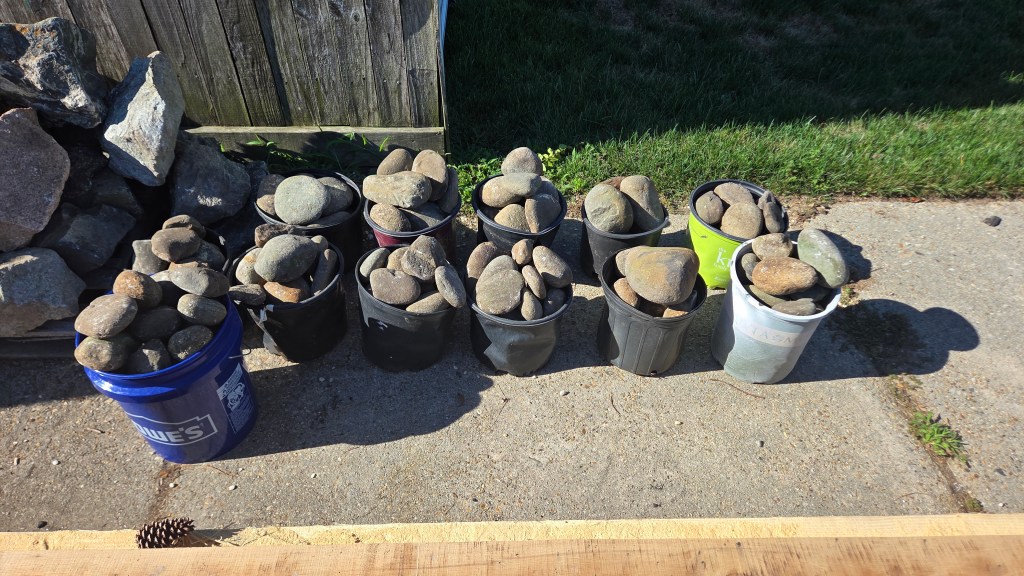
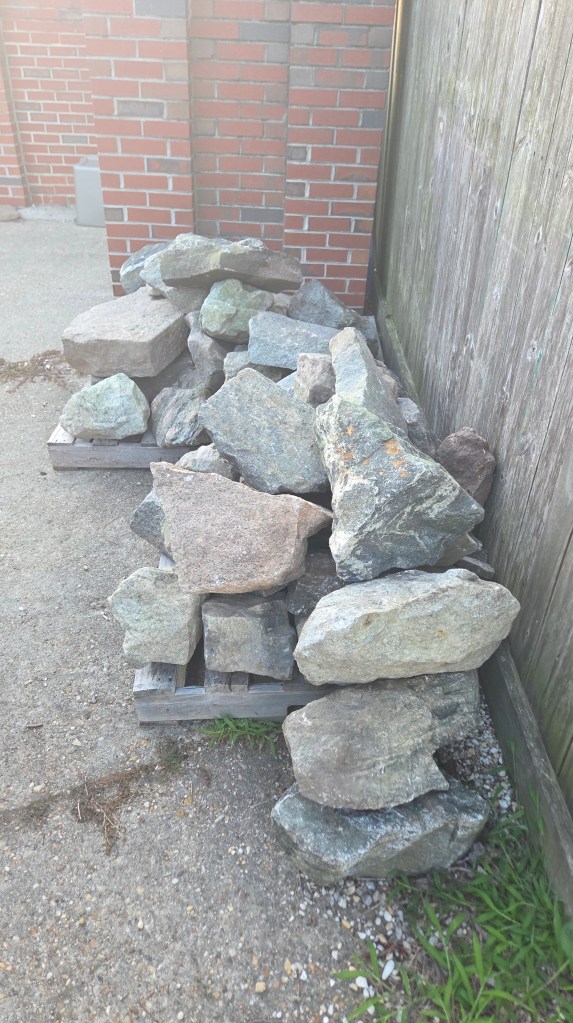
Buttervale also went rock shopping. Sort of.
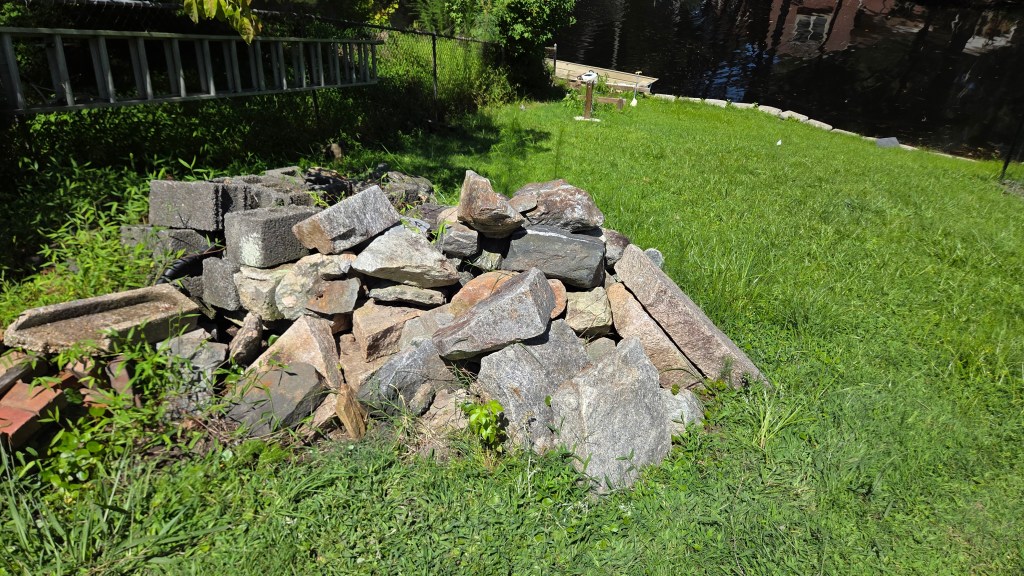
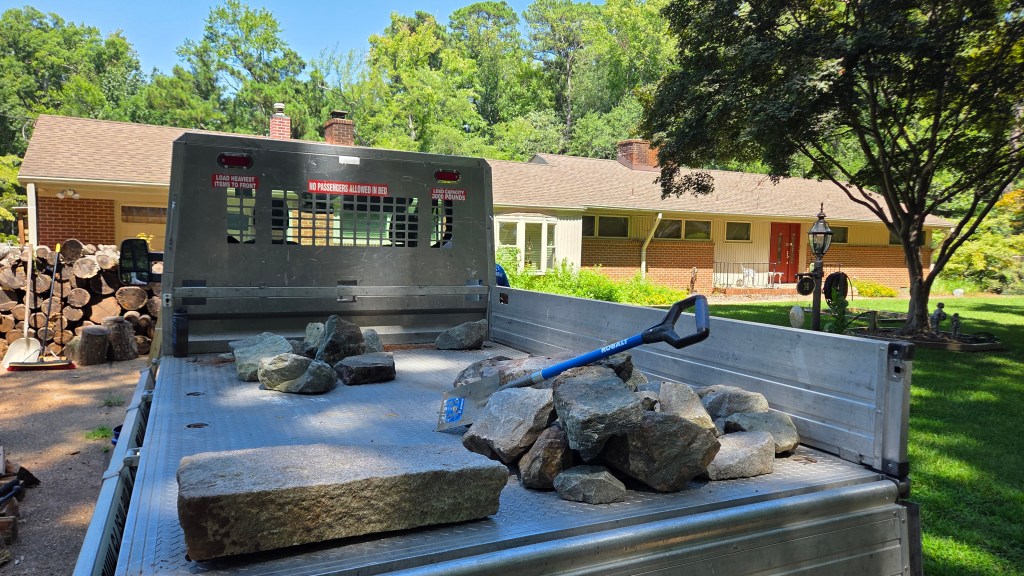
The store was someone’s yard, the rocks were free, and the shopping involved considerable sweating, swearing and ibuprofen.
A guy on Craigslist had a large pile of old stone that needed to disappear. Having several places around Buttervale where stone would be useful, this seemed like an excellent arrangement.
It was.
It was also considerably heavier than the phrase “let’s go pick up some rocks” makes it sound.
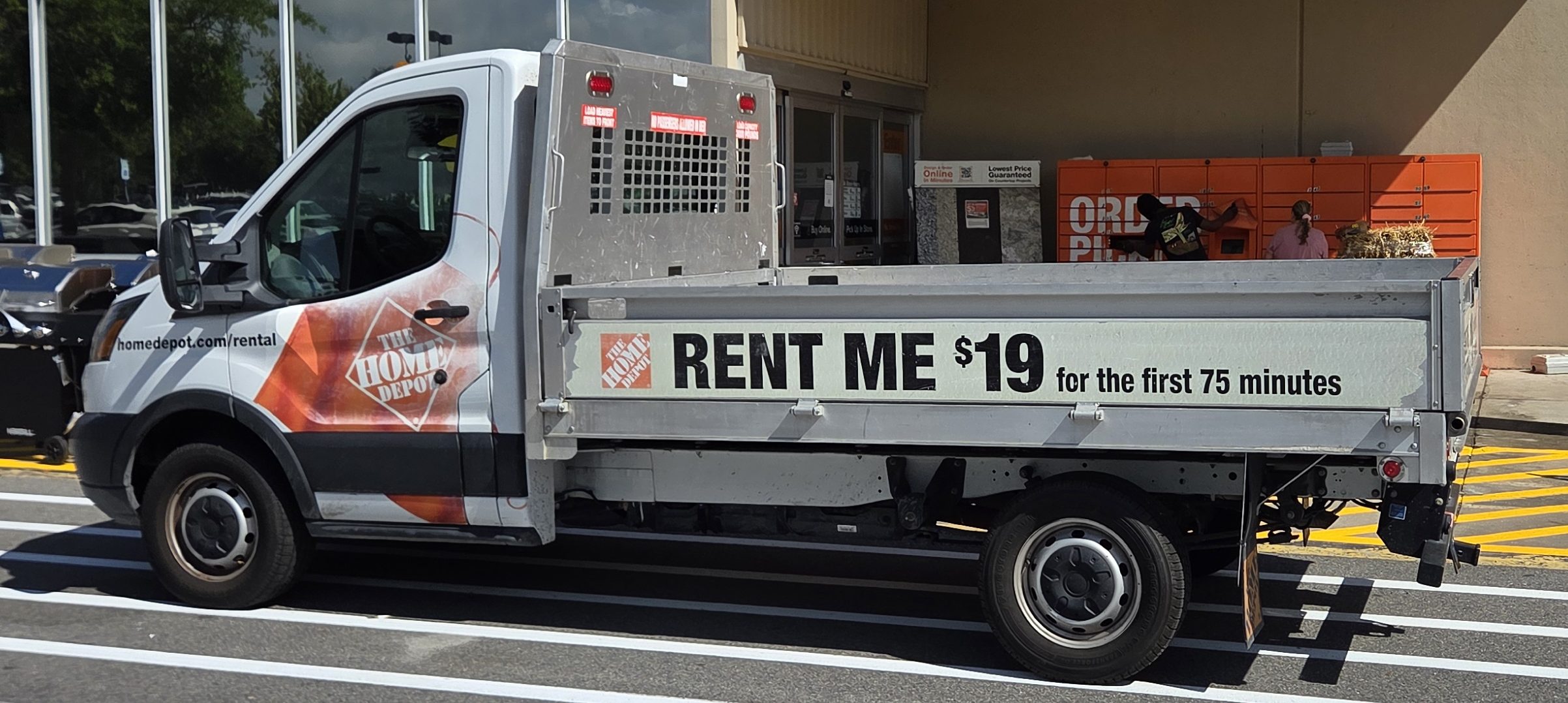
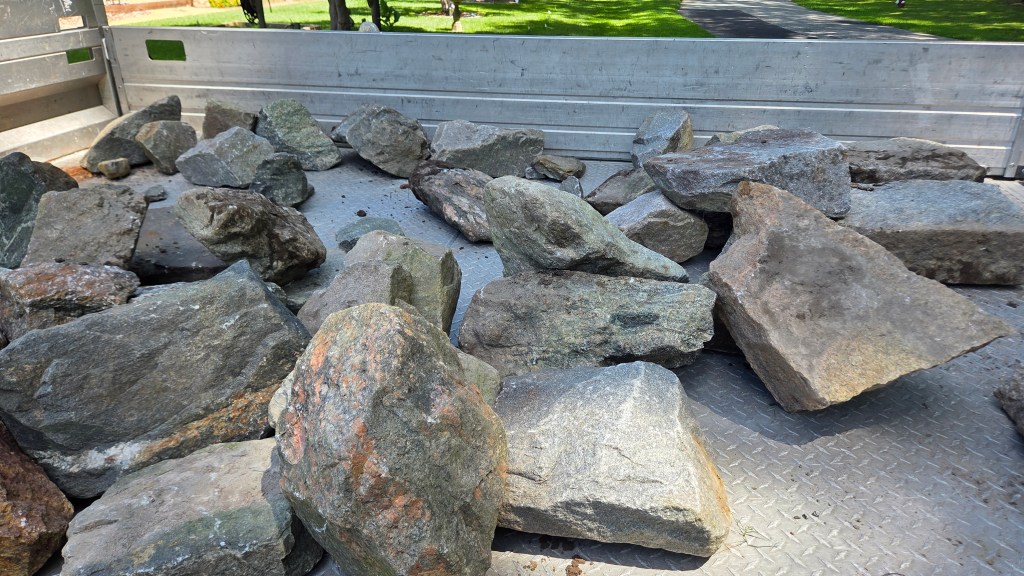
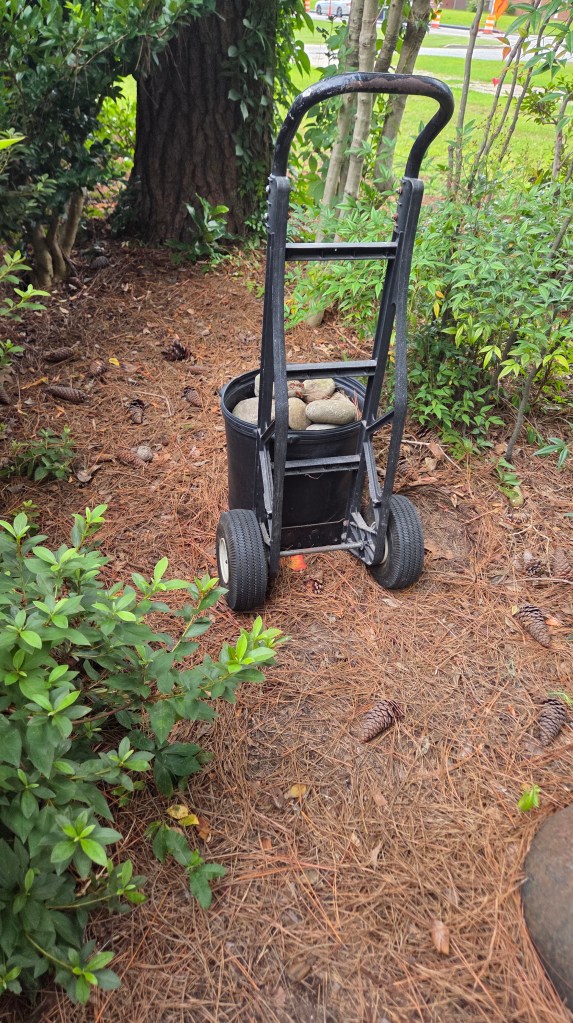
Jumped in the Home Depot flatbed, grabbed shovels, gloves and buckets, and started moving stone.
And moving stone.
And moving more stone.
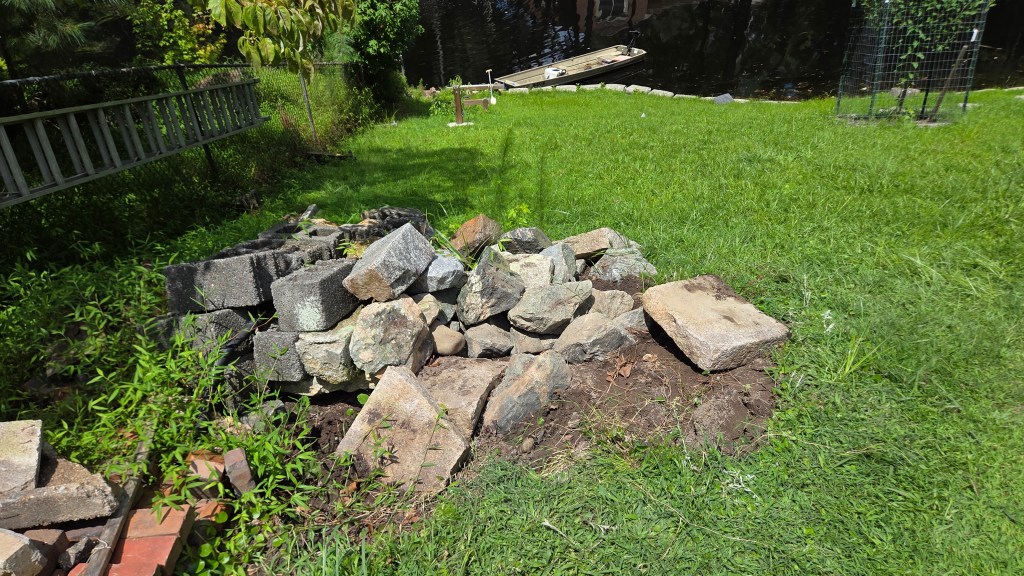
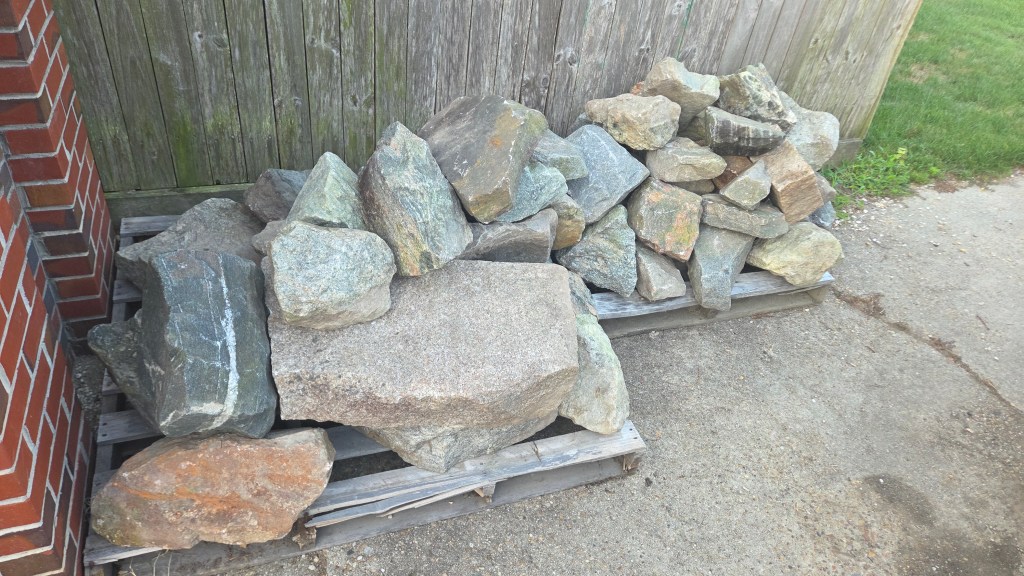
There were big rough pieces, flatter slabs, rounded stones and several buckets of smaller river rock. Some of it took two people to wrestle onto the truck. By the time we finished unloading at Buttervale, we had accumulated what now looks like our own small quarry.
But wait, there’s more. We only could put about half the pile on the truck so more lifting rocks in my future. I mentioned it on Facebook, but if anyone has a teen they are trying to convince to go to college, send with me for the day. They can see what a long shift of lifting rocks for a few dollars feels like.
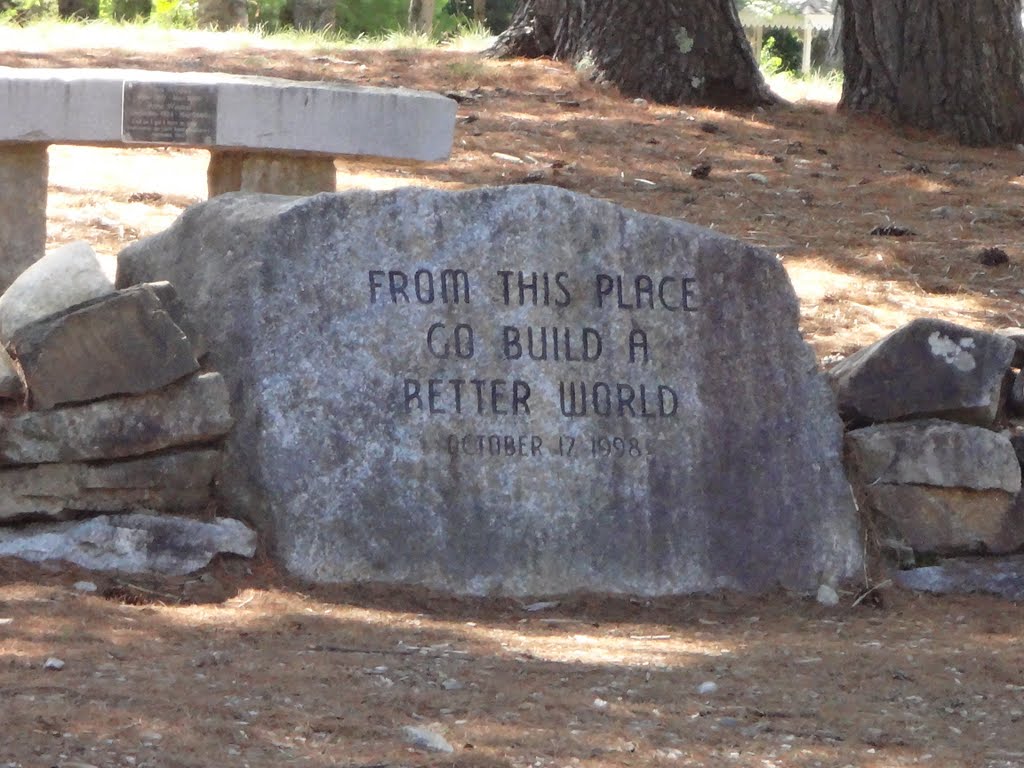
I have plans for much of it. Some will end up in garden beds. Some will be used around water and drainage projects. Some of the larger stones are just too interesting not to find a home somewhere in the landscape.
Foreshadowing
At least a few of them are destined for projects I am not quite ready to talk about yet.
Meanwhile, something else followed me home
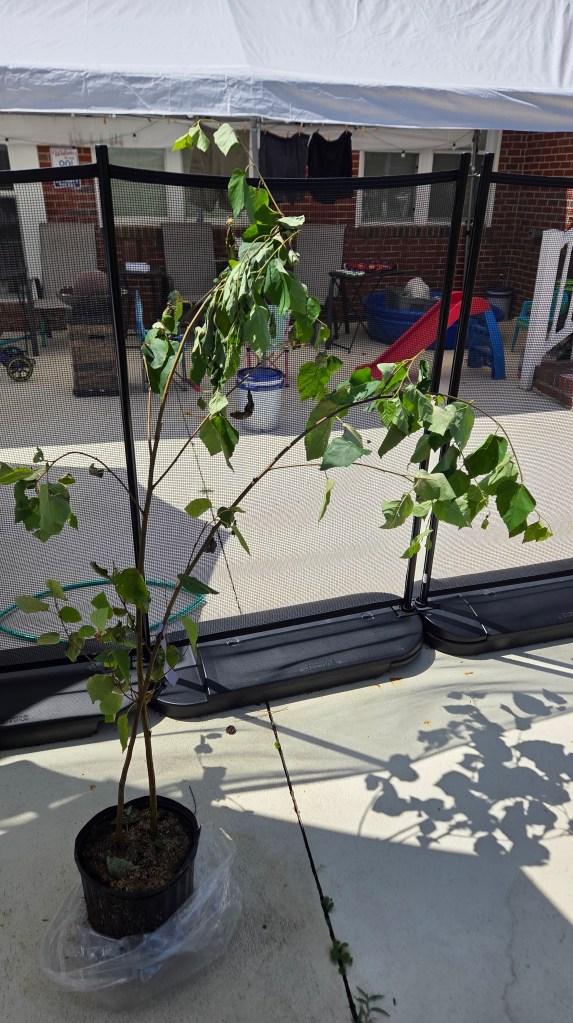
A birch tree.
Because obviously what Buttervale needed in the middle of August was another tree.
This one arrived looking understandably unhappy about the trip. A couple of small branches were damaged, the leaves were drooping, and it was roughly 1047 degrees outside. Not ideal birch weather.
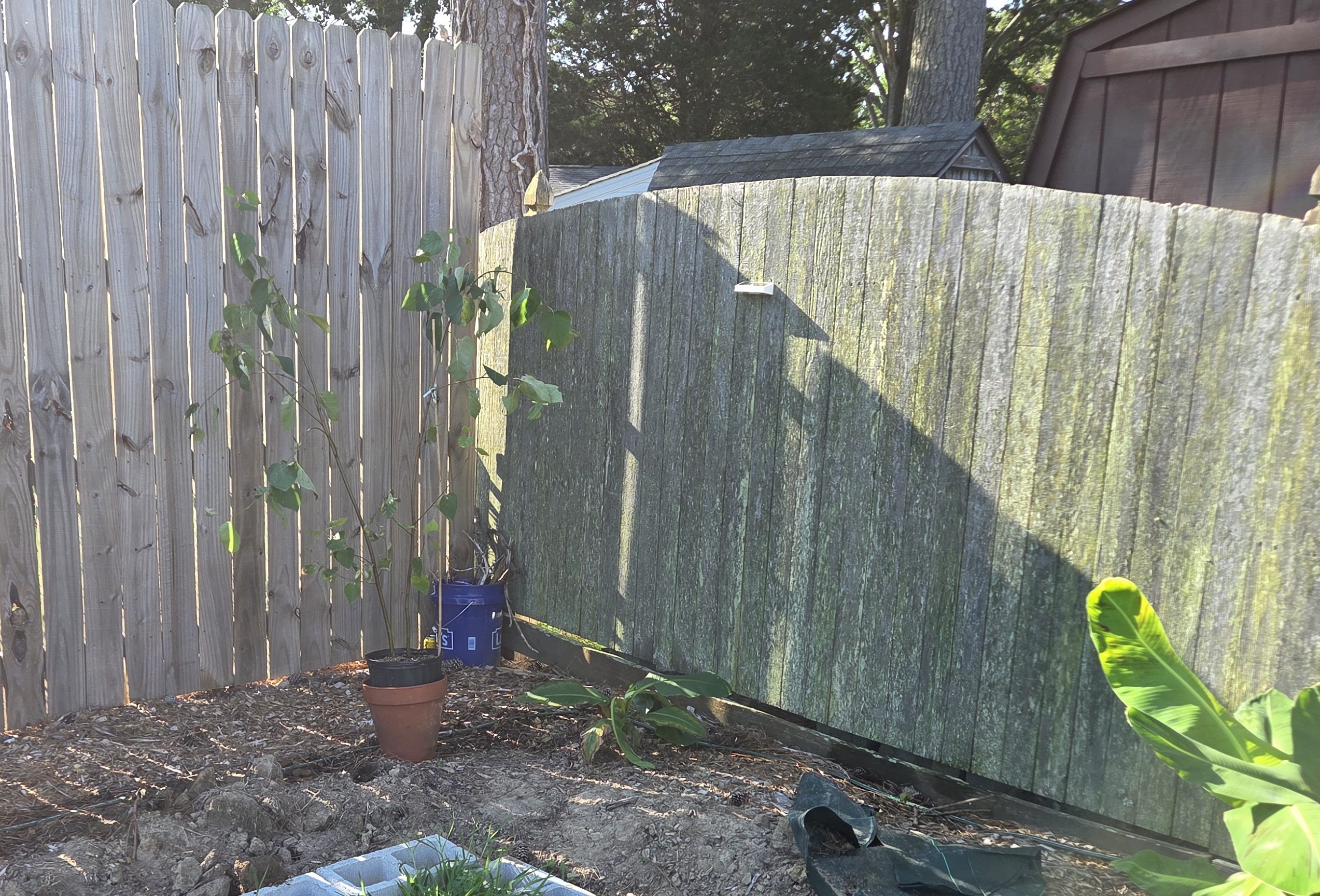
So instead of immediately planting it, I’ve been letting it recover in its nursery pot, keeping the root ball watered and cool while moving it around to consider exactly where its permanent home should be.
Birches have a completely different feel from most of the trees already at Buttervale, lighter, softer and a little wild looking. If all goes according to plan, this one should eventually become a pretty dramatic addition to the yard.
For now, its only job is to survive August.
My job to stop moving it around long enough for it to end up in the soil so it has a chance to thrive.
Speaking of trees not thriving…
An update on the Elberta
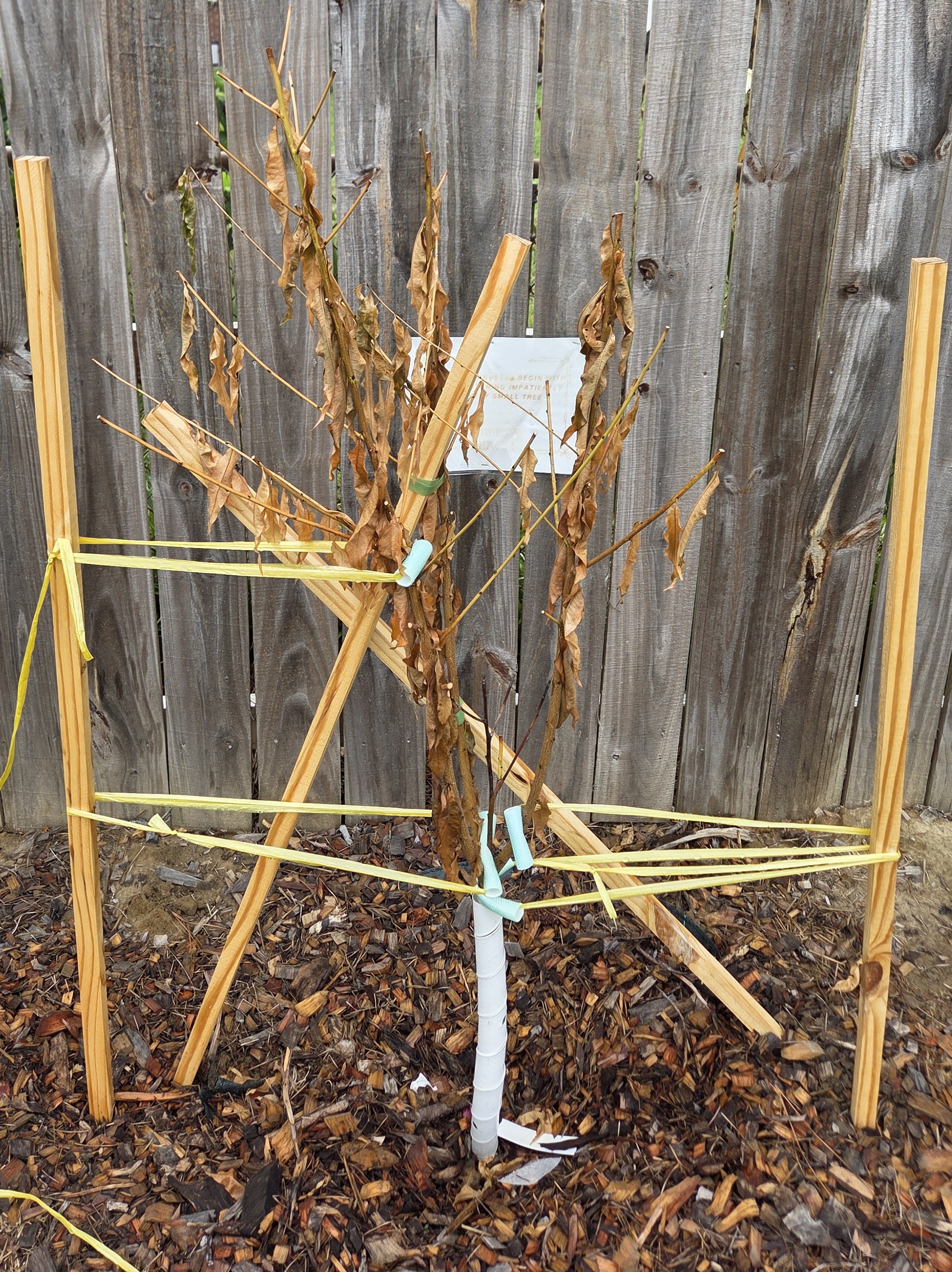
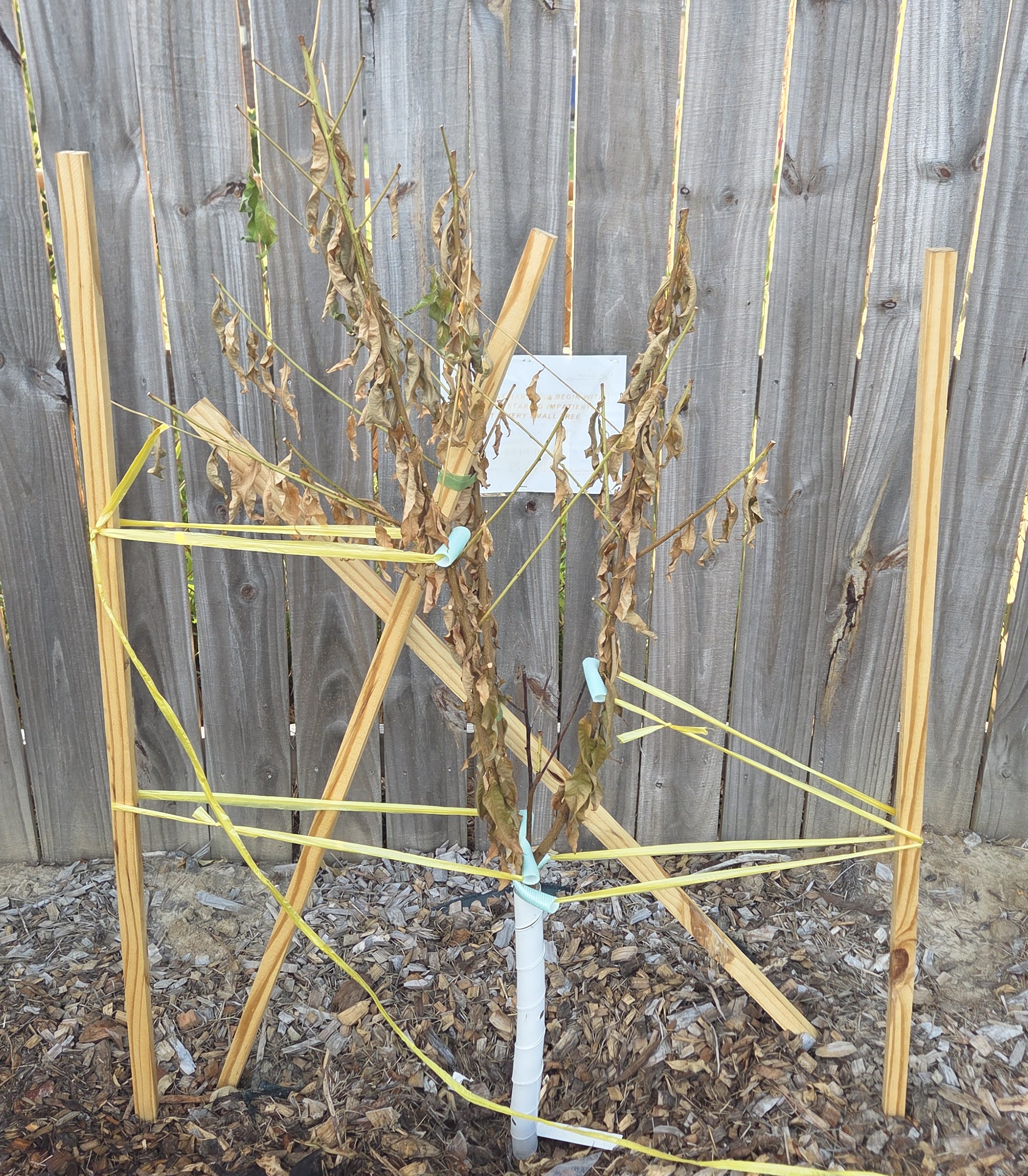
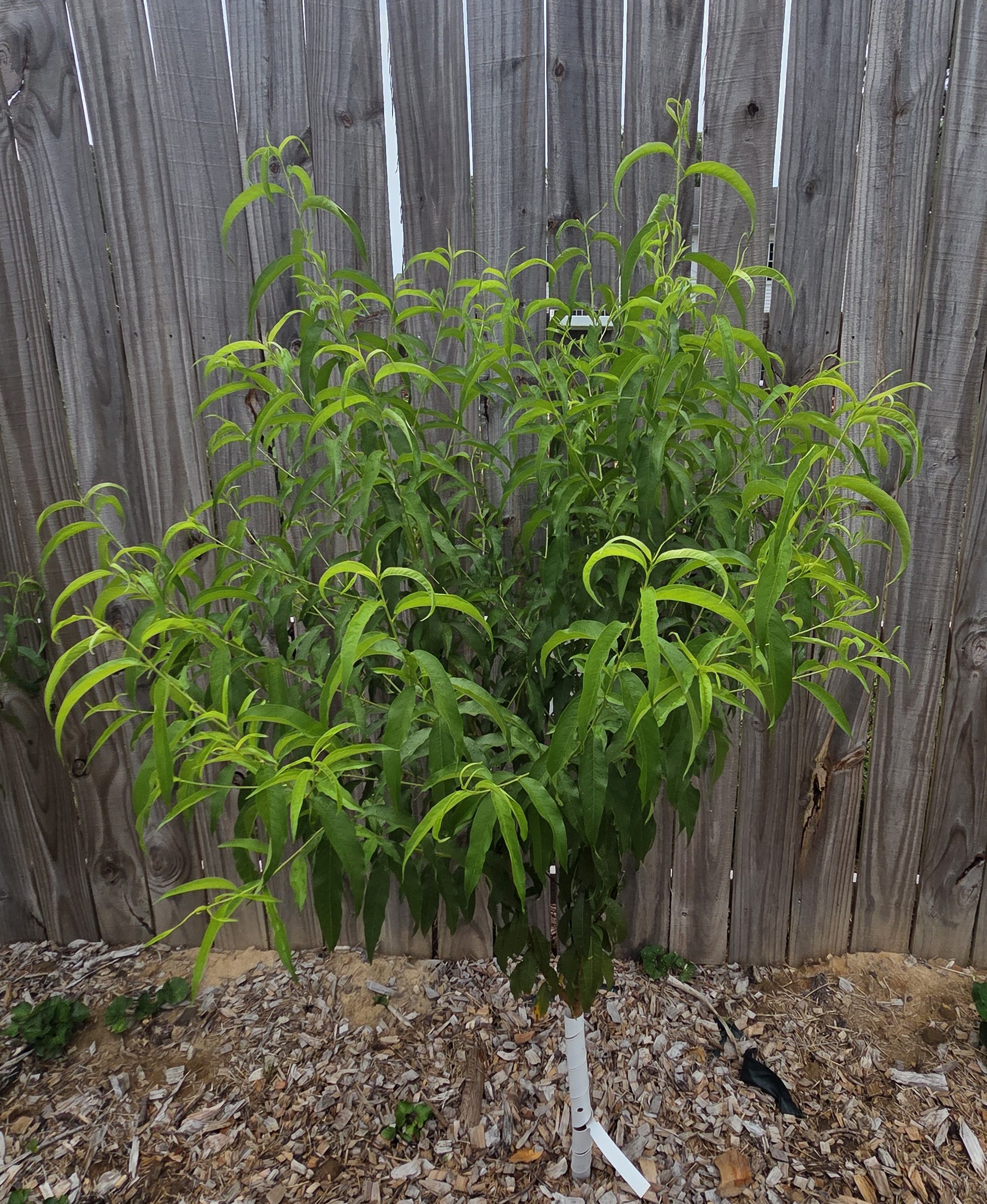
The little Elberta peach tree continues to hang on. A little. Kinda. But maybe not really?
Sad Tree
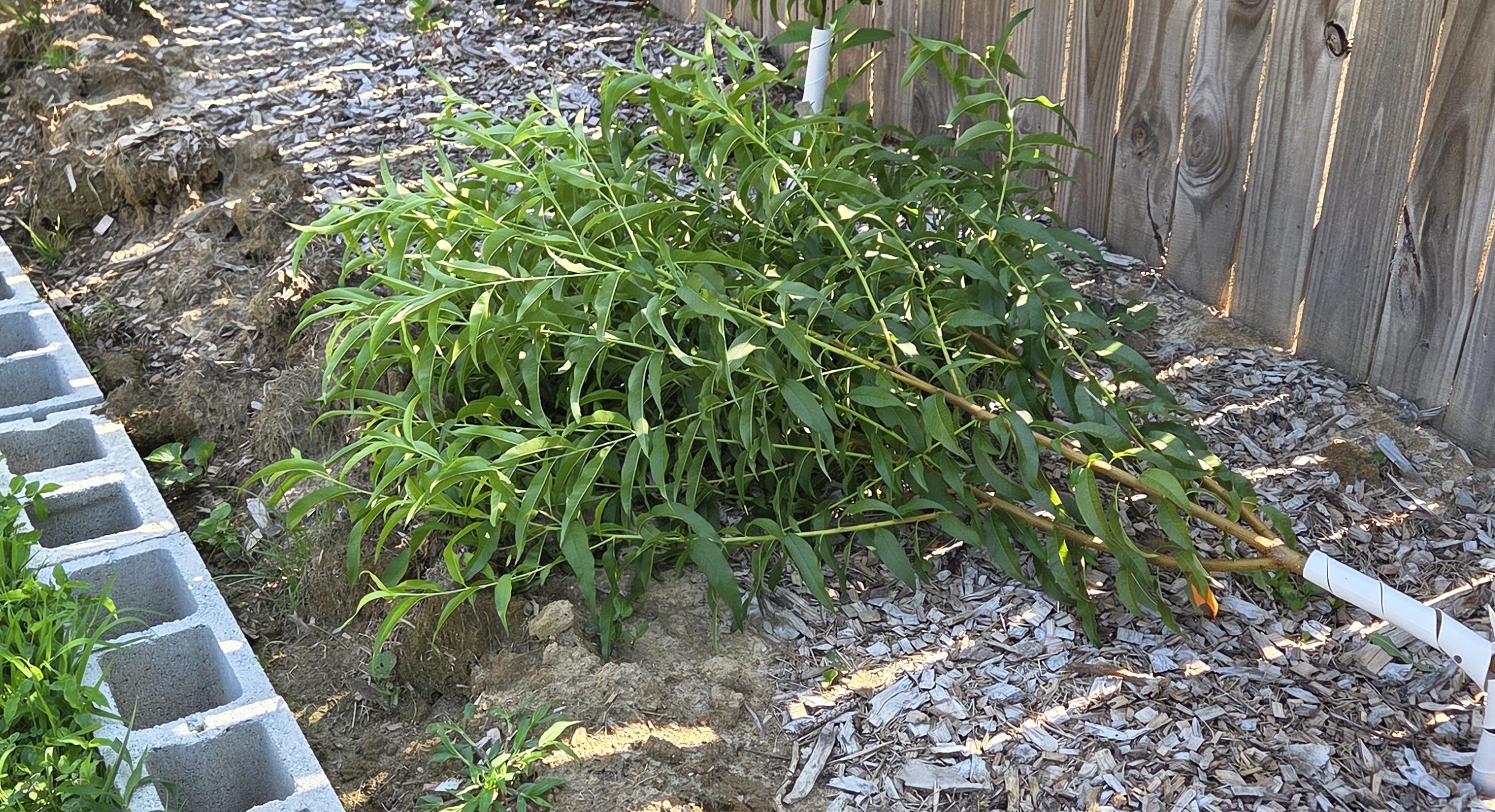
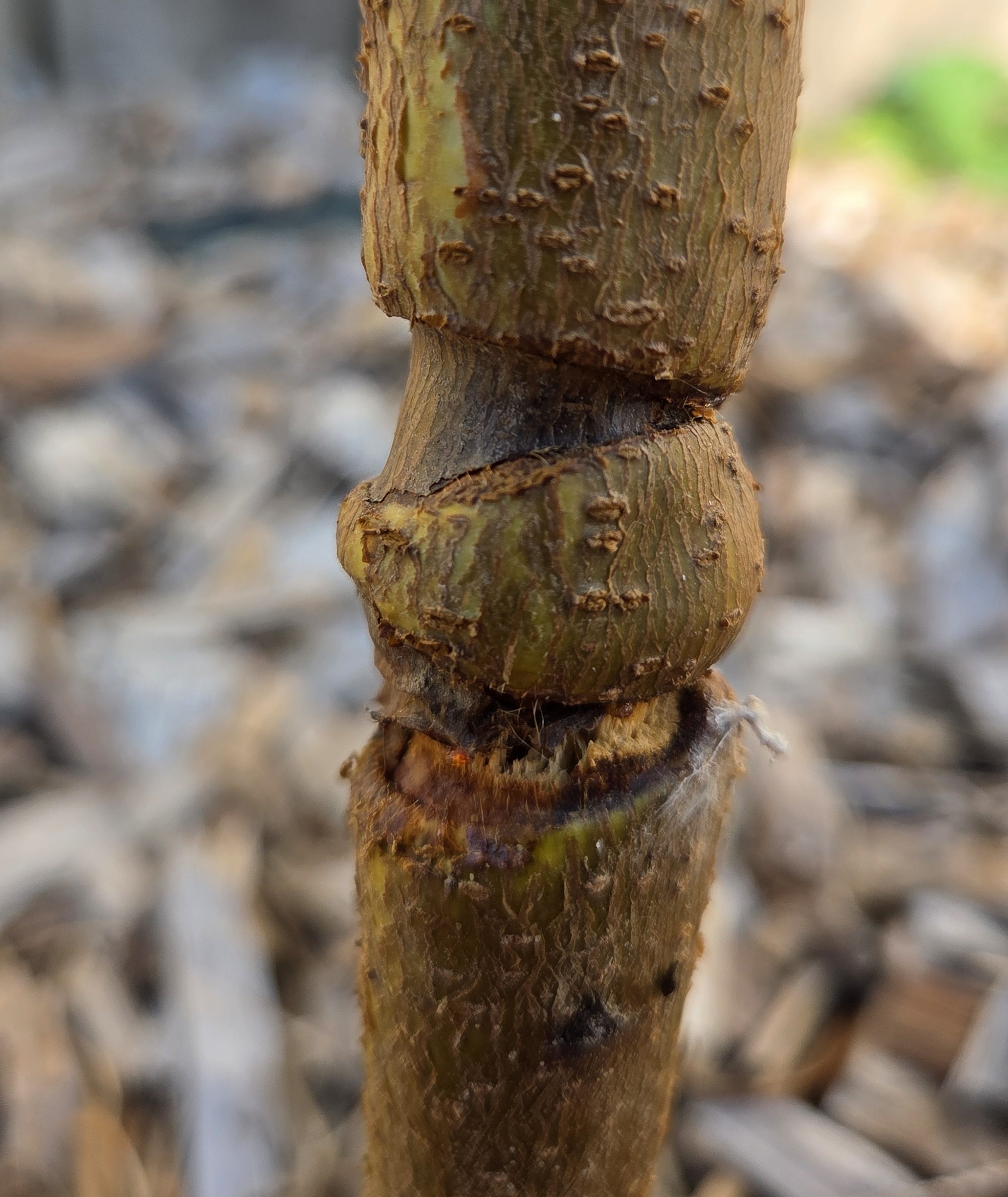
You may recall, this is the tree that snapped a couple weeks ago after the nursery tag had constricted the trunk and created a severe narrowing. When the wind caught it, the trunk broke badly enough that I wasn’t sure we had any chance of saving it.
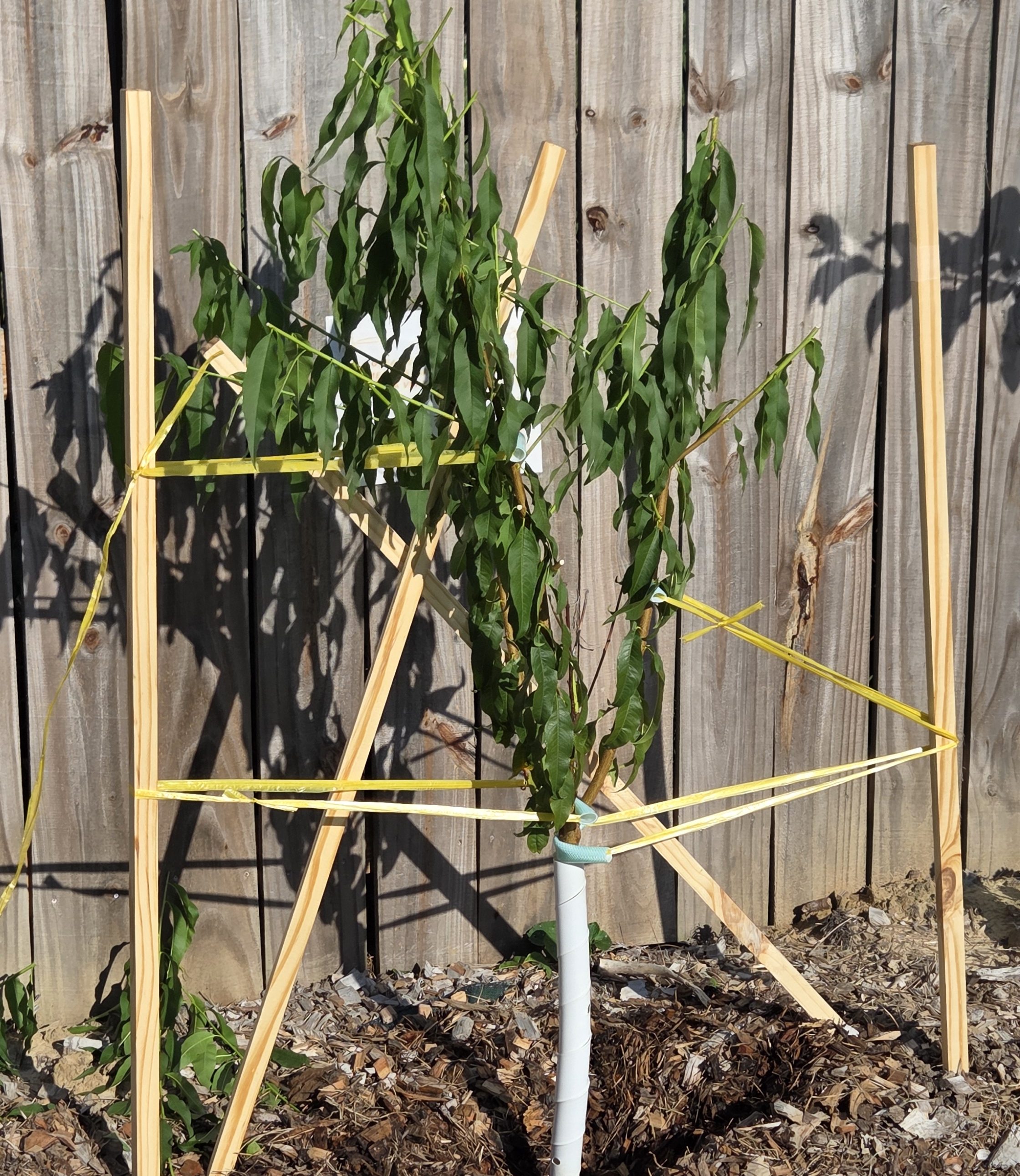
I trimmed the damage, carefully pulled the trunk back together, wrapped it and built a small orthopedic support device around the tree.
It has not been pretty. Everyday she looks worse.
A lot of the leaves have now dried up and died, and if you judged the tree only from across the yard you would probably pronounce it finished.
I’m not quite ready to do that.
I’m stubborn.
There is still green wood, and there are still signs that the tree hasn’t completely given up. So the brace stays. The watering continues. And the little peach gets every opportunity to decide whether it wants to make a comeback.
A replacement can be ordered later if necessary.
I have looked and they are surprisingly affordable even for a size or two up from what I originally planted, so I can basically “buy” the year I have lost. Its replacement wouldn’t ship until it is dormant in December, so there is plenty of time to be stubborn and see if this is The Little Elberta That Could. I think it can.
So, for now, it gets to fight.
And the actual food garden keeps fighting too
While we were hauling several thousand pounds of future projects around town, the garden continued doing its thing.
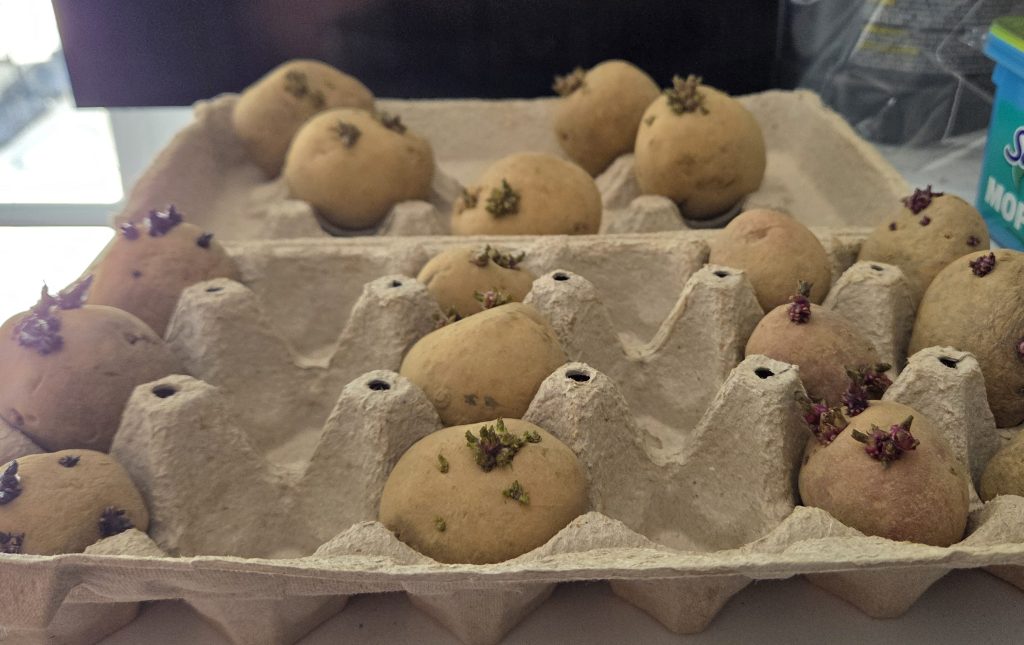
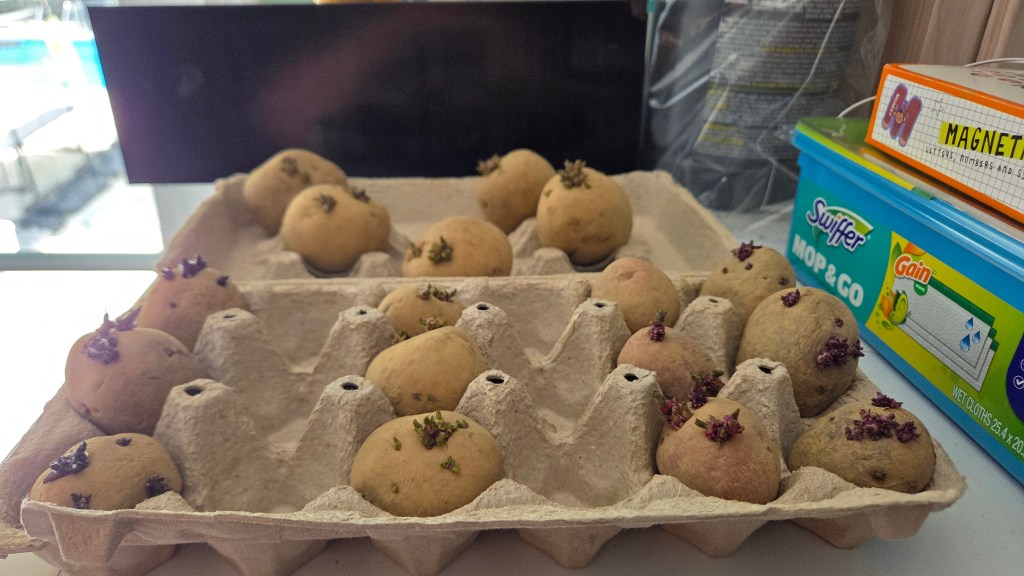
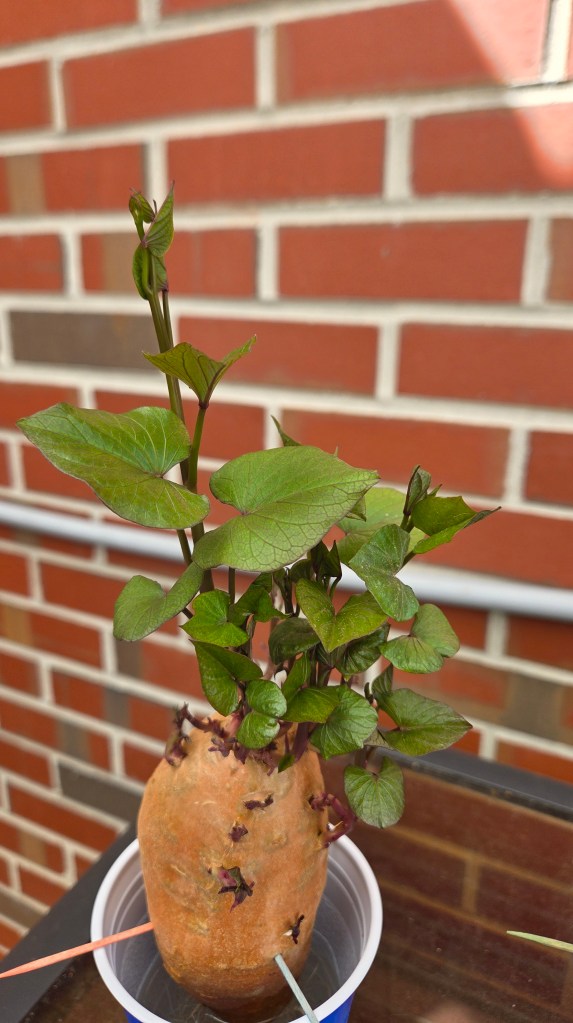
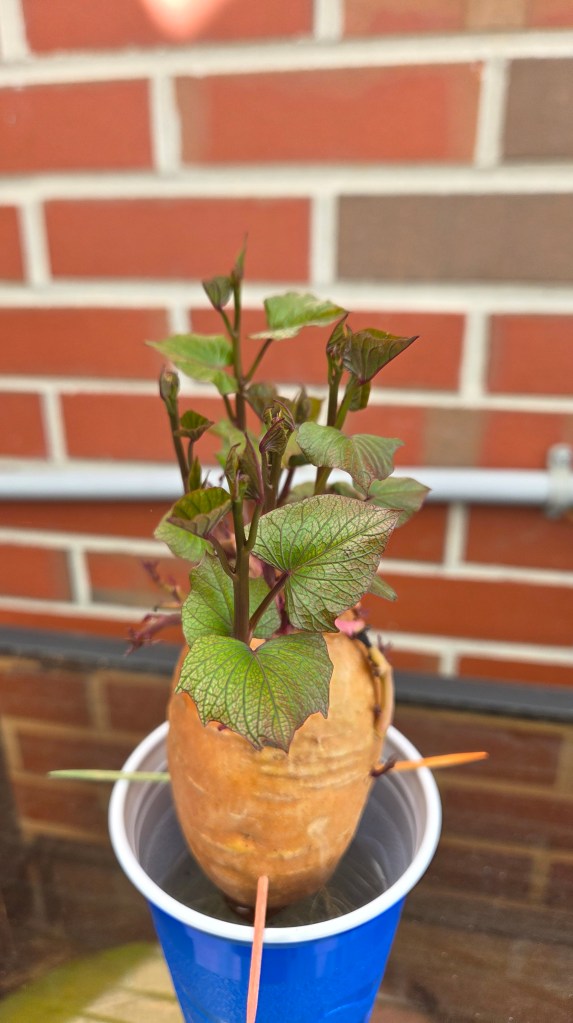
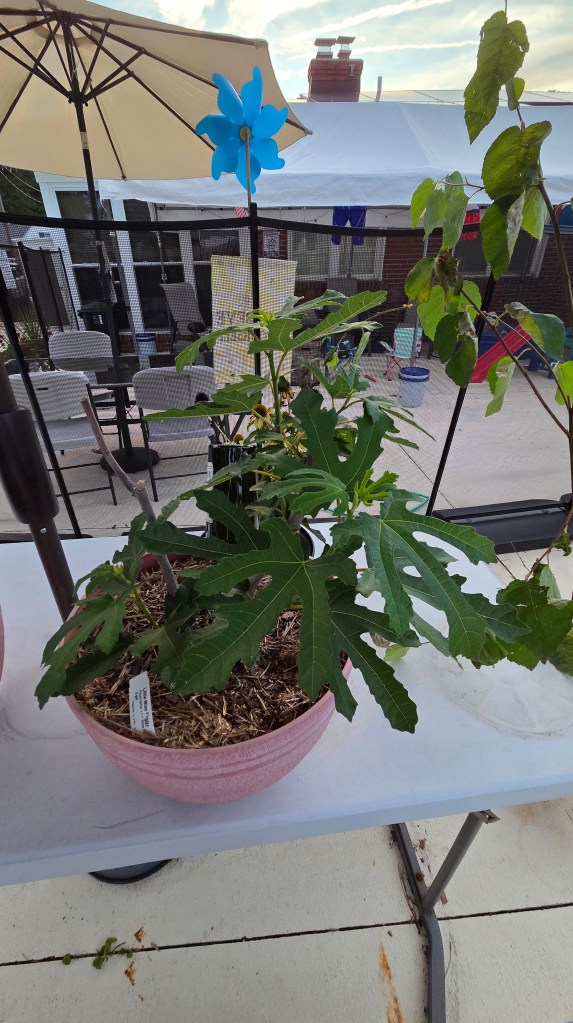
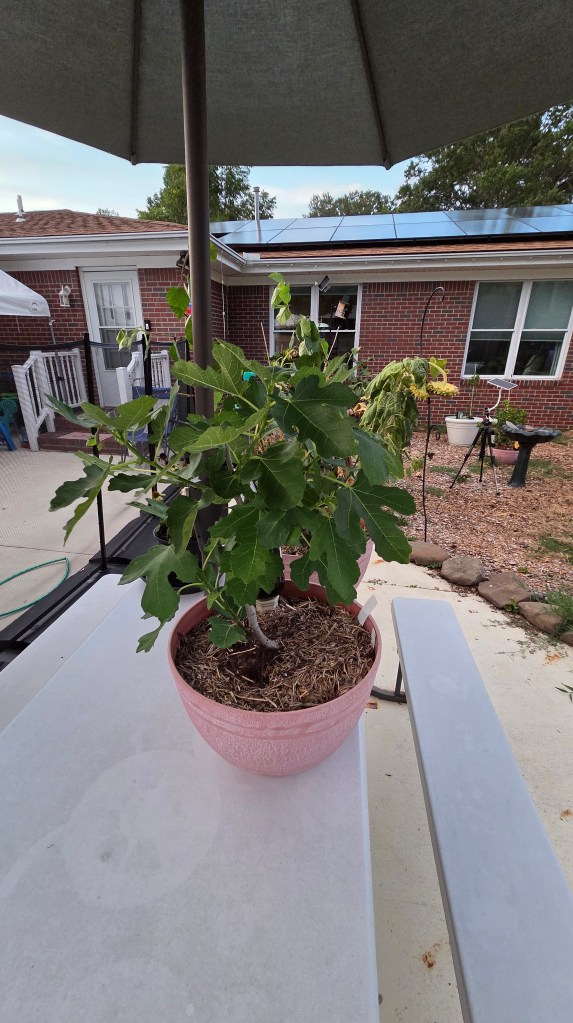
The figs are finally looking vigorous after their slow start this year. The sweet potatoes are producing new slips. And the seed potatoes we ordered for the Thanksgiving garden are now chitting inside the house, with little purple and green shoots beginning to appear.
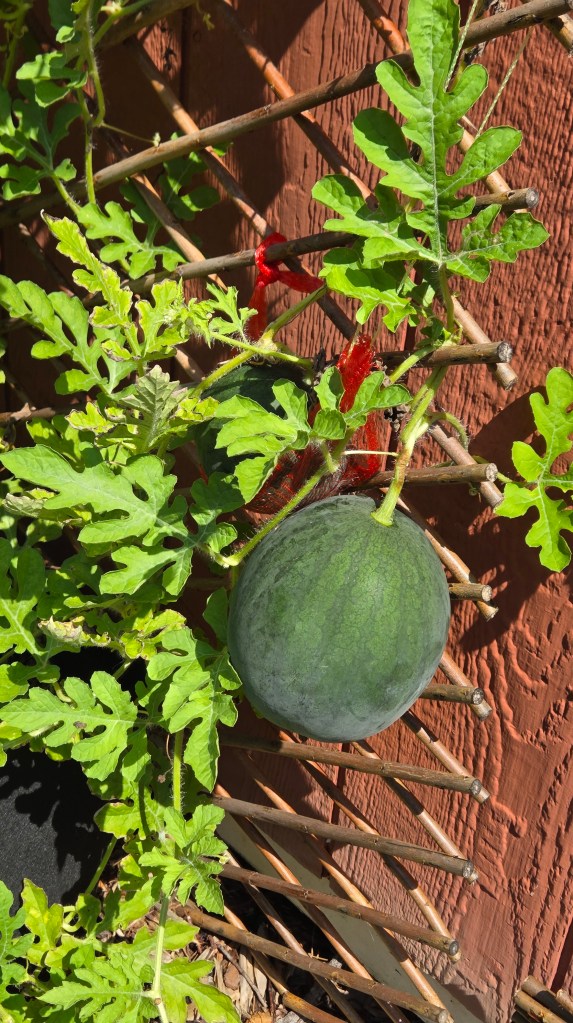
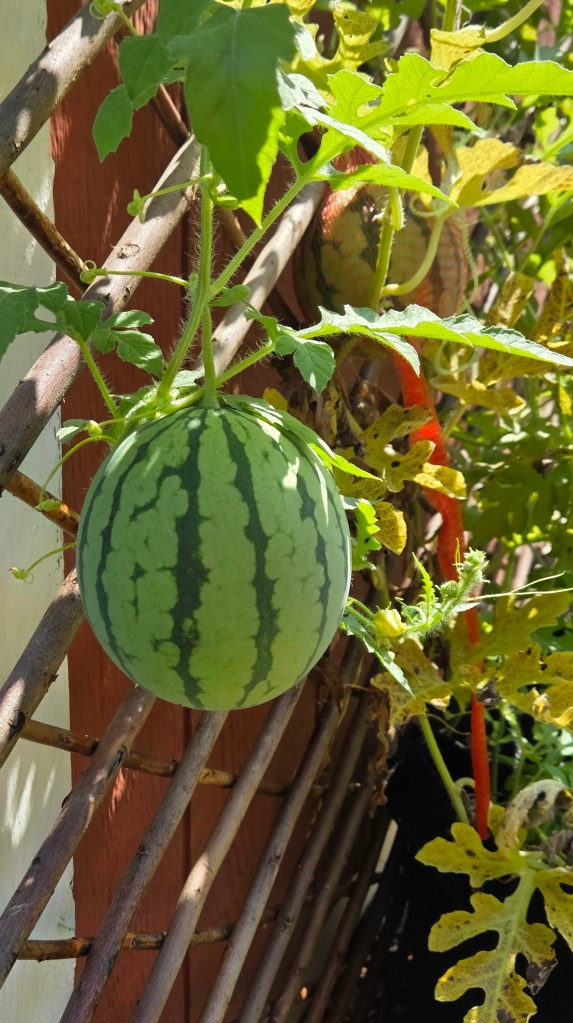
I am most proud of the blackberry hedge that is starting to establish itself and will feed us for years to come. We have watermelons and pumpkins. Carrots and Romaine lettuce are in the ground. Swiss Chard and Kale freshly planted.
Faith is becoming sight.
Oh, and four rocking chairs showed up
Because, Winni vibes.
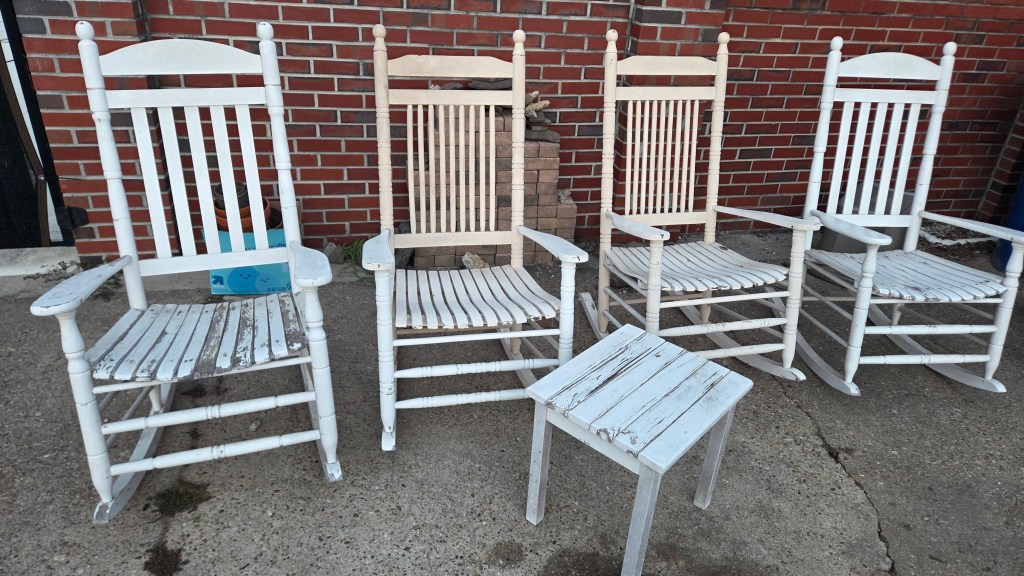
Four old wooden rocking chairs also joined the collection this week.
They are weathered, mismatched and badly in need of cleaning, scraping, new screws, glue and paint.
In other words, ideal.
I know exactly what I want to do with them. Hopefully Susan will get started on them soon.
But that is another story.
For now there are timbers stacked beside the house, a small mountain of boulders waiting for assignments, potatoes sprouting indoors, a peach tree refusing to officially die, a birch tree waiting for its permanent home, and four rocking chairs waiting for a new lease on life.
Does it get any better than this?
And I’m pretty sure we’re going to need the truck again.
Tragedy in the Orchard – It sounds like an Agatha Christie novel.
There are moments in gardening that feel like victories.
And there are moments that just plain hurt.
Today HURT!
This morning I walked out to check on the Buttervale Fence Orchard, coffee in hand, as is my morning ritual and something was off.
I almost didn’t see it.
My Elberta peach tree was bent over. Like all the way over, on the ground. I first went to blame the critters, but this was the biggest tree in the line and there is nothing in our yard that could topple a tree. Bunnies, squirrels, crows? Nope.
Maybe wind had simply knocked it sideways.
Then I saw the awful truth and knew exactly who was to blame.
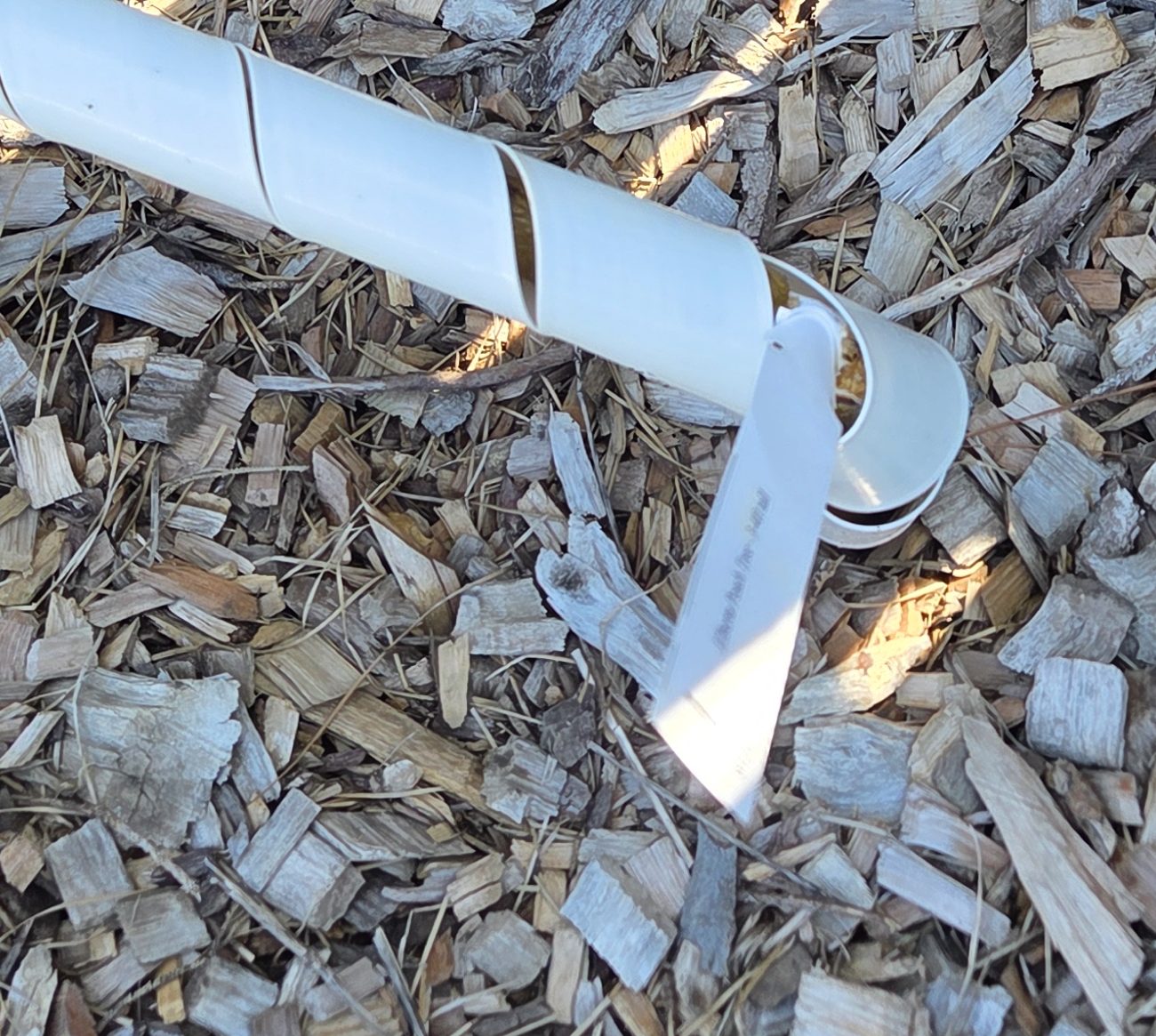
The nursery tag I had decided not to remove had slowly tightened around the trunk as the tree grew.
Planting day it seemed like a plan.
All those dormant, leafless sticks looked the same. It would be handy, so I thought, to leave the label on them.
SPOILER ALERT: I’d advise against it.
It had quietly girdled the tree until the trunk became its weakest point. When a stiff breeze came through, the tree didn’t just bend…
…it broke.
The hardest part is that this wasn’t just another tree.
It was my favorite. Seriously, I mean it this time. It really was my favoirte.
From the day it broke dormancy, this Elberta peach seemed determined to prove something. While the other fruit trees settled in and popped out a leaf or two, this one exploded with growth.
Every day it seemed taller, stronger, and fuller than the last. I found myself checking on it first every time I walked the fence line Lingering just a little longer.
It looked unstoppable.
That’s the irony that stings the most.
The very thing I admired about it, was the thing that sealed its fate.
A slower-growing tree would have taken months before the tag became a problem. My Elberta grew so quickly that it tightened the plastic against its own trunk until the tree nearly strangled itself, little by little, without anyone noticing.
Success became the enemy.
As gardeners, we tend to think the big dangers are storms, insects, drought, disease, or hungry rabbits.
Sometimes the greatest danger is something as small as an ignored piece of plastic. It really did seem like a good idea at the time.
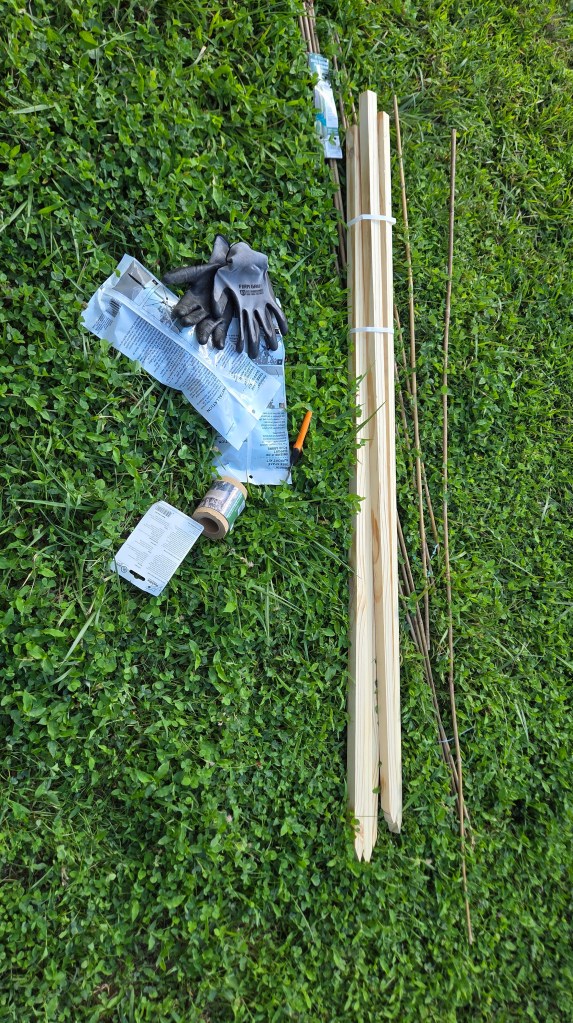
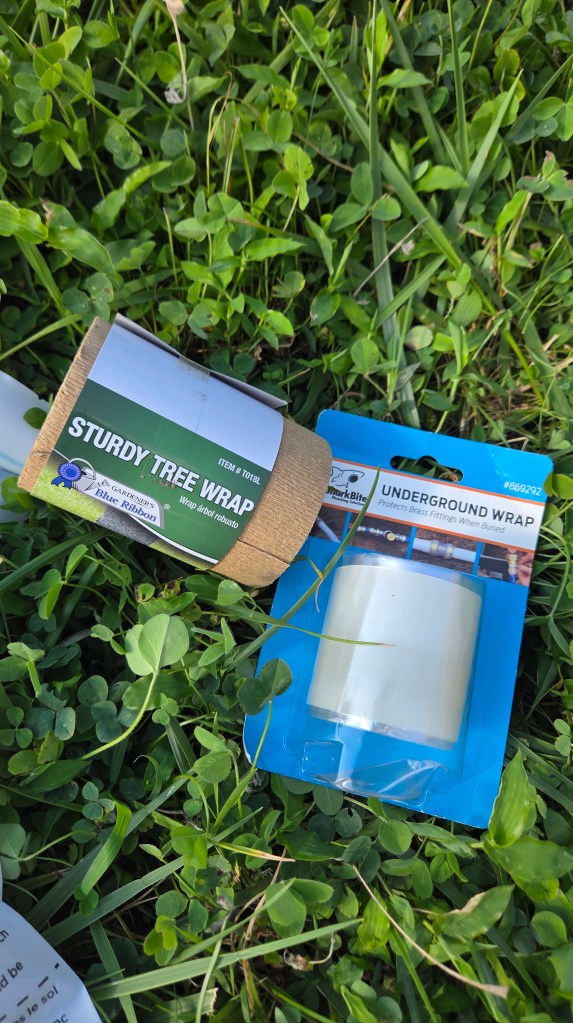
I spent a chunk of today collecting supplies for what amounted to emergency tree surgery.
First, we carefully reduced the canopy. Every branch removed meant less weight pulling on the shattered trunk and less “sail” in the air. It felt almost cruel pruning back the very growth I’d been celebrating just days before but it had to be done.
Then came the delicate part.
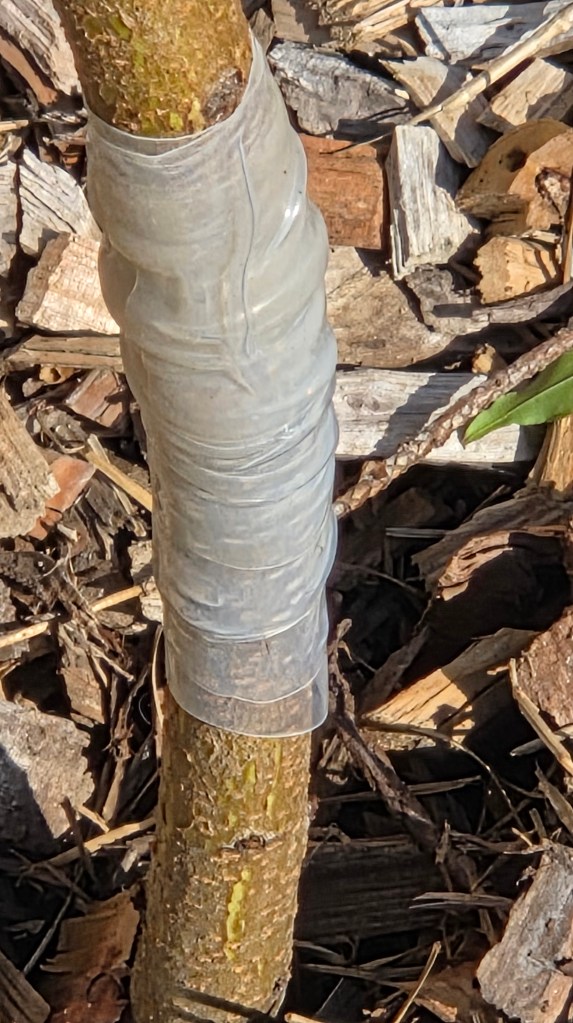
The broken trunk was gently lifted back into alignment until the cambium layers lined up as closely as possible.
The silicone tape was stretched tight and wrapped around the wound, creating a waterproof splint that would hold everything together.
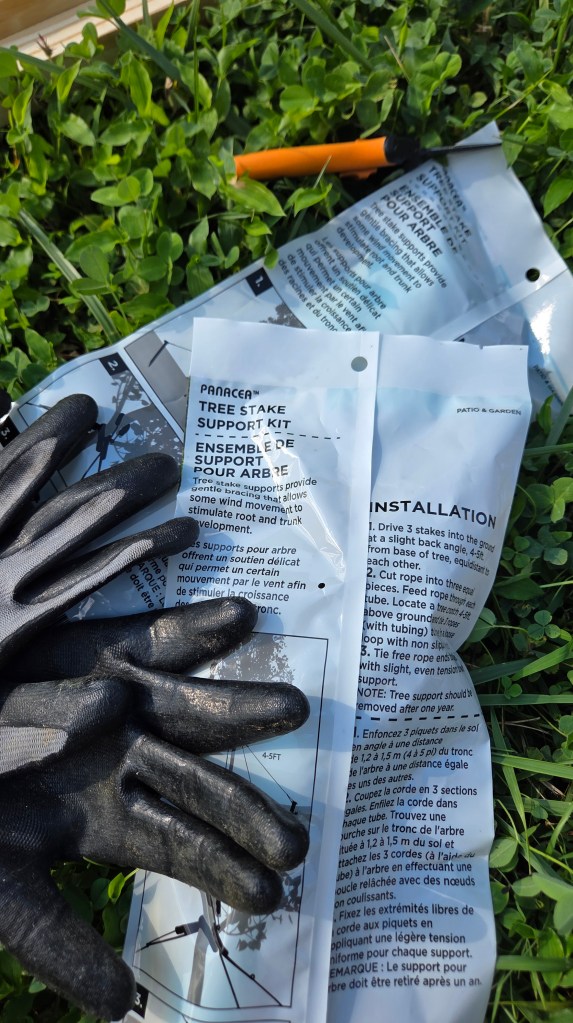
Then we drove some five foot stakes into the ground and built a support system around the tree itself.
Instead of just tying directly to the damaged trunk, padded lines were attached higher in the canopy and anchored to four stakes surrounding the tree. Every connection was cushioned with sections of hose so nothing could rub against the bark.
When we stepped back, our Elberta looked less like a fruit tree and more like a patient in the ICU.
And somehow…
That felt hopeful.
Will it survive?
I honestly don’t know. It will or it won’t so that is 50/50.
I hope it does.
Because I’d love to watch that tree make peaches for my grandchildren someday. Except the boy grandchild who inexplicably seems to hate all FRUIT. Go figure. Maybe it’s just a phase.
If it is the little tree that could and makes it to adulthood, that scar will stay with it forever.
I’m okay with that.
That scar remind me that orchards get stronger from the battle.
Trees that fight the wind have deeper roots.
Today’s lesson, check every single fruit tree in the orchard and remove every nursery tag and never plant a tree again with the tag in place. Got it.
One painful lesson may have just saved the rest of the orchard.
So here’s my advice to anyone planting young trees this season.